

Every Minivan Is Cool And Here's The Proof
We can now count all new minivan models on sale in the U.S. on one hand — two if we are generous and account for all different powertrains. In fact, Volkswagen complicated matters as it paused production of the ID Buzz for the 2026 model year. The all-electric minivan will return for the 2027 MY, but for now, you'll be able to buy the remaining 2025 MY retro minivans sitting on dealer lots. Yup, they didn't sell as much as VW anticipated.
So, congratulations, SUVs, you won! Minivans are almost dead in the U.S., so much so that even the mega-cool ID Buzz couldn't win over buyers. Heck, only a few automakers are still competing in the minivan segment. And we think it's a shame. Minivans are not only excellent people carriers, but they handily beat SUVs in the practicality department. They typically have more space for passengers and cargo inside, better seat configurability, and sliding doors that work in tight spaces. They are also easier to get in and out of. Oh, and did we mention minivans are also cheaper?
Sure, minivans can't reach outdoor places, but the same can be said for many crossover SUVs. Besides, some minivans currently on sale in the U.S. come with raised suspensions and AWD for light all-terrain capability. And that's just one of the cool features available on the current crop of family shuttles. The market may be dwindling, but automakers are still innovating to make minivans more attractive. In fact, we think that every minivan is cool, and we'll prove it to you. Who knows, maybe we'll contribute to the resurgence of the minivan in the U.S., after it already won over China!
2025 Volkswagen ID Buzz — futuristic nostalgia trip
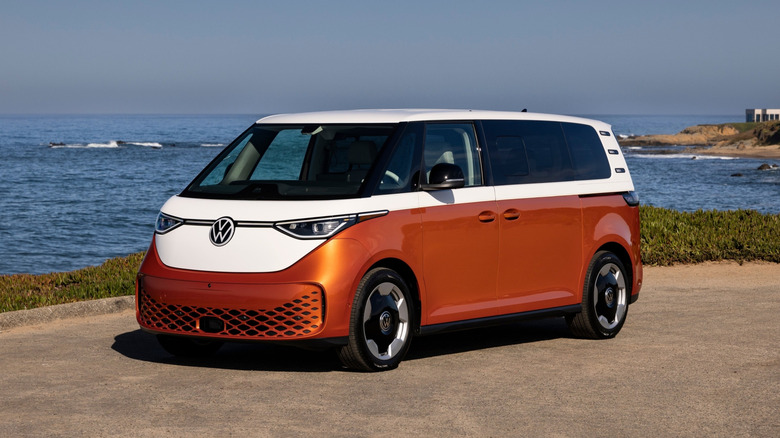
The original Volkswagen Type 2 Microbus was a van, but that didn't stop it from becoming the most influential people mover globally. The Microbus even became a symbol of the counterculture, and you could argue it's also the van life brand ambassador.
So, VW wanted to capture some of that hippy magic with its latest electric minivan, the ID Buzz. Frankly, this surprised nobody — the German automaker already did a similar thing with the New Beetle. Like the egg-shaped two-door family car, the ID Buzz is a completely different vehicle conceptually. Still, it retains the retro vibes we loved about the original, without looking outdated.
Yes, the new ID Buzz is electric, which comes with some negatives. In particular, the 234-mile (377 km) EPA-estimated range for the RWD model doesn't exactly fit the van life lifestyle. The 86.0-kWh battery is fine for a smaller family vehicle, but clearly not enough for a minivan, so let's hope VW bumps the capacity a bit for the 2027 MY. A 300-mile range and faster charging (right now it's 10% to 80% in 26 minutes) would make the ID Buzz a killer electric minivan, especially at the $61,545 base price (including the destination fee).
Inside, the ID Buzz's cabin is truly cavernous, with ample room for up to seven adults. Even with all seats in place, the ID Buzz can accommodate 19-cubic-feet worth of cargo. Fold all seats, and the capacity rises to massive 146 cubic feet. Moreover, the entry-level ID Buzz with a 282-horsepower, rear-mounted electric motor is peppy, while the 335-hp, dual-motor AWD reaches 60 in sports-car-like 6 seconds.
2026 Toyota Sienna — the mpg king with available AWD
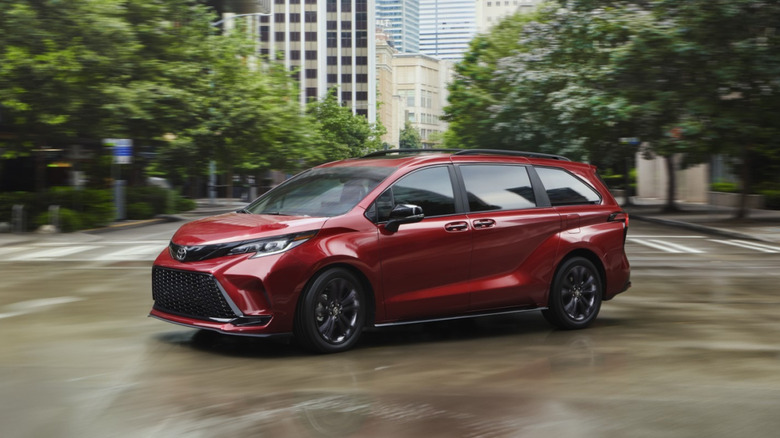
Instead of the potent 3.5-liter V6 with 296 horsepower, the 2021 Sienna went full hybrid with Toyota's 2.5-liter electrified powertrain with 243 hp. The eight-speed auto was also replaced by the hybrid's e-CVT transmission.
So, yeah, Toyota said goodbye to speed but also hello to efficiency – the right move for a family hauler. The latest 2026 Sienna even has a slightly improved hybrid drivetrain with 245 hp and exceptional EPA-estimated fuel economy of up to 35 mpg combined. For comparison, the old model was rated at just 21 mpg combined, The 2026 Honda Odyssey? Only 22 mpg combined.
The standout feature, however, is the AWD availability, just like in the predecessor. Only this time, Toyota implemented a rear electric motor, instead of a prop shaft, reducing mechanical complexity and maximizing interior space. As a result, the 2026 Sienna is very spacious in all three rows, with seating for up to eight people. The 34-cubic-feet trunk capacity with all seats in place is also outstanding, and there are many cubbies scattered around the cabin. The vacuum cleaner, available on upper trims, is another handy addition. Alas, Sienna's second-row seats aren't removable, but the Split & Stow third-row seats fold down easily to reveal a larger, flat cargo area.
The electronic AWD also allowed Toyota to attract outdoorsy customers with the rugged Sienna Woodland Edition. With standard AWD and increased ground clearance, the all-terrain model is ready to tackle light off-roading. The 1,500-watt power outlet also turns it into a great camper. However, at $53,095, the Woodland Edition is much more expensive than the base $42,315 Sienna (destination fees included).
2026 Chrysler Voyager/Pacifica — Stow 'N Go disappearing act
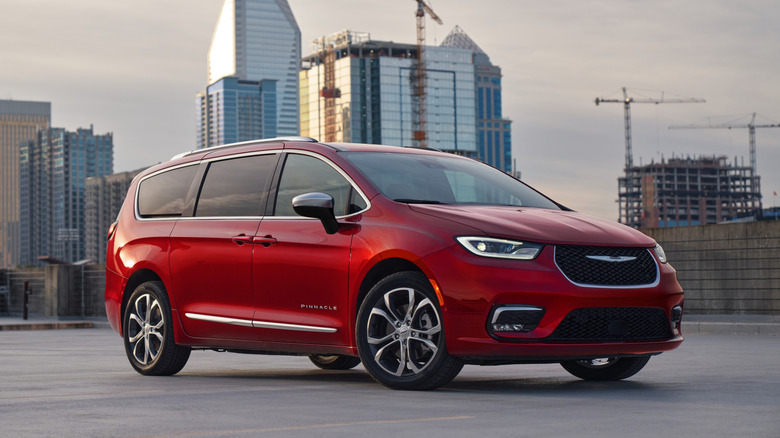
Don't let the two different names fool you — the Voyager and Pacifica are mechanical twins. Yeah, they have a slightly different appearance, but it's mainly the equipment levels that set them apart. The Voyager is an entry-level minivan, while the Pacifica is more of an upmarket people hauler and can be optioned with AWD. Both share the same 3.6-liter V6 with 287 horsepower and a nine-speed auto. It's a potent engine, but with a 23-mpg combined EPA rating, it isn't particularly efficient.
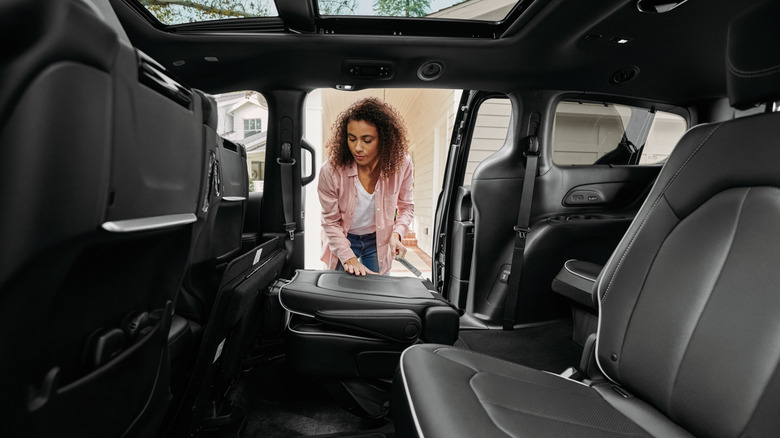
Still, the coolest feature of the Voyager/Pacifica is the Stow 'N Go disappearing seats. Namely, the second-row chairs in Chrysler's minivans don't just fold flat, but they store neatly into the floor. The whole process takes less than a minute, and you are left with a low, flat floor for hauling bulky items. Fold down the rearmost seats and you are left with even more flat space.
Those are just some of the reasons why we fell in love with the 2022 Chrysler Pacifica after driving it for 1,000 miles. It's a particularly roomy minivan, too. There is sufficient space for adults in all three rows and a useful 32-cubic-feet cargo capacity behind the third row. Passengers will also enjoy a quiet cabin, thanks to the cool active noise cancelling feature, which is also standard in the Voyager.
The $43,390 Voyager (with destination fee) also matches the $46,385 Pacifica's (with destination fee) tech game with a 10.1-inch infotainment. Still, expect your kids to gravitate toward the Pacifica, as it can be optioned with the rear-seat entertainment system, powered by Amazon Fire TV.
2026 Honda Odyssey — magic slide seat wizardry
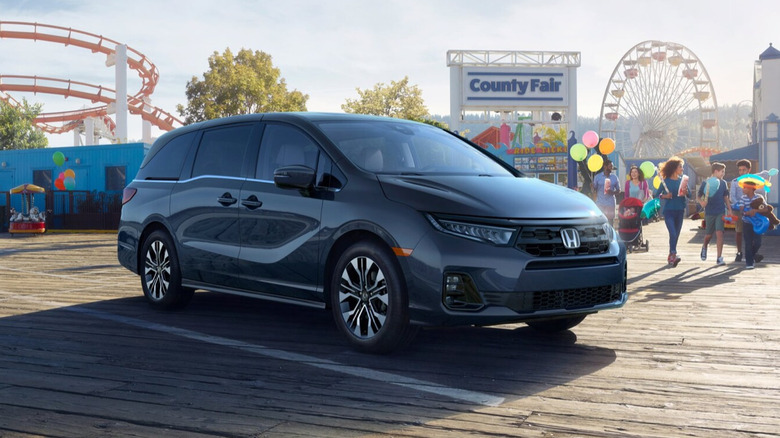
Unlike most of its rivals, the 2026 Honda Odyssey isn't available with AWD. It's a shame, because it's otherwise great mechanically. With 280 horsepower and 262 pound-feet of torque, the 3.5-liter V6 is decently potent and pairs nicely to the 10-speed automatic. According to Car and Driver, the Odyssey sprints to 60 in 6.4 seconds, so it's quicker than its rivals. The 22-mpg combined rating is hard to swallow, though. Here's hoping that the Odyssey gets Honda's Next Generation Large-size Hybrid V6.
Still, Honda possesses a secret sauce that sets it apart from the competition — the Magic Slide second-row seats. These defeat the purpose of paying more for captain chairs, as you can remove one seat and have basically the same feature. Then, the remaining two seats can slide longitudinally and sideways. You can push them closer together to make ingress/egress for third-row passengers easier, or physically distance your kids when they are in fighting mode. All three seating rows are also super comfortable, making the Honda Odyssey a superior road trip solution. The 33-cubic-feet cargo capacity with all seats in place is very competitive. Fold the second and third row, and you are left with a flat, cavernous cargo area.
Unfortunately, the 2026 Odyssey's onboard vacuum cleaner has been discontinued, which may make you more nervous about your kids' crumb grenade snacks. They may be even less careful if you opt for the rear-seat entertainment system, which features a 12.8-inch center screen on the ceiling. Of course, you can always address them via Honda's CabinTalk PA system, which boosts your voice so they can clearly hear you. The 2026 Odyssey starts at $44,290 (including destination fees).
2026 Kia Carnival — SUV in disguise
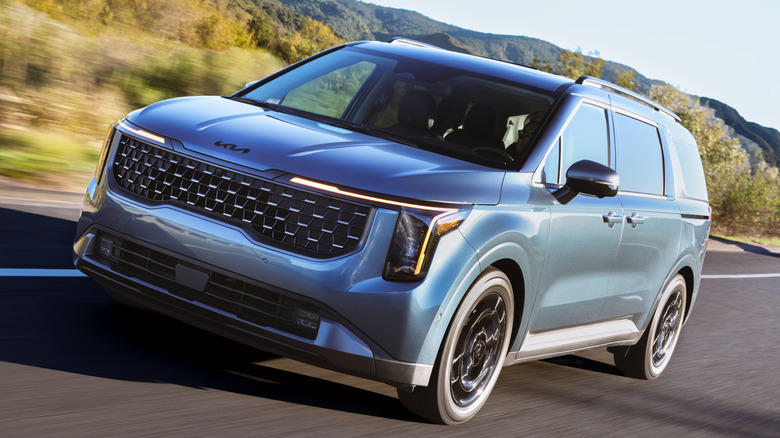
With its latest minivan, the Carnival, Kia clearly wanted to attract the crossover-SUV crowd. The Carnival looks more rugged than its rivals, and with a 6.8-inch ground clearance, it also approaches SUV territory. Unfortunately, Kia doesn't offer AWD in any of the trims, which somewhat defeats the purpose. But, come on, many people are happy driving their front-wheel-drive crossovers!
Still, the numbers don't lie — the Carnival is more practical than Kia's three-row crossover-SUVs. Back in 2021, we tested the pre-facelift Kia Carnival and liked it better than the Telluride, and we found that it uses the available footprint more efficiently. It's more comfortable inside, with enough room for adults in every row. The trunk is much larger, too — with all seats in place, the 2026 Carnival can accommodate 40 cubic feet worth of cargo. Meanwhile, even the latest 2027 Telluride is only good for 22 cubic feet.
In fact, the Carnival's trunk is the largest in the category, but it comes at the expense of third-row legroom. The Sienna, Pacifica, and Odyssey all have more spacious third rows. There is also no seat rearrangement sorcery — no stowing like in the Pacifica and no lateral sliding like in the Odyssey. Alas, at $38,935 (with destination fees), the Carnival is the cheapest minivan in the U.S. and can be optioned with the longitudinally-sliding Slide-Flex second-row seats.
Kia's practical shuttle is propelled by a 3.5-liter V6 with 287 horsepower, mated to an eight-speed auto. It's a potent combo, bringing the Carnival to 60 in just 7.0 seconds, according to Car and Driver. However, it's also thirsty, with a 22-mpg combined EPA rating.
2026 Kia Carnival Hybrid — better efficiency without many trade-offs
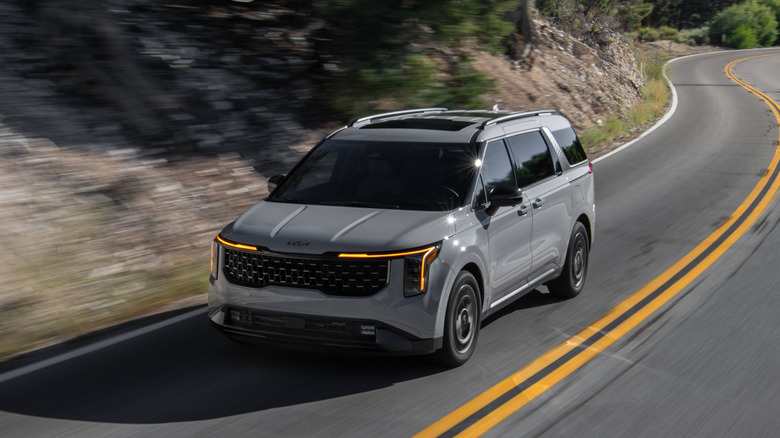
Compared to the regular gas model, the 2026 Kia Carnival Hybrid is a game of give and take. At $42,935 (including destination fees), the hybrid is more expensive, while also being less powerful. It packs a 1.6-liter turbocharged four-cylinder and a 74-horsepower electric motor, paired to a six-speed auto. The combined output is 242 hp. According to Car and Driver, the Carnival Hybrid sprints to 60 in 7.8 seconds.
Still, the silver lining is that the hybrid is way more efficient without sacrificing interior space and practicality. It's EPA-rated at 32 mpg combined, while offering the same cargo capacity and passenger comfort. Moreover, the base Carnival can accommodate up to seven people, while the Carnival Hybrid is rated for eight. The Slide-Flex seats are also standard only on the hybrid. Both come as standard with 12.3-inch center infotainment, though.
But does the Carnival Hybrid have what it takes to challenge Sienna's hybrid dominance? Toyota's electrified minivan is slightly cheaper and a tiny bit more powerful. Car and Driver measured a 0-to-60 time of 7.5 seconds in the Toyota, so the Sienna is quicker, too. What's more, the Sienna is EPA-rated at 35 mpg combined, and it can be optioned with AWD. Yes, it comes with an e-CVT transmission, but it still wins the number game.
Still, the Carnival Hybrid is better equipped. The base Sienna only comes with an 8.0-inch center touchscreen and no heated seats. The Carnival Hybrid also comes with standard parking sensors, which are optional on the Sienna. That said, only Toyota's minivan has an optional vacuum cleaner.