

Callaway's Sledgehammer Corvette Was Faster Than The Veyron 17 Years Earlier
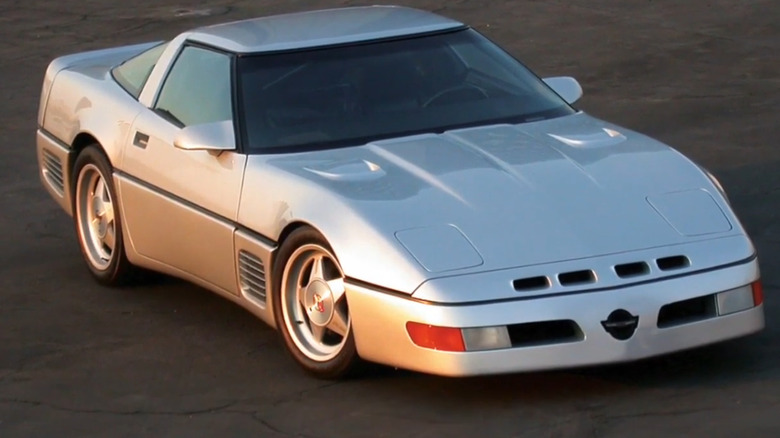
The 1980s were an era when the automotive world was obsessed with breaking the 200-mph barrier. In 1987, Ferrari had unleashed the F40, a carbon fiber legend and the first to do it, topping out at 202.68 mph. It was a feat its direct competitors like the Lamborghini Countach (183 mph) couldn't match, but the rarer Porsche 959 Sport (210.64 mph) did. However, across the Atlantic, in Old Lyme, Connecticut, a soft-spoken genius named Reeves Callaway was on track to make these supercars feel irrelevant in matters of speed. The car was the Callaway Sledgehammer.
Now, most enthusiasts credit the Bugatti Veyron as the founder of the 250 mph club. The Sledgehammer beat it to the punch by a staggering 17 years. On October 26, 1988, at the Transportation Research Center in East Liberty, Ohio, the Sledgehammer clocked a verified 254.76 mph top speed. For context, 17 years later, the Veyron touched 253.81 mph. And that was 20 years ago!
The Callaway Sledgehammer wasn't just a dragster; it was a car that could actually survive a road trip. The Callaway team drove the Sledgehammer 700 miles from Connecticut to Ohio for the record run, shattered the world record, and then, just for the heck of it, drove the car back home in the rain.
And this wasn't a stripped-out sports car; it retained its full factory interior, power-adjustable sports seats, the Delco Bose cassette stereo, and even a functioning air conditioner. It was a 255-mph land missile you could drive to the supermarket to get groceries. Reeves Callaway set out to prove that the American muscle car could be both brutal and sophisticated. The resulting Sledgehammer remains the ultimate expression of the Corvette C4 platform.
Twin turbos, 889 horsepower, and million-dollar shoes
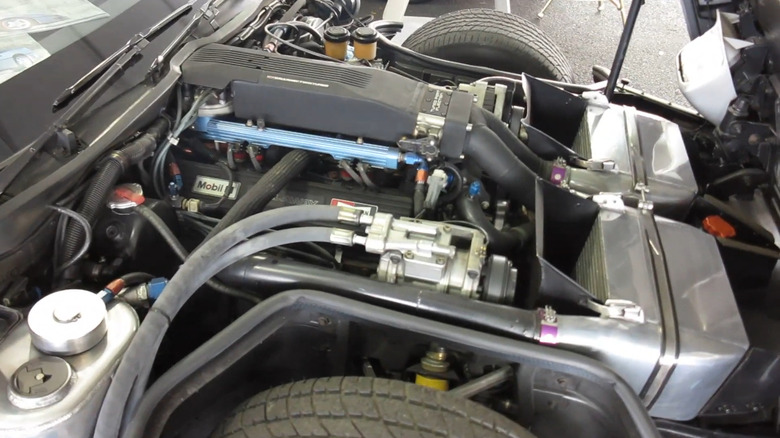
Under the Sledgehammer's hood sat a 5.7-liter small block V8. However, it was small block in name only. Callaway engineers hand-assembled the engine with a blueprinted block, a Cosworth crankshaft, forged Mahle pistons, and a dry sump lubrication system that ensured the engine oil didn't pool to one side when the car hit high g-forces.
The engine got two massive Turbonetics T04B turbochargers pumping out a whopping 22 pounds per square inch of boost. The result was a heady 898 horsepower and 772 pound-feet of torque — in an era when the factory Corvette C4 delivered just 240 horsepower. To handle this power, the Sledgehammer used a Doug Nash transmission for its record attempt, swapped with a ZF six-speed manual gearbox when making the car more street-friendly.
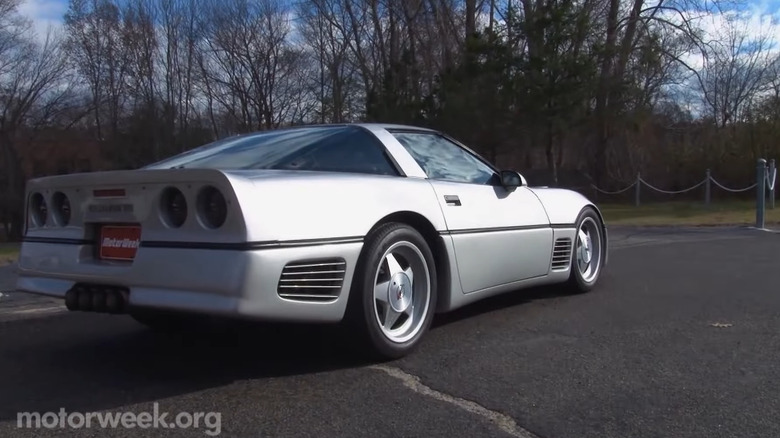
To get to the desired top speed, Callaway commissioned Canadian designer Paul Deutschman to create an "AeroBody" for the Sledgehammer. This comprehensive aerodynamic overhaul included a reworked nose, functional fender vents, and an integrated rear section that housed the quad exhausts. The AeroBody was so effective that Callaway offered parts of it as an option to its other customers.
However, the most insane part of the build was the tires. Callaway reached out to Goodyear to request tires that looked like standard Goodyear Eagles but could survive speeds up to 300 mph. Goodyear agreed, but the R&D behind the tires supposedly cost it $1 million — in 1988 dollars; more than $2.76 million today. After the record run, Goodyear took back the tires. Since then, it's been sitting on regular Goodyear tires.
A one-off legend that remained unbeaten for decades
Despite its legendary status, the Callaway Sledgehammer was a one-off masterpiece. While its RPO B2K twin-turbo was a legitimate performance package factory option you could order at a dealership, the Sledgehammer was limited by the tire technology of the time. However, today you can pick up its cousin, a 1987 twin-turbo Callaway, for $33,000.
The Callaway Sledgehammer stood unbeaten for nearly two decades, a feat that went beyond the usual 15 minutes of fame. For the next 17 years, "Is it faster than a Sledgehammer?" became a de facto question in every supercar launch press briefing. It took the combined might of the Volkswagen group and a multi-billion dollar budget for the Bugatti Veyron to finally eclipse the performance standard set by the Callaway Sledgehammer all those years prior.
In the years following its record run, the Callaway Sledgehammer settled into a quiet life, often displayed at the National Corvette Museum and changing hands a couple of times. It was inducted into the Bloomington Gold Great Hall in 2013 as one of the most influential Corvettes ever made.
The Calloway Sledgehammer remains a testament to a time when American engineering didn't just compete with the best of European exotics, it surpassed them. The Sledgehammer didn't just break a record; it set the goalpost so far down the field that it took the rest of the world over two decades to get to it. The Calloway Sledgehammer is more than the baddest C4 to ever turn a wheel; it's a statement that America could build a world-beater with simple things, like a pushrod V8 and a set of turbos.