

Here's How Much A 2021 Hyundai Ioniq Electric Has Depreciated In 5 Years
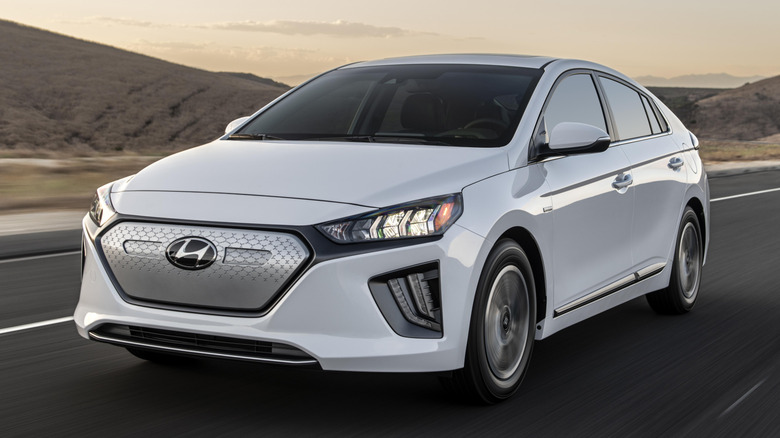
You may look at this article's headline and perhaps wonder if we forgot a number after Ioniq. That's understandable as the Ioniq 5, 6, and 9 make up Hyundai's current all-electric lineup (the Kona EV is on hold for 2026). Yet the Ioniq name in the United States dates back to 2017, when the automaker applied the moniker to a humble, electrified five-door sedan: the Ioniq Hybrid and the Ioniq Electric. A plug-in hybrid version would come on board for 2018. 2021 was the last year of this electrified trio, as enumerated Ioniqs (the Ioniq 5, to start) would hit Hyundai showrooms.
These original Ioniqs are forgettable because so few sold. Across all three electrified variants, Hyundai moved less than 20,000 units in 2021, compared to more than 150,000 Tucsons. It didn't help that the company only offered the Ioniq Electric in 13 states and the range maxed out at 170 miles. But enough of the history lesson, let's move on to the subject matter at hand: depreciation for the 2021 Hyundai Ioniq Electric. And it's not a pretty picture. In the last three years, the Ioniq Electric has lost 47% of its original value. Depreciation over five years increases to 62.5%. It could be worse; some EVs are depreciating by $600 per day.
Traditional valuation sources, CarEdge and iSeeCars, don't have comprehensive data on this vehicle. For a better understanding of Ioniq Electric depreciation, we reviewed data from Kelley Blue Book (KBB). We also looked at CarGurus' listings for the 2021 Ioniq Electric to see how depreciation estimates hold up against real-world pricing. Lastly, we compared the Ioniq Electric's depreciation with that of competitors such as the Chevrolet Bolt and the Nissan Leaf.
Depreciation for the 2021 Hyundai Electric
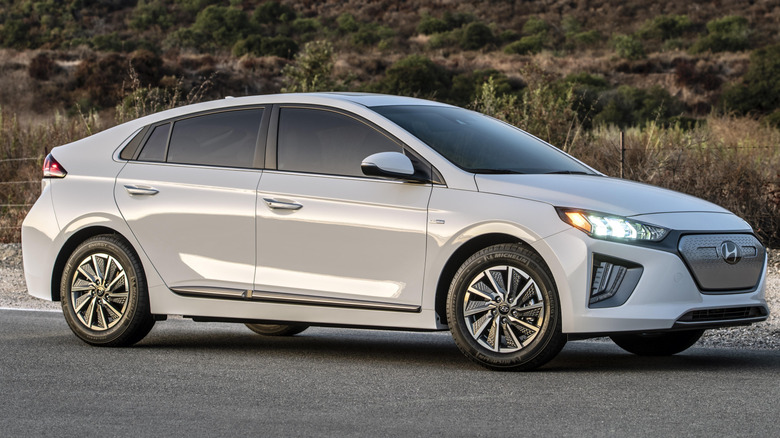
In 2021, Hyundai offered two trims for the Ioniq Electric: the base SE with an MSRP of $34,250 and the higher-end Limited at $39,820 (both prices include a destination charge). Using the SE as a guideline, KBB estimates the Ioniq Electric's current resale value at $12,850. That's a depreciation rate of 62.5% from its original MSRP. KBB also reports that about three-fourths of that loss of value (47%) occurred in the last three years.
From an owner's perspective, that devaluation is worse than the five-year rate for the 2021 Ford Mustang Mach-E (57%) or the depreciation rate for the 2021 Volkswagen ID.4 (55%). However, that plunging value is advantageous for shoppers. A review of retail listings on CarGurus shows around a dozen examples nationwide (searching only for clean-title, no-accident units).
Nonetheless, these asking prices are even lower than what KBB's projections suggest. One offering showed a base SE trim with an asking price below $11,000. In addition, there are dealer listings for the upscale Limited trim with asking prices around $13,000. The greater challenge is availability. Because the Ioniq Electric's distribution is limited, inventory appears to be concentrated mostly in coastal states.
Hyundai Ioniq Electric depreciation compared to competitors
Even half a decade ago, there were more EV choices than the Ioniq Electric. On the affordable side of the equation, options included the Chevrolet Bolt and Nissan Leaf. The 2021 Bolt, with an estimated range of 259 miles, easily outdistances this Hyundai EV on a full charge. Yet, despite the better range, this Chevy's five-year depreciation hits harder at 67% (versus 62.5% for the Ioniq Electric), according to KBB. The base LT, which stickered at $37,495 (including freight charges), has a current resale value of $12,350. A quick look at CarGurus' listings shows a supply of examples at that price point.
The 2021 Nissan Leaf is available in two configurations. The base edition offered a 149-mile range, while the Plus variant increased capacity to 226 miles. KBB only provides a depreciation rate for the lower-range Leaf, which translates into a five-year devaluation of 69.7%. The original MSRP of $32,620 (including the destination fee) works out to a $9,900 resale value, which is spot on with the starting prices for the same vehicle on CarGurus. Expect a $2,000 to $3,000 premium for a 2021 Leaf with the longer range.