

Here's What Happens To All Those IndyCar Tires After A Race
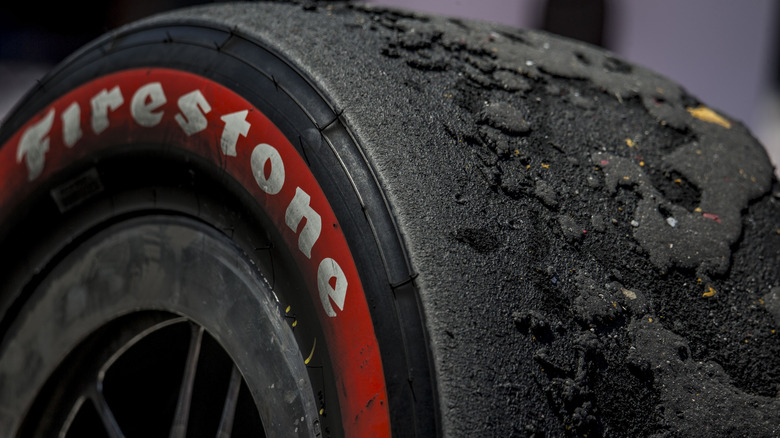
IndyCar tires have come a long way since Ray Harroun — winner of the inaugural Indy 500 in 1911 and, eventually, the inventor of the rear-facing mirror – took the checkered flag while rolling on barely 4.5-inch-wide Firestone tires. Wider 9.2-inch tires were introduced in 1965, while legendary racing driver Mario Andretti began experimenting with staggered rear tire widths in the early '70s when radial tires and rear wings entered the spotlight. And, as you might expect, all of those tires had to go through some serious abuse to even make it there.
The racing teams at IndyCar can go through more than 5,000 tires in a month. It's not unusual for IndyCars to consume up to 1,200 Firestone tires during the Indy 500 weekend, and that includes the tires for practice, qualifying, and the actual race. Another fun fact is that Firestone Racing engineers concoct different tires for the left and right sides of the car, with some having a stiffer or softer construction to compensate for the stresses of racing in oval circuits.
With thousands of custom-made used tires after every race, it's not unusual to wonder where all that spent rubber goes after the victor hoists the trophy and bathes in champagne. As it turns out, IndyCar tires are treated no differently from NASCAR tires and Formula One tires when the festivities end. Firestone takes the tires back, shreds them, and repurposes the rubber for other practical applications.
Firestone leases racing tires to IndyCar teams
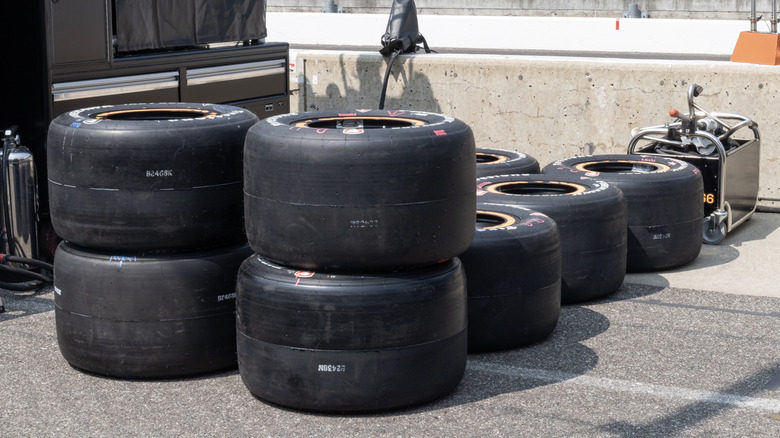
The custom Firestone Racing tires for IndyCar are not available for sale, whether new or used. Even the most hardcore fans, enthusiasts, and collectors would have almost zero chances of getting their hands on one, since even IndyCar racing teams can't buy them despite their ginormous budgets. Instead, Firestone leases the tires to racing teams and gets them back after every race for recycling.
Yes, IndyCar racing teams don't buy the tires they use for practice sessions and qualifying races, and they can't take them home, either. The lease agreement presumably includes provisions that only Firestone and Performance Tire can mount, inflate, and balance each tire to the wheel. The teams can handle racing strategies, air pressures, and tire placements throughout each run.
For the 2026 NTT IndyCar Series, all racing cars have 10-inch-wide front and 14-inch-wide wheels measuring 15 inches in diameter. The Firestone Firehawk tires have a 25 to 26 front and a 26.5 to 27.5 rear diameter when inflated to 35 psi. As you might expect, those custom racing tires cost way more than your Camry's all-season tires, although Firestone refused to give an actual number.
IndyCar tires are embracing sustainability, too
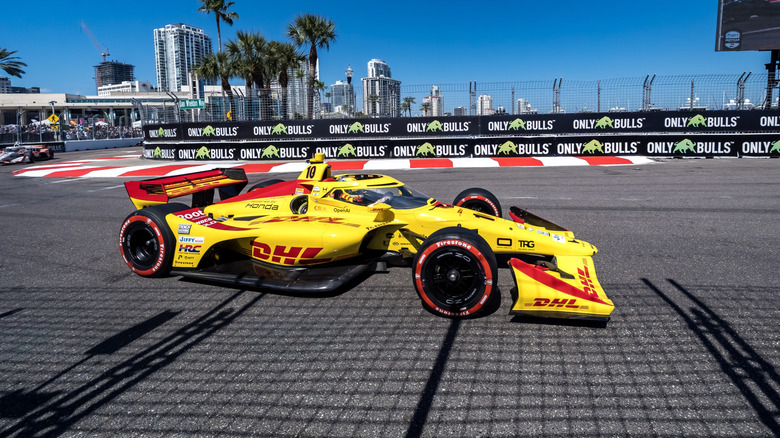
Firestone has debuted its Firehawk racing tires infused with Bridgestone's global ENLITEN technology since the 2026 IndyCar season-opener in St. Petersburg, Florida. The Earth-friendlier tires feature renewable soybean oil, recycled steel for the bead wires, and recycled carbon black derived from old tires. This is part of why the company takes the tires back in the first place: so they can be reused.
Firestone's been working to make its racing tires more sustainable over the past few seasons. In the past few years, it made use of hard-to-recycle plastics and palm oil waste residue, helping to squeeze some extra environmental friendliness out of environmentally-unfriendly materials. IndyCar also reported that, according to Firestone itself, "nearly 100% of the tires used in the NTT INDYCAR SERIES and INDY NXT by Firestone are recycled into new uses beyond the racetrack — including playground and sports surfaces, flooring and other rubber products." Considering how this covers over 32,000 tires in total, it's not hard to see why Firestone prefers to take them back rather than to give them away.