

NASA Says Screw All This, Is Just Going To Blow Fuel Up Now
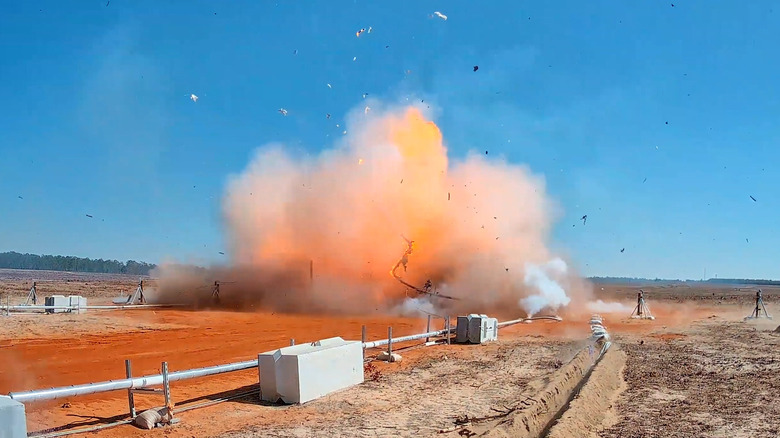
Ever just wanted to blow stuff up? You're not alone: Amercia's space agency does, too. It's very excited to blow stuff up, and what's more, wants to blow increasingly larger amounts of stuff up. If you want to know where it plans to do this, just search your heart, for you knew the answer all along: Florida. Because of course. Florida Man may be off trying to drive a burning car, but Florida NASA has asked him to hold its beer. Its liquid methane-oxygen beer. Which it will then try to blow up. Some people just have the best jobs, man.
NASA is saying this all with a straight face and pretending this is serious work regarding safety, not merely something it wanted to do because why wouldn't it. The underlying concern here is that, after decades of using the same basic fuels, all these newfangled space companies want to use a new one. SpaceX and Blue Origin are among those using cutting-edge thrusters that ignite a mix of methane and liquid oxygen, or "methalox." This mixture creates less residue than kerosene and can be stored at a much higher temperature than liquid hydrogen, a balmy -260 degrees Fahrenheit, per Ars Technica. Sounds great, except for one problem: it can blow up. Well, "problem" if you don't like explosions for some reason.
NASA sure does, so boy howdy is it going to blow a bunch of methalox up. Jason Hopper, from NASA's Stennis Space Center in Mississippi, said, "This type of testing only comes around once every few decades," presumably while giggling. Describing the complex, technical, and again very serious work, he continued: "We put fuel in a rocket, blow it up in a remote location, and measure how big the boom is." These tests are happening at a test site inside Eglin Air Force Base in, where else but, Florida.
We're going to need a bigger boom
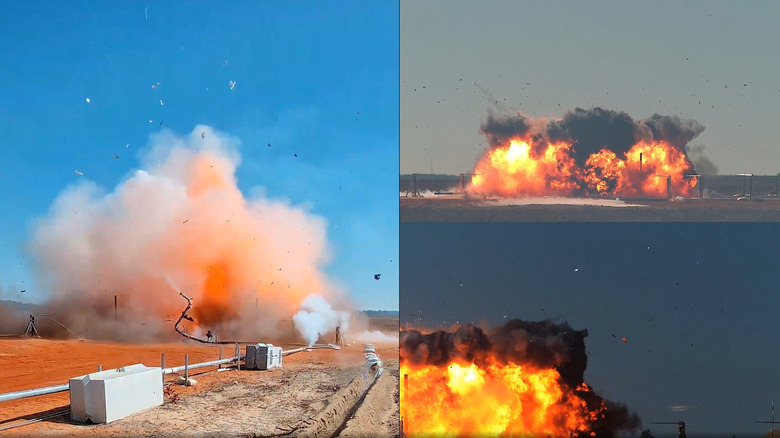
The reason to blow up methalox, other than "because it's fun," is because it's just possible that a space rocket might explode accidentally. If one were to do so on the launch pad, it turns out that could be very bad for the people nearby! Who knew? But what NASA, alongside the Federal Aviation Administration and the U.S. Space Force, need to know is just how bad that would be. Blast radius, concussive force, shrapnel distance, that sort of thing. So as the space agency blows stuff up, it will take careful measurements of exactly how it blew up. For science! And also safety.
The tests are cut up into three series. The first series, already completed in February, involved using the plastic explosive C-4 to blow up a mock thruster with the methane and liquid oxygen still separate. This sounds like fun, as you can see from the pictures, but was it fun enough? Obviously not, because later in March, the second series will up the ante from a measly 100 pounds of fuel to a full 2,000 pounds. And this time, the liquids will be mixed. Now we're cooking with methalox!
Still not enough boom for you? Don't worry: in June, the third series will test a worst-case scenario, simulating a full bulkhead breach and detonating an entire 20,000 pounds of fuel. For that one, NASA will literally move the control room from 1.6 miles away to 4 miles, just to give you a sense of how big that explosion will be.
SpaceX, as usual, has an opinion. It's done its own methalox testing, apparently, which it believes indicates that everything's fine and there's no reason for anybody else to test it for themselves. Therefore, its methalox-fueled Starship rocket is perfectly safe and should be able to launch from anywhere just fine, thank you. For some reason, NASA went ahead with its own tests anyway. Possibly, it wasn't willing to take SpaceX's word for it. Or just maybe, it just wanted to blow stuff up. In Florida. Obviously.