

8 Of The Rarest Chevy Corvettes – And What They're Worth Today
We've said before that when you get right down to it, the best Corvette is the one you've driven. Corvettes have always been remarkable at delivering on their multi-generational promise: democratizing exotic car performance — and sometimes the looks — in a way that stays within reach of enthusiasts who don't have a hedge fund's worth of commas in their bank account.
Of course, like anything else, Corvettes exist on a spectrum. At one end are the everyday models that might barely get a second glance in traffic. At the other are the rare and obscure variants that might not look wildly special to the uninitiated but will absolutely stop the right crowd in its tracks. Today, we're looking at eight of the rarest Corvettes out there, and what they're worth.
Before we dive in, though, we should acknowledge the elephant in the room. And by "elephant," we of course mean "one astoundingly uncommon Corvette example that survived a year when Chevy didn't offer any Corvettes," even though there's technically no such thing as a 1983 Corvette. Just one pre-production example survived after Chevrolet scrapped the rest, and General Motors still holds onto it today. Since that car isn't hitting the auction block anytime soon, we're focusing instead on historically rare Corvettes you can actually buy — if you've got the cash. And to do that, we'll start at the very beginning.
1953 Chevrolet Corvette
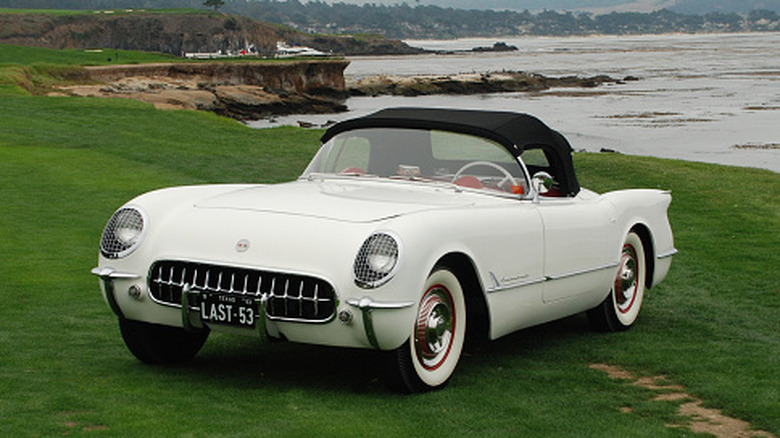
It was the early 1950s when legendary automotive designer Harley Earl cooked up a premise for General Motors that still echoes within the brand today: a sports car that would rival what Europe had to offer without the European price tag. The vehicle which would fulfill this vision was unveiled to the world almost preposterously soon after, debuting publicly in January of 1953 and, perhaps even more remarkable, reaching production just months later. The first Corvette was built on June 30, 1953. It all happened in less time than most modern automakers can work through a mid-cycle facelift on a mid-sized crossover.
The very first 'Vette weighed just over 2,700 pounds and was powered by a straight-six producing 150 horsepower that Chevy dubbed the "Blue Flame Six." It retailed for $3,498, which when adjusted for inflation would put it roughly on par with a well-optioned Chevy Equinox today.
Even with only 300 Corvettes rolling off the line in that first year, they have held their value better than an Equinox, with recent auction results fetching north of $200,000.
1963 Chevrolet Corvette Z06
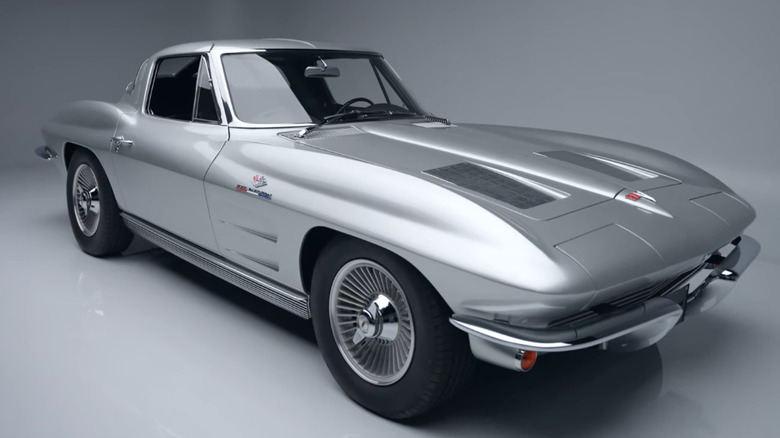
In today's automotive landscape where the Corvette E-Ray is a thing, it's easy to forget that you used to be able to get a Corvette with a gigantic gas tank. The 1963 Z06 is affectionately known as "Big Tank," on account of, well, the big tank. Its 36.5-gallon capacity puts it in the same ballpark as the very largest extended range tanks today. For reference, consider that the 2026 Silverado carries just 24 gallons and that you'd need to step up into a Silverado HD if you want the range extending 36 gallons, still just shy of the Big Tank's big tank.
What was up with that? It was about endurance racing. The large tank was an additional option over and above the now-familiar Z06 package, requiring adding the N03 package to get those sweet extra gallons, with only 63 examples ordered in that configuration in 1963. The result is an exceptionally rare variant with a bit of endurance racing history baked in, making for well-preserved examples landing between $200,000 and $300,000 of late.
1967 Chevrolet Corvette L88
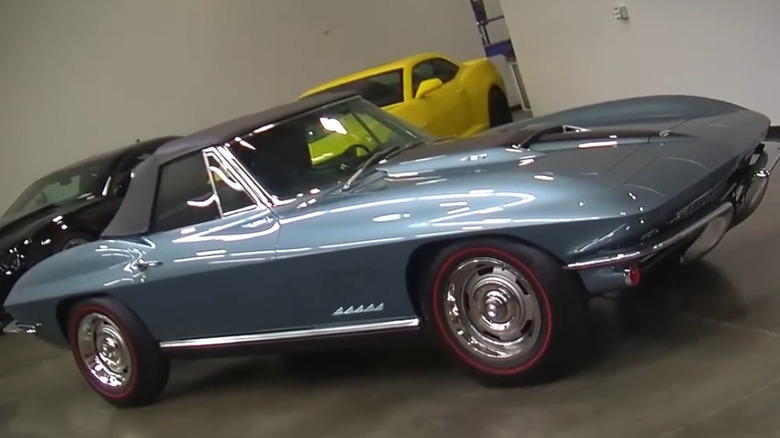
In the mid-1960s, when the muscle car horsepower wars were in full swing, it was going to take something special for Chevy to put a credible foot forward without breaking the exotic-performance-for-the-masses mantra that had taken them as far as it had already. What they didn't do was engineer an expensive new motor from scratch. Instead, they opted to get creative in extracting as much power as possible from their existing 427 Mark IV big-block, previous iterations of which had powered everything from Impalas to motorhomes and even some (literal) boats.
The L88 that ultimately found its way into the Corvette for the 1967 model year produced horsepower in the mid-500s — quite a feat when you consider that Chevy began the 60s with their fastest 'Vette generating just 290. Undeniably special and unrepentantly race-focused, there were just 20 L88s produced in '67. To put that into context, there were nearly 23,000 non-L88 Corvettes produced that year. In any case, that's why a 1967 L88 Corvette sold for $3.85 million at an auction in 2014.
1969 Chevrolet Corvette ZL-1
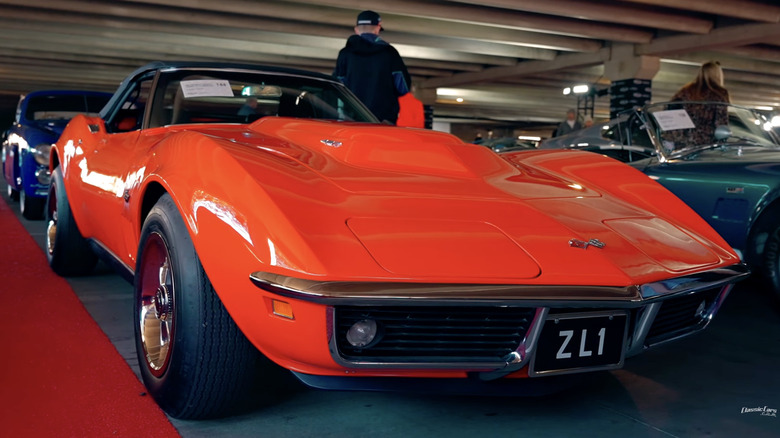
After the successful Corvette debut of the L88 that we just told you about, two years later you could order a lightweight aluminum version of that storied motor as part of the ZL-1 package. Only nobody ordered it. Well, almost nobody.
There are exactly two examples of 1969 ZL-1s, one hardtop and one convertible. Given the rarified air of being a literal factory-built, one-of-a-kind car, you'd be correct in assuming that the history, care, and restoration of the lone convertible '69 ZL-1 would be abundantly documented.
You can trace this car back to its original purchase by John W. Maher, all the way up to an expansive restoration that took place in 2014. In 2023 we predicted that this one-off 1969 ZL-1 Corvette would bring $3 million at auction and indeed it did, crossing the block with Sotheby's and a final sale price of $3,140,000, with tons of swell documentation included.
1970 Chevrolet Corvette ZR1
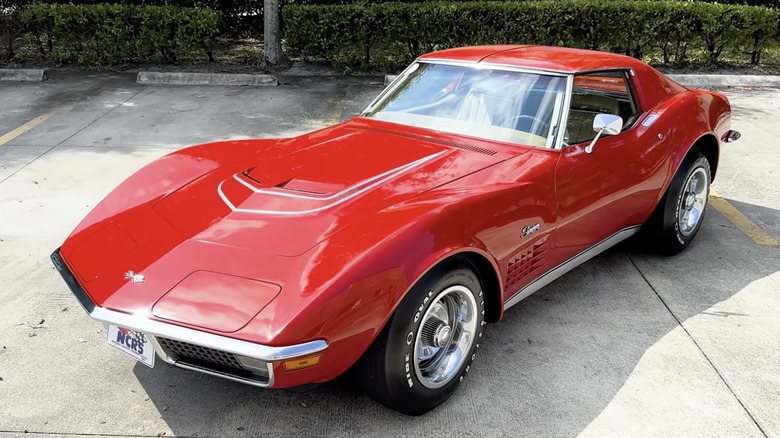
Today, you can buy a 2026 ZR1 with more than 1,000 horsepower and a top speed of 233 miles per hour. But in 1970, the ZR1 package got you a motor rated for 370 horsepower and a handful of other performance-oriented bits for buyers with racing in mind. You'd also lose some comfort-focused amenities, like power steering, air conditioning, and a stereo system. It was a compelling proposition, but not an inexpensive one: $968.95 on a vehicle with a $5,192 MSRP.
Between the steep price tag and the significant-commitment-required daily driving experience, the take rate on the ZR1 was low, translating to just 25 worldwide in 1970. Essentially, the idea was to give amateur racers a factory-offered upgrade kit that would have them ready for the track or autocross more or less out of the box. As far as values go, that rarity helps translate into recent auction results in the neighborhood of $200,000.
1971 Chevrolet Corvette ZR2
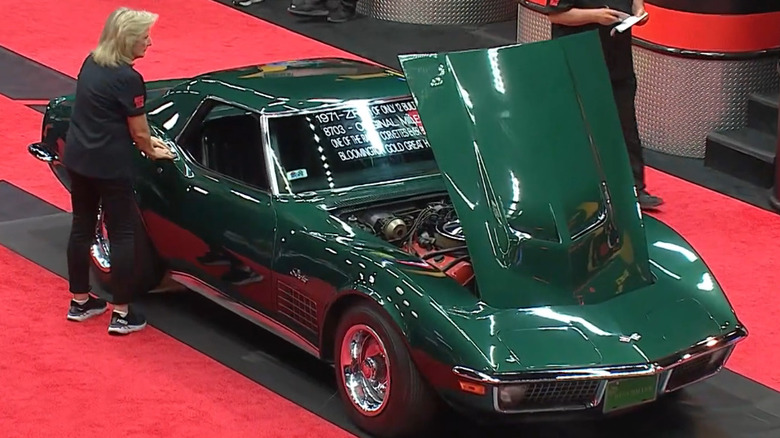
What a difference an engine can make — especially when you pair a slightly beefier one with an even more limited production run than the previous generation. Between our previous entry of the 1970 ZR1 and the ZR2, Chevy ratcheted horsepower up to 425 and production numbers down to an even dozen. Of those twelve, ten were coupes and just two were convertibles, putting the topless variant among the very rarest of 'Vettes.
This was also the early '70s, which meant that leaded gasoline was on the way out, and new emissions regulations brought on by the Clean Air Act of 1970 placed the ZR2 at something of an inflection point in automotive history — at least when it comes to unrepentant big-blocks whose days were numbered.
Take it all together and you've got something special, which becomes clear when you look at auction results between the two model years. While our previous entry sat near $200,000, the 1971 ZR2 has recently sold for as much as $863,500.
1995 Chevrolet Corvette ZR1
Upon careful research, it appears that 1995 was more than 30 years ago. Still, as this list reaches the 90s, it feels like we're entering the territory of unremarkable Corvettes you see around town. Could you pick up a 1995 Chevy Corvette Z07 for a few grand off Facebook Marketplace? Sure. But that doesn't mean that there aren't mid-90s variants out there that combine specialness and rarity to fetch a higher price on the market. The ZR1 is one of those. 1995 was the last year for the ZR1 and represents the peak performance from the aluminum-block LT5 V8 designed by Lotus, which at the time of its demise was putting out 405 horsepower.
With 448 units built in that final model year, this fun and special car remains incredibly attainable by rare Corvette standards, with many auction results showing examples selling in the neighborhood of $50,000. If you feel like that math isn't adding up on this one, you're not entirely wrong. Zoom out a little bit and you'll see that earlier years of the C4 ZR1 were delivered in significantly higher numbers — think 3,049 in its 1990 debut. So while the fruits of this era of ZR1 aren't exactly rare, you can still snag one from a comparatively special final year, which offers a nice balance of historical provenance, driving experience, and price on the used market.
1996 Chevrolet Corvette Grand Sport
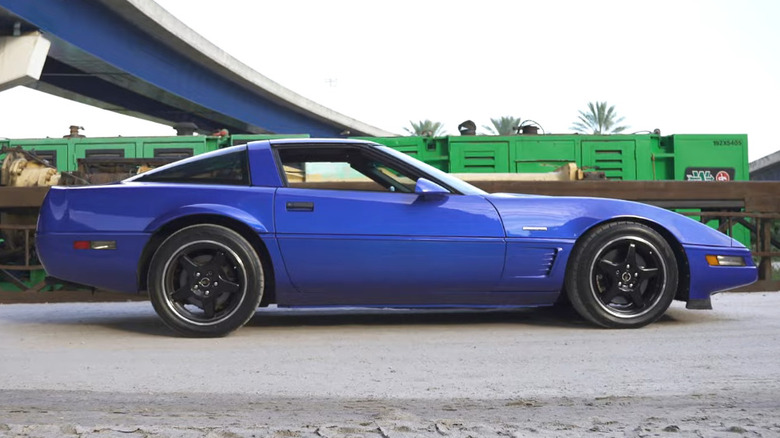
Just as the previous year had marked the end of the ZR1, 1996 marked the end of the C4, with Chevy going out of their way to end the run with a bang, offering a single-model-year optional LT4 engine producing 330 horsepower through the 5.7-liter V8. The Grand Sport came standard with this engine, and only 1,000 were built. When Car and Driver reviewed the car in period, they described it as building incrementally over previous model years and ultimately characterized the Grand Sport as having a "GM parts-bin feel" and generally unsettling handling which kind of makes it sound like an appropriate end to the C4 generation, worthy of a place in Corvette history.
As for value, an unbelievably nice example of the '96 Grand Sport can be yours for something like $70,000, with plenty of more mundane options sitting between $30,000 and $50,000. With its unmistakable paint stripes, special edition badging, and one-year-only LT4, it's not hard to see why you might covet one of these as emblematic of an era. For a Corvette that was never the sharpest tool in the drawer, the '96 Grand Sport still manages to feel like exactly what it was meant to be: a loud, slightly imperfect, and unmistakably American sendoff to an era that refused to go quietly.