

What Is A Dual-Mass Flywheel And Why Do Automakers Use Them?
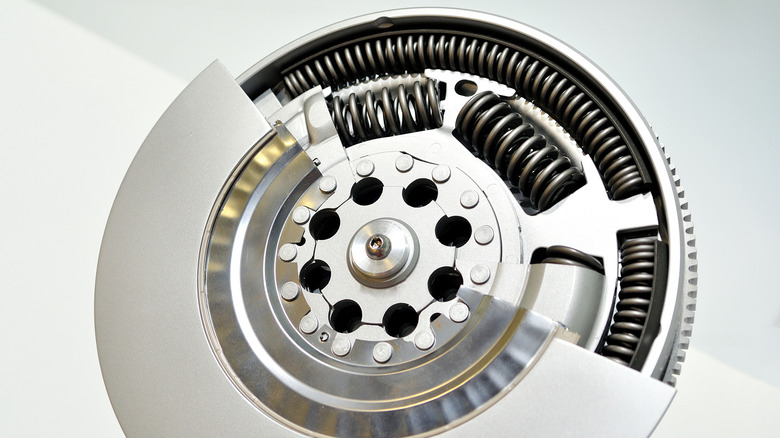
One of history's great art and science collisions is the invention of the potter's wheel in Mesopotamia around 3500 B.C. Potter's wheels led to the creation of flywheels, which helped artisans achieve smoother, more consistent revolutions while throwing clay. These foot-driven instruments are still used today, and the same principles are at work in the dual-mass flywheels you'll find in many modern cars with manual and dual-clutch transmissions.
A car's flywheel is a disc, usually made of aluminum, steel, or cast iron, bolted up to the end of the engine crankshaft. It's there to help start the engine, keep it running smoothly, and send power to the transmission. Automatics technically have flex plates instead of flywheels, but they're designed to accomplish the basically same thing.
The teeth on the flywheel's outer edge mesh with starter gears to help generate the oomph needed to get a diesel or gasoline engine to fire up. When it does, each power stroke creates a jolt of torque. The flywheel's weight and inertia help smooth out that power delivery, harnessing energy as rotational momentum.
A single-mass flywheel's surface engages directly with the clutch, and the clutch plate springs provide some dampening. But with a dual-mass flywheel, one disc that bolts to the crankshaft, and a second disc — hence "dual-mass" — syncs with the clutch. The two masses are connected by springs that dampen like suspension struts. Automakers will opt for a dual-mass flywheel in applications where there's massive torque, fewer cylinders, or a desire to quell noise, vibration and harshness.
The pros of dual-mass flywheels
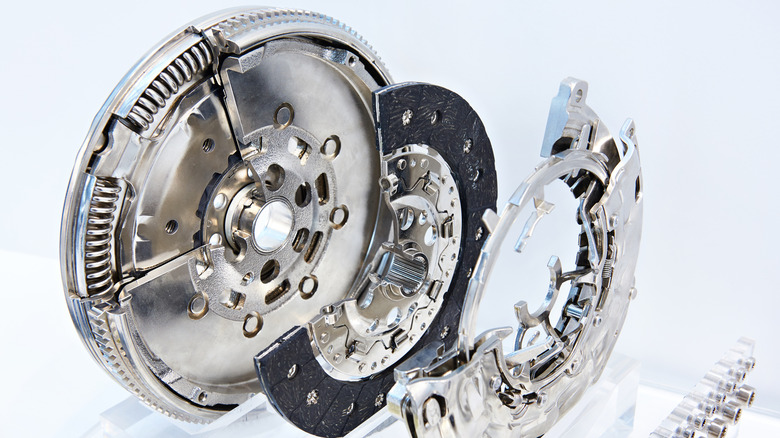
Imagine cranking a horizontal steel rod with a 25-pound weight on the end. It's tough at first, but gets easier and smoother to turn as the weight picks up speed. This is what's happening when a flywheel spins, and how flywheels help keep the engine running when you're not accelerating.
Once a single-mass flywheel starts to rotate, its force is absorbed by the clutch and transmission driveline. In a dual-mass flywheel, when the first mass rotates, it compresses springs, which starts the second mass rotating along while absorbing some more of the shock coming through the crankshaft. That means less vibration is transferred to the transmission.
In high-torque situations like towing, this equates to transmission preservation and longevity. This is why a dual-mass flywheel is appealing in diesel engines, which outsell gas in heavy-duty trucks due to their stump-pulling prowess, and tend to run for eons.
In smaller engines with fewer cylinders, there are fewer overlapping power strokes. Automakers will fit dual-mass flywheels on four-cylinder cars, for example, to quell some of the harshness of those sporadic jolts — which are less of an issue in the best inline-sixes. Volkswagen, for example, uses dual-mass flywheels across the Golf GTI and Golf R turbocharged 2.0-liter inline-4 engine lineup, as well in Audi DSG transmissions.
Dual-mass flywheels provide a comfort benefit, because they help stifle the clunky shock that can come when accelerating from a standstill at lower RPMs. That can make stop-and-go traffic a little more pleasant. The result is everyday driving with smoothness and refinement, thanks to reduced drivetrain noise and vibration that might otherwise buzz through the the cabin.
The cons of dual-mass flywheels
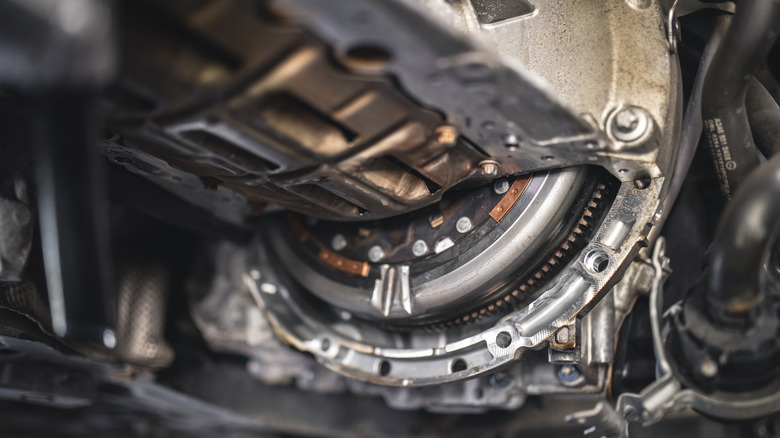
Perhaps the biggest disadvantage of dual-mass flywheels is that they are expensive. And while a single-mass flywheel isn't necessarily cheap, it can be resurfaced, and that costs just a fraction of a new one. Dual-mass flywheels can't be resurfaced — you have to replace the whole thing if it fails.
If there's one thing failure loves, it's complexity. Two masses, springs, and associated parts introduce more potential problems. Single-mass flywheels are one solid lump.
Another consideration is weight. Factory dual-mass flywheels are usually pretty heavy, coming in at around 30 pounds. Where some see smoothness, others see sloth. All that mass sitting between the engine and transmission requires power to push, and time to unwind, which can feel less responsive. This is why enthusiasts and aftermarket performance parts companies turn to lightweight, dual-mass flywheels, with some coming in at 10 pounds.
Also from a performance standpoint, dual-mass flywheel parts may be tuned to handle a specific power output from the factory, which might not hold up if you add boost through a tune or new turbocharger. In these cases, owners can opt for a single-mass flywheel conversion, which up the noise and vibrations, but deliver a more direct power engagement between the engine and transmission.