

Tragic Story Of Woman Dying From Exhaust Leak Is A Terrible Reminder To Get Your Car Checked Regularly
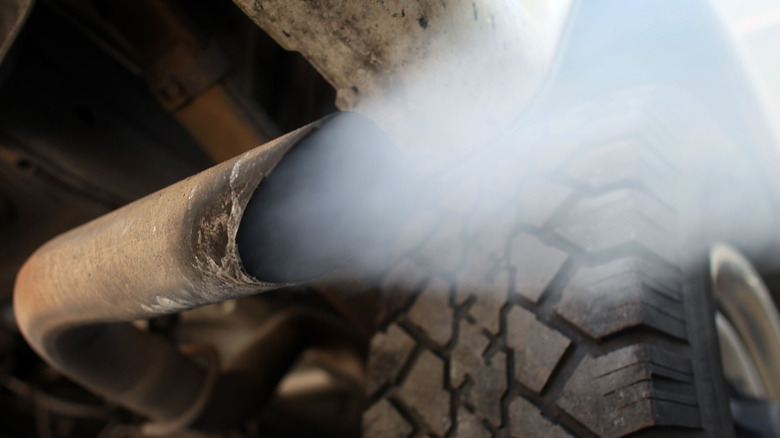
Exhaust fumes may smell bad, but the part you can't smell could turn out to be deadly. Aubrie Morgan was parked in a Royal Oak, Michigan parking garage near the restaurant where she worked and the cosmetology school she attended, reports FOX 2. She fell asleep inside her running car, and sadly never woke up. Police determined that Morgan had suffered carbon monoxide poisoning from a cracked exhaust manifold as she sat in her car.
According to the EPA, "Carbon monoxide (CO) is a colorless, practically odorless, and tasteless gas or liquid. It results from incomplete oxidation of carbon in combustion." Gasoline and diesel are hydrocarbons, and internal combustion engines burn them to produce power, producing carbon monoxide and other noxious gases as a byproduct. When you breathe it in and it gets into your blood, it forms carboxyhemoglobin, which prevents your blood from receiving oxygen. In moderate quantities, this lack of oxygen can affect vision and coordination, as well as cause headaches, nausea, dizziness, and confusion. At particularly high concentrations, not enough oxygen gets into the bloodstream to sustain life.
Your car's exhaust system is designed to flow out of the engine, through emissions equipment like catalytic converters, resonators and mufflers to keep it quiet, and out the back, away from where passengers could breathe it. However, a cracked exhaust manifold, like Morgan had, allows some of those exhaust fumes to escape before they've been treated. Ventilation systems then bring those fumes inside the car, where they can collect and start making the occupants sick, or worse. Cars old and new can suffer from this. Several years ago, Ford voluntarily repaired Explorers built between 2011 and 2017 because occupants were complaining of these symptoms.
An ounce of prevention is worth a pound of cure
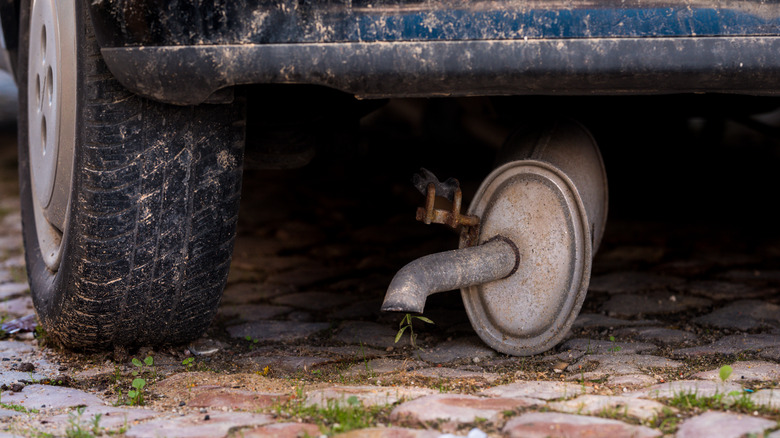
Michigan is one of fourteen states that require no car inspections whatsoever. While inspection programs have a lot of problems, they would have caught this particular problem, and likely forced it to be repaired. I'm making an assumption (and certainly not a judgement), but it's unlikely that a recent high school graduate going to school for cosmetology, not auto mechanics, would be able to recognize and diagnose such a problem herself. They just don't teach that in school anymore. So we're going to teach that right here, right now.
The biggest sign that you have a hole in your exhaust is that it's louder than it used to be and sounds like garbage. The noise makes it easier to track down the source of the sound and get it patched or repaired. Another sign is if you smell something bad. Carbon monoxide has no odor, but other fumes like unburnt fuel do, and can indicate an exhaust leak. If you start getting headaches or nausea while driving, particularly while the car is stopped, get your exhaust checked immediately. You're already starting to feel the symptoms of carbon monoxide poisoning, and you don't want them getting any worse.
It's still possible to suffer from carbon monoxide poisoning even if your exhaust is perfectly good. Last month, Joseph Boutros, a student and football player at Salve Regina University in Rhode Island, died while running his car to charge his phone during a blizzard, according to CBS News. His exhaust was intact, but snow had piled up high enough to block his exhaust outlet, causing carbon monoxide fumes to accumulate inside the car. When running your engine, make sure your exhaust comes out where it's supposed to, and nowhere else.