

What Made Ford's Toploader Transmission So Durable?
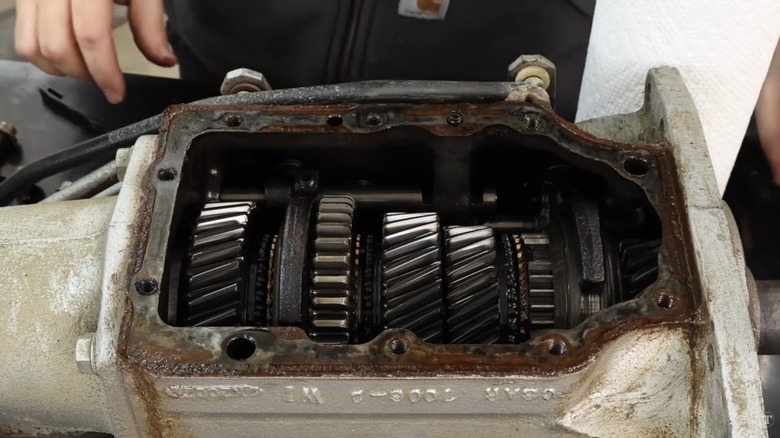
The answer to why Ford's Toploader transmission was so robust lies in its name. It features a brawny cast-iron case that's only accessible through the top, which means that the internals all had to be lowered into place during installation. This is in contrast to transmissions with a side-loading design, featured on units such as the Borg Warner T-10 – which was used prior to Ford adopting the Toploader for many of its '60s and '70s models. While earlier transmissions had served drivers well, as the industry approached the start of the classic muscle era, something more rugged was needed.
The Toploader could leverage more of the case for support, unlike side-loading designs — which weren't as resilient. In a Toploader, the metal rods used to engage the gears (also known as shift rails) are held up by supports built into the sides of the case. Because of this, holding in transmission fluid was the only job of the transmission's top cover. The Toploader is hardly the only unit remembered for its strength, as there are plenty of other nearly indestructible transmissions, but that doesn't change the fact that it has remarkable longevity.
Which Ford models used the TopLoader and why was it necessary?
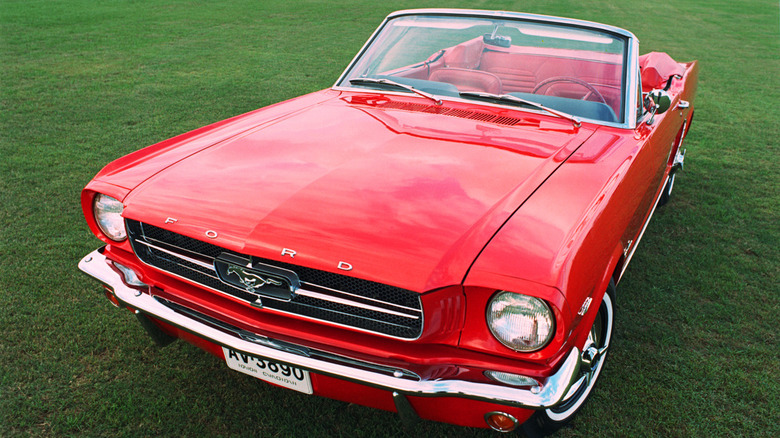
The American automaker first brought out its four-speed Toploader in 1964, equipping it in several notable muscle cars with two configurations available — a close ratio and wide ratio – which offered some significant differences in performance. You could find the transmission in Mustangs, Fairlanes and Torinos, just to name a few. The iconic '64 Mustang could be found with a few different options of small-block V8s under the hood, with the most powerful outputting 300 pound-feet of torque. Models like the Mustang were part of why Ford's small-block V8 helped shape the muscle car era, but they might not have made it so far without the Toploader.
Torque is a significant factor in terms of transmission performance, especially in demanding scenarios. The Borg-Warner T-10, able to handle up to 280 pound-feet of torque, struggled with the increased output loads of aggressive automobiles of its era. Out of necessity, engineers worked to devise what would become the Toploader, which is still used in some forms today. Although, Borg Warner would come back later with an improved Super T-10, which corrected many of the T-10's shortcomings in terms of coping against enhanced torque and higher rpm.
Ford's Toploader, the T-170, was a highly popular component in classic motorsports. Racing iterations of the Toploader not only swapped out the heavy cast-iron case for a lighter aluminum one, but also paved the way for several customized gearsets. Although you won't find it in the top-tier series, the Toploader design is able to withstand the abuse from NASCAR's high-revving engines. In terms of project builds, the stout four-speed is still a good choice today for iconic Ford models and even street rods.