

NASA Rammed An Asteroid Hard Enough To Change Its Trajectory, Maybe We're Not All Doomed
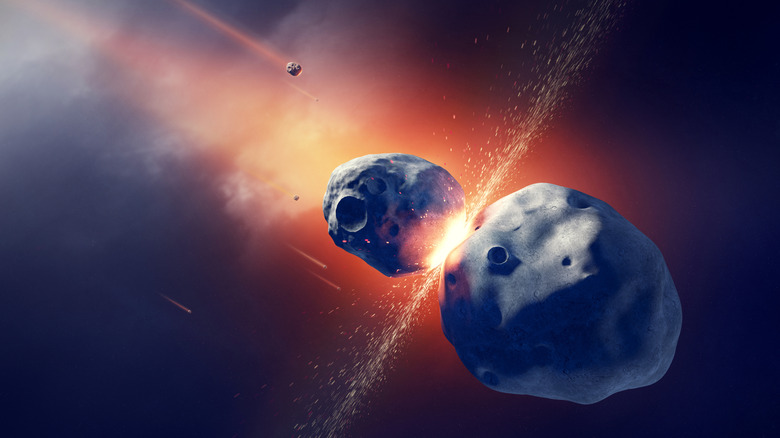
In an important step for both planetary defense and childhood imaginations everywhere, a recent scientific study has confirmed that NASA rammed an asteroid hard enough to change its trajectory. The ramming actually occurred all the way back in 2022, when the Double Asteroid Redirection Test (DART) spacecraft, built by the Johns Hopkins Applied Physics Laboratory on behalf of NASA's Planetary Defense Coordination Office, deliberately smashed itself into an asteroid's moon. Yes, the half-mile wide asteroid Didymos has a moon of its own, a little baby asteroid named Dimorphos. The study concludes that NASA punched the tiny guy so hard that it now orbits the bigger one a full 33 minutes faster than it used to. That, in turn, changed the asteroid system's orbit around the Sun –something humanity has never achieved before, and which might just save our planet one day.
You can read the whole study if you like, but the main takeaway is that smashing into the baby asteroid is only part of the equation. What happened was that the 14,000 mph impact caused damage to Dimorphos (poor little guy), causing shrapnel (called "ejecta") from the space rock to shoot off into the universe. That ejecta carries its own momentum with it, of course. But as you remember from high school, momentum is always conserved, so if a bunch of momentum is leaving the asteroid pair, then the pair itself loses steam. In other words, the ejecta multiplies the total effect of the ramming, called the "momentum enhancement factor." In this case, the study concludes that the ejecta doubled the power of the punch itself!
Slowing a celestial pair down by definition changes its orbit. As foretold by Bruce Willis long ago, we humans have proven that we can in fact move an asteroid out of the way if necessary. The hard part, of course, is changing its orbit by enough.
We're going to need a bigger DART
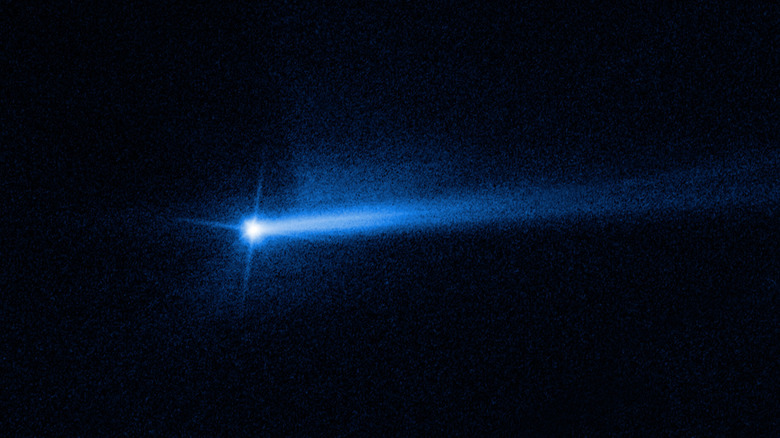
So, how much of an effect did DART actually have on the asteroid pair? Well, per the New York Times, the spacecraft slowed down the system's 76,000 mph orbital speed... by two inches per hour. Or as NASA puts it, the system's entire 770-day orbit around the Sun has been shortened by a whole 0.15 seconds. We're going to have to punch an asteroid a lot harder if we want to actually save the Earth. Either a bigger DART or a much faster one, or maybe lots of little ones. Of course, small changes add up to big differences, so if we hit the incoming asteroid early enough, a little DART might enough.
So while we're not quite asteroid-proof just yet, at least we've move one once. That provides important data for scientists to comb through, which will lead to new development down the line. In the meantime, a different asteroid, called 2024 YR4, reminded everyone of how vulnerable we really are. When it was first detected last year, it was calculated to have a slim chance of hitting our planet with the force of a nuclear bomb. While its threat to Earth (and also, our Moon) has since been disproven, it wouldn't take very much for it to be a crisis. Given that we now have interstellar visitors bombing in from the edge of the galaxy, planetary defense is something we're going to want to get serious about sooner rather than later.