

What Those Cables In Highway Medians Actually Do In A Crash
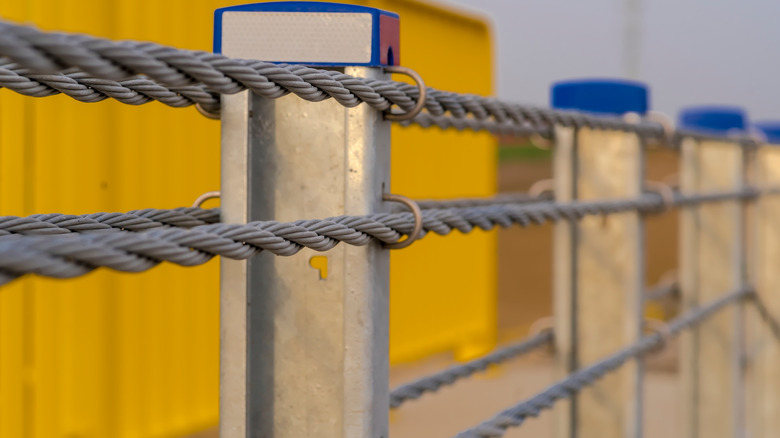
The history of the highway median divider is a long one, and today's cable median barriers are a relatively new phenomenon when you keep that in mind. They first became popular as a way to prevent accidents in the 1960s, with the three-strand setup – developed by the New York State Department of Transportation and featuring cable mountings placed on the traffic side of the posts – helping lead the way. But the idea of traffic dividers goes back to at least the year 1300. That's when Pope Boniface VIII created what may have been the world's first physically divided "road" across Rome's St. Angelo bridge, a popular route for pilgrims during the Catholic Church's Jubilee. For safety's sake, the pope had booths installed along its center and had the crowd cross on one side of the bridge and return on the other.
The first divided highway in the United States is often considered to be Savery Avenue in Carver, Mass., which had a green space with trees between the lanes. Of course, that was meant to be more of an aesthetic choice than a decision based on safety. The push for better wire barriers to prevent accidents in the U.S. seems to have begun with the introduction of the concrete "jersey" barrier in 1946 — developed specifically to reduce the number of head-on collisions on a particularly steep section of California road.
Currently, concrete barriers, metal guardrails, and cable barriers are all in the mix as protective devices, but each has its benefits and drawbacks. Today, we'll talk about the latter. Just keep in mind that, much like those ugly concrete walls on the highway, or those black and white stripes, there's more to cable median barriers than meets the eye.
Benefits of cable median barriers
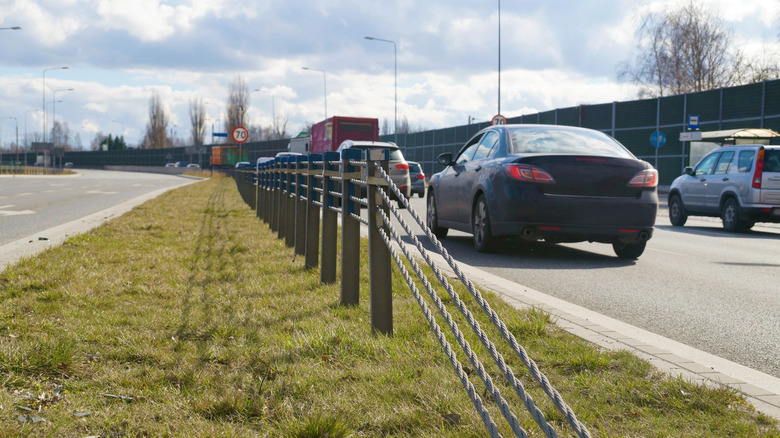
The No. 1 advantage of cable median barriers, of course, is their safety effectiveness. The North Dakota Department of Transportation, for instance, reports that they can "reduce cross-median crashes by 97%." The Federal Highway Administration indicates 92% fewer cross-median fatalities, 93% fewer head-on fatalities, and 94% fewer crashes involving multiple vehicles traveling in opposite directions. (It's also worth noting that cable median barriers can increase some other types of crashes, although this risk can be mitigated somewhat by combining them with rumble strips.)
Certainly helping matters is that the cable isn't as rigid as concrete barriers or guardrails, which helps to transfer crash forces in a lateral direction instead of back toward the people in the car. The cable does much the same for the car itself, catching it sort of like a net rather than having it bounce back into the potential path of other vehicles.
Cable-style median barriers can be less expensive to install as well. One study by the Washington State Department of Transportation — which took into account costs such as sales tax and bidding expenses — showed that for the same outlay, 2.4 times as many miles of cable barriers could be installed than concrete ones. As for so-called affordable guardrails, they can actually cost more in the long term. Part of this could be impacted by the fact that cable systems are significantly simpler to install on slopes and hills than the alternatives — which don't perform as well in those locations either. Nor will cables let snow and ice accumulate like they do against concrete barriers.
One big problem with cable median barriers (and some small ones)
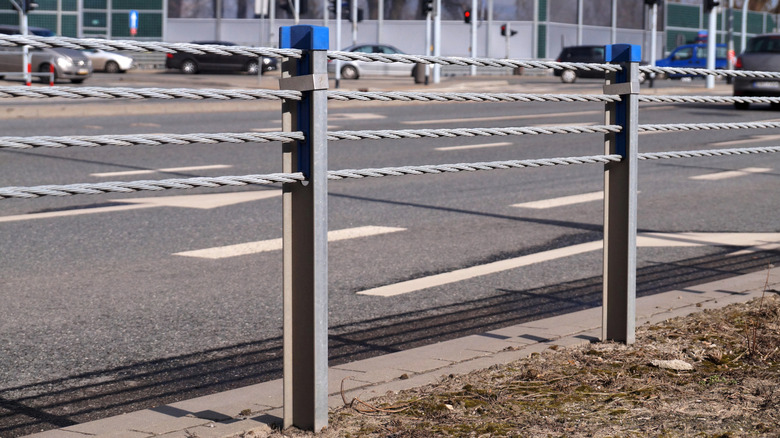
As mentioned, one of the odder effects of using cable-based median barriers is that — while they tend to lower the number of fatal accidents from head-on collisions — they can actually increase the number of overall crashes. As the Federal Highway Administration noted, a study of North Carolina highways discovered that installing cable median barriers led to upticks in crashes where a vehicle runs off the left side of the highway, hits a stationary object, or receives a rear-end impact.
Moreover, despite their low installation costs initially, this is far from a one-and-done situation: one thing that increases the effectiveness of cable barriers is that the posts they're mounted on are relatively weak, and they're specifically meant to bend or break as part of how they absorb the crash forces — meaning they sometimes have to be repaired or replaced even after a single impact.
Cable barriers also work best when combined with wide medians. After all, they can flex up to 12 feet when struck by a vehicle, and that could still be enough to bridge the gap between oncoming lanes on the highway, resulting in a head-on collision, and that's even if the barrier acts as it was engineered to do. To provide some context here, for a "high-speed, fully controlled access roadway," as DOT puts it, that sees fewer than 20,000 vehicles per day, the median has to be at least 50 feet wide to go without a median barrier. Barriers are recommended if the median is under 30 feet and the roadway has average daily traffic of 20,000 vehicles or more, and a cost-benefit analysis is suggested for locations with medians between 30 and 50 feet.