

Porsche Ponders Panamera-Taycan Merger As Possible Penny-Pinching Measure
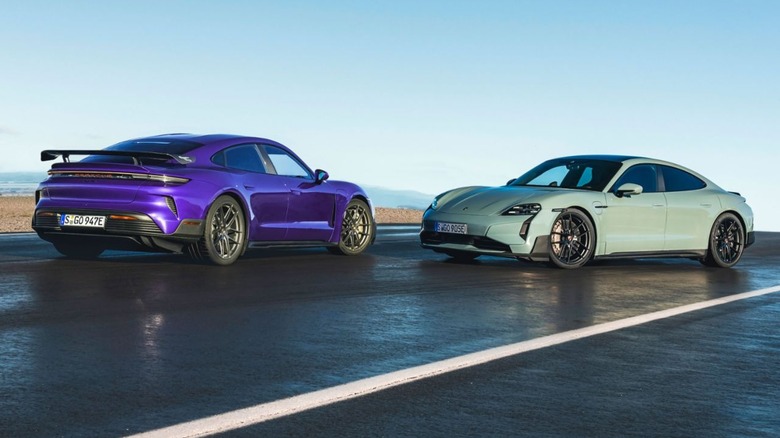
Porsche makes two big sedans right now — the gas- and hybrid-powered Panamera and the all-electric Taycan, but that could apparently be changing as the German automaker considers merging the two nameplates into a single, unified model line that'll carry every powertrain variant. It'll be similar to what Porsche has going on right now with the Macan and Cayenne crossovers and what was proposed for the 718 Boxster and Cayman sports cars.
It doesn't seem that this decision is being made as a way to streamline Porsche's lineup. Instead, it's part of broader cost-cutting measures that have been put in place by the company's newly minted CEO, Michael Leiters, according to Autocar. It comes after a noticeable downturn in global sales as well as the high costs that resulted from former CEO Oliver Blume's decision to scale back Porsche's electrification plans in 2025, which we reported on at the end of last year.
It's just not a good time to be developing dedicated electric vehicles right now — especially at Porsche, where things aren't going as well as they once were. That's why it is looking at the viability of having two completely separate but sort of similar vehicles in its lineup. Hell, even if Porsche doesn't go through with this plan to merge the two vehicles, their next generations could be much more closely related. Anonymous sources who spoke with Autocar say that the company is exploring increased parts sharing across the two vehicles, whether their successors use the same platform or not. Two totally different vehicles under the same nameplate are far from unheard of at Porsche. Just look at the Macan and Cayenne crossovers. I suppose time will tell if the "Taycan" or "Panamera" name wins out if the two were to merge.
Porsche's problem
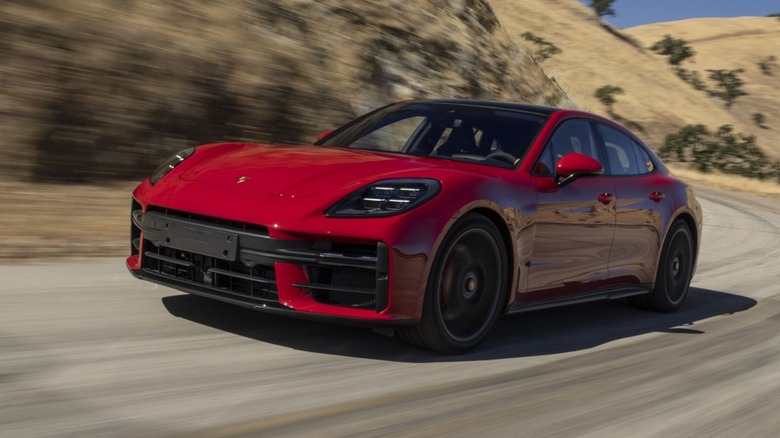
While the Panamera and Taycan might look sort of similar at first glance (if you're giving them a quick look, at least), they're completely different under the skin. The Panamera runs on Porsche's MSB platform, which it shares with the Bentley Continental GT and Flying Spur. However, when the third-generation Panamera arrives later this decade, it'll be replaced by the newer PPC architecture, according to Autocar. The liftback four-door makes anywhere between 348 and 771 horsepower, and it's 198.9 inches long. The Taycan, on the other hand, sits on Volkswagen Group's J1 platform, which is shared with the Audi E-tron GT. Its successor was expected to migrate over to the now-delayed SSP Sport architecture. Currently, it can be had as either a traditional sedan or in two different wagon flavors (Cross Turismo and Sport Turismo). Depending on the powertrain you go with, power ranges anywhere from 402 hp to a monstrous 1,019 hp in the Turbo GT. Size varies a bit depending on trim, but all Taycans are generally a hair under 196 inches long.
Reportedly, one of the ways Porsche could merge the two is by making use of the Panamera's extended-wheelbase variant. It would give engineers and designers a potential route for introducing two wheelbase options for a Taycan replacement, and it would probably give them enough room to fit the batteries it requires between the front and rear wheels.
Financially, this move makes sense. As we reported last month, Porsche wrote down €1.8 billion ($2.1 billion) in 2025, related to platform delays. It warned of reduced profitability as it reworked its original EV strategy — and that included the potential death of the all-electric 718 Cayman and Boxster before they even got the chance to hit the road.
By merging the Taycan and Panamera into one vehicle, Porsche could — theoretically — deliver saving across a number of departments while avoiding a situation where one of the cars has to die later down the road due to costs.