

Spark Plugs Probably Shouldn't Be Made Out Of Pencils, But That's Not Stopping People
We've all seen some of the craziest, zaniest car videos on YouTube, but the brilliant yet unconventional enthusiasts of Garage 54 tend to post about the most out-of-this-world solutions, inventions, and car-related experiments. Whether they're creating 3D-printed bearings and piston rings, turning a Lada into a snow crawler, or slapping a tri-turbo 2JZ-GTE into a Mercedes G-Wagon (deserving a place among the most unexpected cars that came with Toyota's legendary inline-6), these car-crazy Russians never cease to amaze.
Imagine our surprise upon seeing that they also tried turning pencils into spark plugs. It sounds impossible, since spark plugs do more than ignite the air/fuel mixture. They actually live a hard life inside the cylinder head, capable of enduring intense heat, pressure, vibrations, and high voltages. It's why spark plugs come in many types and should be compatible with your car's engine to avoid performance issues and early wear. Moreover, they won't last forever and need replacing at least every 30,000 miles (for copper plugs) to about 60,000 to 100,000 miles (for platinum or iridium plugs).
So if a pencil were to survive inside the engine, would it ignite? Or would it produce a spark at best? As it turns out, the graphite content enables pencils to conduct electricity like metal. Garage 54 tested this by connecting an ignition wire to the pencil, turning the engine, and seeing if it would spark. It did,because graphite's carbon atoms have a single "delocalized electron" along with alternating structures of single and double bonds, essentially creating a molecular Autobahn for electrons.
How to turn pencils into spark plugs
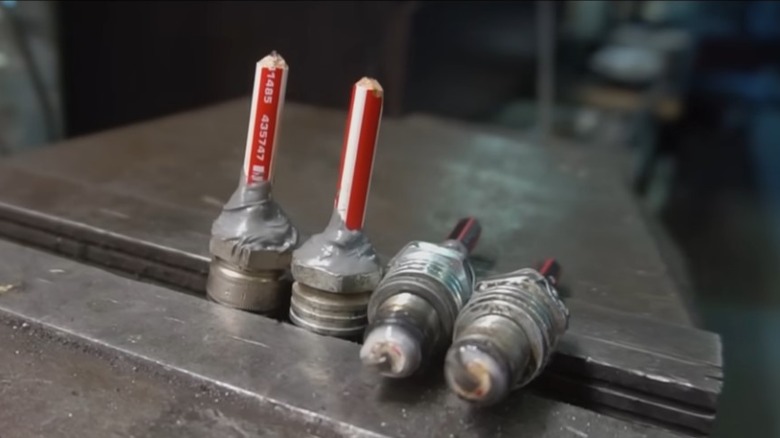
After seeing that a pencil can indeed produce a spark, the hard part is turning an actual pencil into a spark plug you can screw into the cylinder head. For Garage 54, the solution was easy: disassemble an existing spark plug and find a way to shoehorn a pencil into the body.
Of course, some grinding, J-B Weld, and elbow grease went into it, but they managed to infuse four pencils into four spark plugs. It wasn't easy, but it's nothing compared to swapping a boat motor into a car or making a winch out of a meat grinder.
At this point, we were at the edge of our seats, but some wiring had to be done to finalize their somewhat bizarre experiment. They took off the rubber covers of the spark plug wires and tinkered with the wiring to make them compatible with, umm, pencils. Once done, the pencil plugs were installed into their respective holes, and the guys tried starting the engine after connecting the makeshift wiring.
It didn't go well, but it kind of worked
The engine struggled to start initially, but they managed to get it running somewhat after some tinkering and adding more gas. But just as they were about to celebrate their silly experiment, two pencil plugs ejected from the motor, complete with sparks, bangs, and plenty of laughter. Still, they weren't finished.
They replaced the two busted pencil plugs with regular plugs and kept going. Eventually, first one, then the other of the remaining pencil plugs exploded, and that was the end of it. It would have been fun if they had managed to drive the car, but we had our doubts from the outset. Given the high demands spark plugs need to endure, a wooden lead pencil wouldn't cut it.
While we were quite impressed that a pencil can produce enough spark for combustion, the epxerience as a whole further highlights what using the wrong plugs can do to your car's engine. Sure, the pencil-ignited engine started and ran, but it was misfiring like crazy and vibrated like it was about to explode from the inside out. For your sanity's sake, leave any pencil out of your engine and stick to the manufacturer-recommended spark plug during servicing.