

These Steering Wheel Alternatives Go Beyond A Yoke Or Squircle
Concept cars have always pushed the boundaries of design. After all, that's what concept cars are for: to make the imagination real and see what can be done if designers and engineers have free rein. Then again, some concepts were way ahead of their time and had features that were more silly than innovative — but it doesn't mean they're uncool.
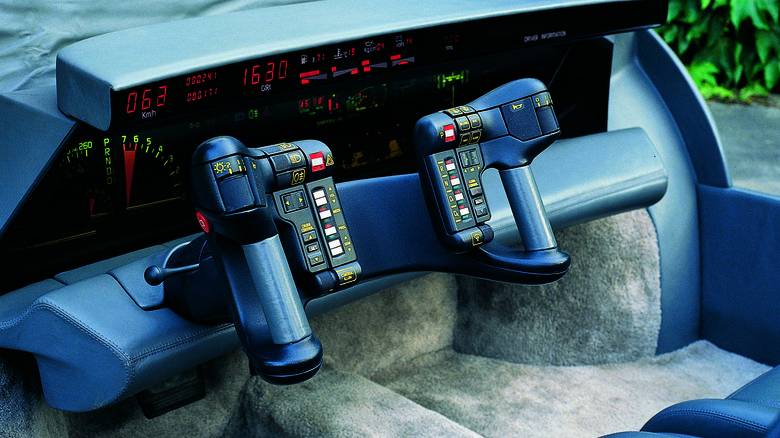
For instance, Oldsmobile was readying for the future with its bonkers and space-age Incas concept car from 1986. The car is gorgeous, no doubt, and the rear seagull doors have ensured the concept is never lacking in visual flair. Concepts are meant to evoke reactions, and that's what happened when we saw the Inca's fighter-jet-style yoke with enough buttons to make Ferraris squeal in envy.
Italdesign claims the right side has controls for the HVAC, windscreen wiper, and to change gears. Meanwhile, the left side has buttons for the lights, indicators, the stereo, and cruise control. Oh, and it has a horn button on both sides. The lucky pilot of this thing will surely ride in a wave of comfort, since it has "real armchairs" instead of seats, and the lock-to-lock of the tiller only takes a 90-degree turn on each side.
However, you can't count on us to read the owner's manual, and it would take the focus of an F1 driver to discern and memorize what all those buttons do. We still find squircle steering wheels oddly more elegant than any yoke, but we had to reconsider upon laying eyes on what Ford and Mercury were up to in 1965, during which they were literally reinventing the (steering) wheel.
Wrist Twist for the win
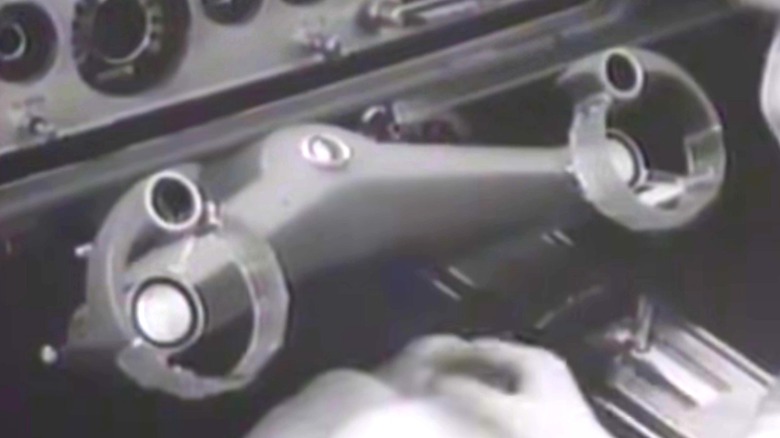
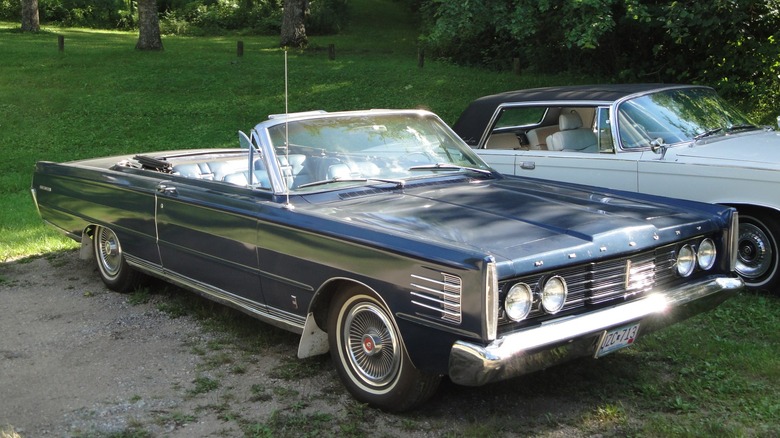
Pictured above is the steering wheel of a 1965 Ford/Mercury Park Lane Convertible, a contraption that the automaker refers to as the Wrist Twist. It's a rather bold yet innovative re-imagining of the steering wheel that we're all familiar with, but we're kind of falling in love with the thing for being more than just a striking design element. At first glance, we're not entirely certain that we'd choose it over a Lexus yoke or even Tesla's dumb yoke steering wheel, but it's still interesting to see what Ford cooked up for its '65 Mercury concept.
Motor Trend had a go at the Wrist Twist-equipped Mercury Park Lane in 1965, and the upsides were kind of hard to ignore. It tilts up on the column for easier ingress and egress, and settling your thumbs into the ergonomic thumb rings felt natural, especially with arm rests for your left and right elbows. As expected, the driving position and the absence of a rim to hinder vision provided excellent visibility, and Mercury surveys back then revealed that people actually liked it.
Two rings instead of a wheel
Instead of a typical U-shaped yoke that you hold with both hands, Ford's Wrist Twist consists of two plastic rings. It was the brainchild of former missile engineer Bob Rumpf, who was then the head of the XR-50 Wrist-Twist steering project. Behind the rings are chains and sprockets to link the setup to the steering column.
Thankfully, the rings are power operated and have an auxiliary power source if the main system fails. That's good, because our carpal tunnel would probably be screaming in agony trying to manually operate those rings. The steering's constant 15:1 ratio means it only takes 1.75 turns of the rings lock-to-lock, which, in theory, makes backing up to tight spaces or perpendicular parking a breeze.
Of course, the Wrist Twist never made it to production, but we think Bob Rumph and his skunkworks team had a great idea with their concept. With a few more tweaks, it could be safer than round steering wheels. However, Rumph knew his creation wouldn't make it past the experimental stage. In a 1965 interview with Popular Mechanics, Rumph said the XR-50 steering project will most likely remain a concept because "people won't give up that old steering wheel easily," and he was right.
China has begun regulating yoke steering wheels to conform with evolving safety standards, but it probably has more to do with them being such a hassle to live with. On the other hand, the Wrist Twist could probably make China and worldwide safety officials reconsider the yoke design for future cars because, well, it kind of makes sense from a driver's standpoint.