

When Does Following A Car Become Tailgating?
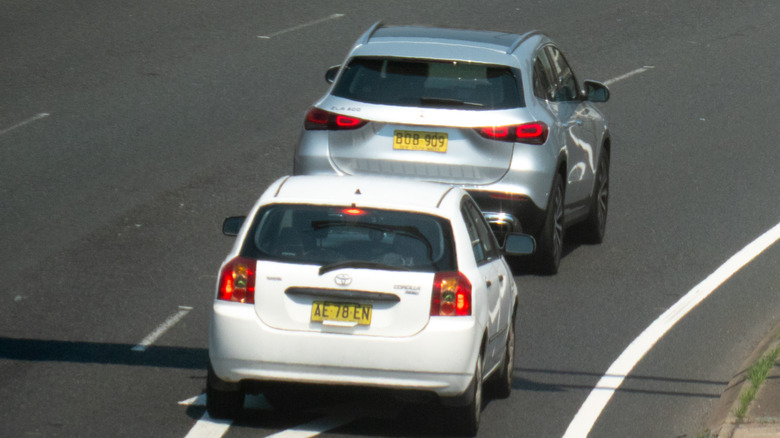
Is there anything that annoys drivers more than a tailgating vehicle in the rearview mirror? Tailgating is when a vehicle follows the car in front too closely, and it's a traffic violation in most states. That's good, since tailgating is one of those annoying driver habits sure to get blood pressures boiling, given that the National Highway Traffic Safety Administration (NHTSA) says rear-end crashes account for around 29% of all collisions on American roads.
NHTSA recognizes tailgating as an aggressive driving action similar to other moving traffic offenses such as improper lane changes, speeding, ignoring traffic signals, and failure to yield to pedestrians and other cars. But just when following a car becomes tailgating depends on where you live.
NHTSA says that "not every moving violation is aggressive driving" and that it's difficult to write laws against aggressive driving, although some states already have laws that criminalize it. For instance, Florida statutes do not specifically refer to the word "tailgating," but the law states that drivers should not follow another vehicle closer than what is "reasonable and prudent." The law does not define those terms.
According to the Pennsylvania Online Driver's Manual, maintaining a safe following distance means adhering to the four-second rule, which is enough leeway to give you time to react to accidents and prevent crashes. On the other hand, Florida law says: "It is unlawful for the driver of any motor truck, motor truck drawing another vehicle, or vehicle towing another vehicle or trailer, when traveling upon a roadway outside of a business or residence district, to follow within 300 feet of another motor truck."
Can I get a ticket for tailgating?

In Florida, Chapter 316.0895 of the 2025 Statutes on Motor Vehicles states that tailgating or following too closely is "punishable as a moving violation" and that violators will be charged with "a noncriminal infraction." So yes, you can definitely get pulled over and get a ticket for tailgating in Florida, and you can get jail time there for speeding, too. Moreover, if the tailgating resulted in death, the offending party could have to perform up to 120 hours of community service in addition to paying fines or other penalties.
In Washington state, meanwhile, following too closely will net a penalty of no more than $250 for each offense. However, Washington law adds that if you were caught tailgating behind a "vulnerable user of a public way" (that is, pedestrians, a person riding an animal, cyclists, motorcyclists, a farm tractor, or a moped), the fine is $5,000, along with up to 364 days of imprisonment and a 90-day suspension of your driver's license.
Following too closely is an offense in other countries, too. For example, tailgating drivers in the U.K. can get charged with unlimited fines and three to nine penalty points on their licenses. However, if the tailgating instigated a crash and resulted in fatalities, the offending driver can get a driving ban and a prison sentence of five years to life.
How to avoid tailgating
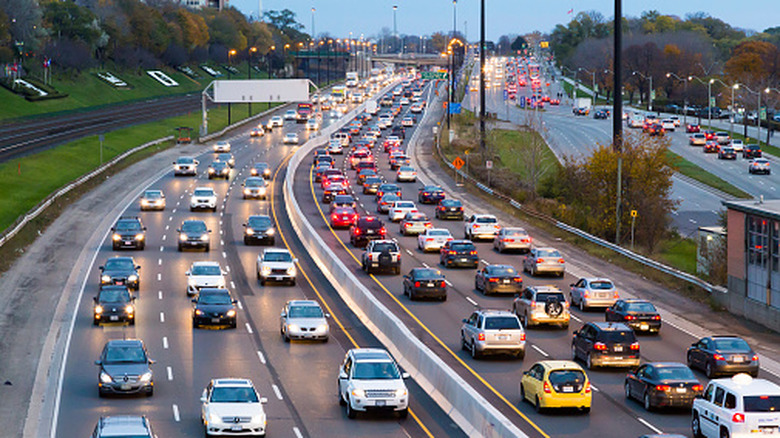
It's not hard to avoid tailgating. All it takes is to maintain a reasonable following distance to the car in front and not be a knucklehead. When driving below 40 mph, the Federal Motor Carrier Safety Administration advises leaving a second of space for every 10 feet of the vehicle's length in front, which is about four seconds when following a tractor-trailer. But if your speed is above 40 mph, it's best to add an additional second of space per 10 feet.
According to NHTSA, drivers only have around 1.5 seconds to react to what's happening on the road and try to stop and steer clear of danger. And during those crucial one-and-a-half moments, the car remains moving at the same speed and on the same path toward a collision. For context, a medium-sized family car traveling at 20 mph requires a stopping distance of 62 feet on average, while the same car going at 50 mph needs around 221 feet to stop, which, based on an average car length of 14 or 15 feet, is roughly 15 car lengths. Fifteen!
Meanwhile, vehicles with balding rubber need more space to grind to a halt, since worn-out treads can contribute to increased stopping distances. If you noticed, the stopping distance almost quadruples if the speed is more than doubled. This further highlights why you should avoid tailgating or following too closely, and maintain three to four seconds worth of distance to the car in front whenever you're on cruising on the highway.