

As The New Dodge Charger Sixpack Reaches Owners, Let's Honor The Hot Aussie Mopar Six
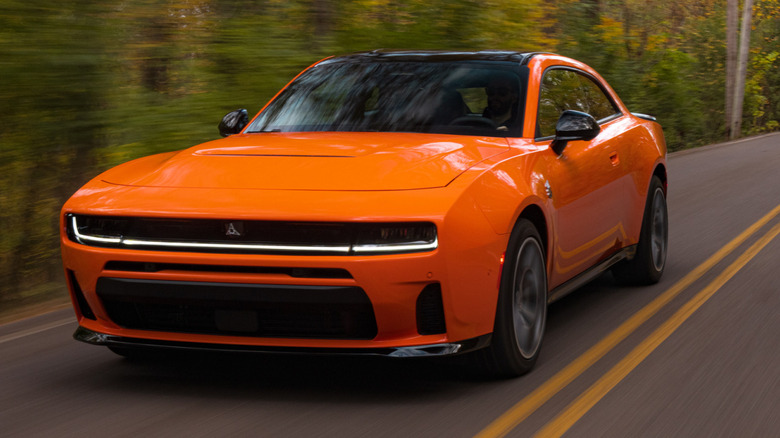
With the all-electric Dodge Charger Daytona arriving first, the reimagined Charger nameplate initially asked enthusiasts to imagine muscle without gasoline. Now, as the Sixpack models begin reaching owners powered by Stellantis' twin-turbocharged 3.0-liter Hurricane inline-6, the conversation shifts. For many enthusiasts, this gas-powered version feels like the Charger they were waiting for. In the spirit of this new Charger and its power train, it's worth remembering that Mopar has a rather interesting past with six-cylinder power — just not in the United States.
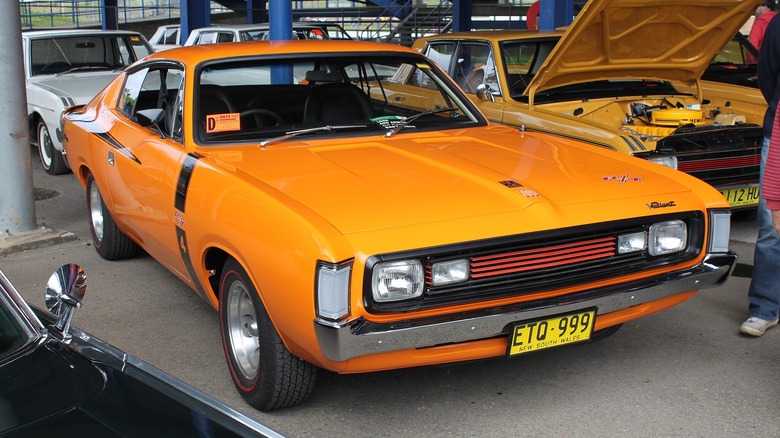
Over five decades ago, long before the Hurricane assumed Dodge's muscle-car torch, Chrysler Australia had already built a straight-6 that punched well above its weight. Australia's Valiant Charger R/T E-49 (quite the mouthful of a name) packed what was called a "Hemi Six Pack."
Despite the name, it wasn't a V8, and it certainly wasn't the hemispherical V8 many Americans associated with the Hemi badge. Rather, it was a triple-carbureted 265-cubic-inch inline-6 that made over 300 horsepower in an era when U.S. muscle cars were beginning to struggle for power under tightening emissions rules. While Detroit was watching performance fall across the board, Australians had just begun.
Before the Hurricane, there was the Hemi Sixpack
Designed in conjunction with its American team, Chrysler Australia's Hemi Sixpack used a canted-valve combustion chamber design instead of a true hemispherical-head engine as found in many of the American V8s.
With this motor, the top-of-the-line Charger R/T E-49 produced a hearty 302 hp and 320 pound-feet of torque — good for a quarter-mile time just north of 14 seconds. Given numbers that placed the Charger R/T E-49 squarely in V8 performance territory, it was easy for Australians to crown it a homegrown muscle car despite having two less cylinders. Though the Ford Barra from decades later has grown an international cult following, it was Chrysler's Hemi Sixpack that first proved a straight-6 could be a legitimate muscle engine. The 265-powered Charger and its many variants would continue to be sold until Chrysler stopped production of the Valiant Charger in 1978.
Today's Dodge Charger Sixpack, powered by a twin-turbocharged inline-6, feels like a modern reinvention of the Hemi Sixpack from decades past. Both produce competitive in-class performance while substituting for the V8 of years past — although with loosening Americans emissions regulations, we might soon see the return of the Hemi V8 to the new Charger. But if you're one of the ambitious folks taking delivery of a new Hurricane-powered Dodge Charger, take a second to tip your hat to its Aussie forefather.