

Cops PIT Family Bringing Child To Hospital For Traveling 10 Miles Over Speed Limit
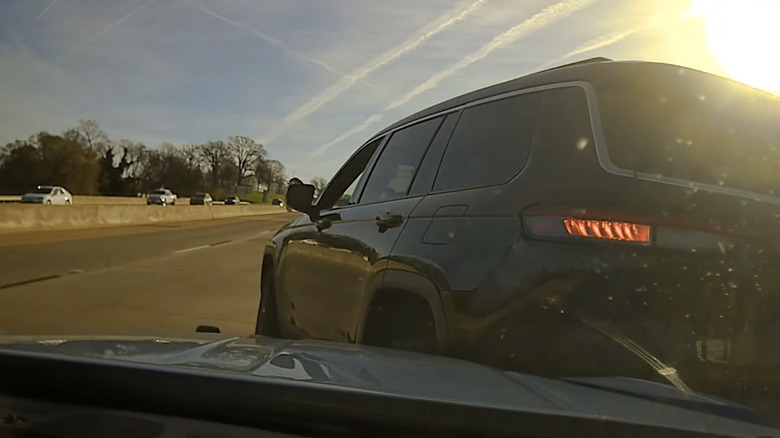
It's already stressful when your child is sick, and you're taking them to the hospital at a mildly accelerated pace. That stress level ratchets up just a little bit when a state trooper protects and serves by spinning you into a concrete wall and pulling you from the car at gunpoint. That's exactly what happened to Dillon Hess, reports the Arkansas Democrat Gazette, with his entire family along for the wild ride.
On February 20, one of Hess's sons suffered from an allergic reaction. He had used an epipen, but the child was still in distress, so Hess, his wife, and two boys, ages 3 and 1, were on their way to the hospital. Arkansas State Trooper Amber Cass noticed their Jeep Grand Cherokee traveling at the blistering pace of 70 mph in a 60 mph zone. She activated her emergency lights around Exit 3B to pull Hess over, who instead turned on his flashers and did not stop. The pursuit that posed absolutely no threat to public safety continued for about a mile and a half to Exit 2B, where Cass performed a PIT maneuver and pinned the Jeep against the center divider. She ordered Hess out of the car at gunpoint and handcuffed him while he tried to explain the situation.
Was this really necessary?
In her report, Cass justifies her actions because she didn't know the driver's intentions, and because he was approaching heavier traffic ahead. "Fleeing in a vehicle is viewed as an inherently dangerous crime (by the courts) regardless of the speeds involved," wrote Cass.
While 10 mph over the limit is still speeding, this was no wild high-speed pursuit, either — at least, until Cass decided to spin Hess and his family into the wall. He was not weaving through traffic or driving dangerously. After Hess was in handcuffs, Cass told him that if he had stopped, he would have gotten to the hospital more quickly. That does not compute, because stopping is slower than maintaining highway speed.
Prosecutors have dropped all charges against Hess, including a felony charge of speeding while fleeing. How generous. From the Arkansas Democrat Gazette:
"This incident underscores the importance of communication when it's necessary to transport someone having a medical emergency in a private vehicle, which occurs with regularity across Arkansas," Col. Mike Hagar, director of the state police, said in a news release Friday.
Hess's wife was already on the phone with 911 at the time of the incident. Just before the PIT maneuver, the Jeep's driver's window rolls down, perhaps indicating that Hess was trying to talk with the trooper himself. He never got the opportunity. If Cass had simply followed Hess until he stopped at the hospital, the situation would have explained itself. Or even given off pursuit, considering the officer now had the license plate of a car that was not reported stolen, and could make contact with the driver in a less life-threatening manner. A home address is attached to most folks' car registrations after all. Police chases in general are dangerous, irresponsible and often don't yield any different results from issuing a warrant for a driver and making contact at a later time. An in-depth piece by the San Francisco Chronicle found that between 2017 and 2022, at least 3,336 died in police pursuits, at least 551 of those deaths were uninvolved bystanders.
Trying to do the right thing
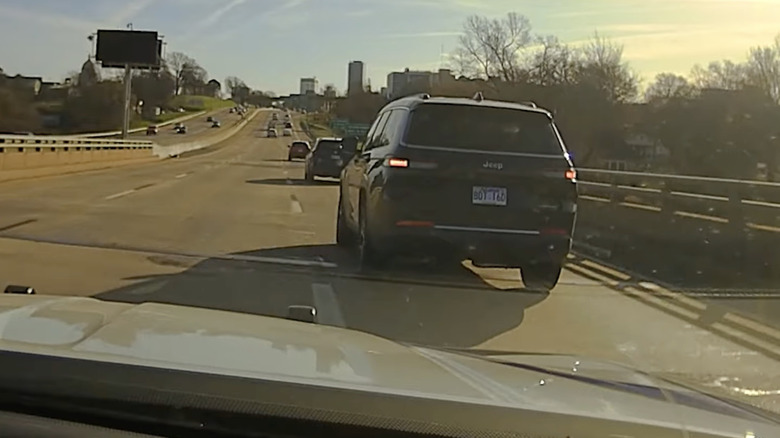
We're certainly not saying you shouldn't stop for police, but time is of the essence in a medical emergency especially with such young children. You need to take out a second mortgage to afford an ambulance these days, plus you'd have to wait for it to arrive when you can start putting those miles down yourself immediately. Even Col. Hagar admits this situation "occurs with regularity." This isn't even the first time ASP has crashed out a car on its way to the hospital.
In another incident, ASP chose to PIT and flip a pregnant woman's car while she was trying to find a safe place to pull over rather than stopping immediately in an unsafe area. In that situation, the woman had turned on her flashers to indicate these intentions, just as Hess did. From that post:
Turns out that's textbook what to do according to State Police's "Driver License Study Guide."
Under "What to do When You Are Stopped," number one says to use, "emergency flashers to indicate to the officer that you are seeking a safe place to stop."
That post's link to that version of the study guide is now broken. The current version, dated January 2026, does not mention this at all. But this is still what many Arkansas drivers learned is the right course of action in a situation like this. Perhaps police shouldn't PIT first and ask questions later when someone puts on their flashers and doesn't pull over instantly.