

Why Do Harley-Davidson Motorcycles Have Such A Distinct Sound?
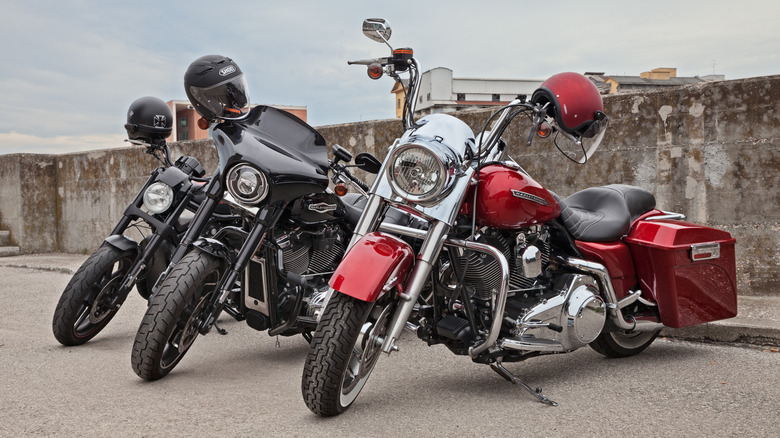
There is something invigorating about the irregular firing of a big Harley-Davidson V-twin that gives each cold start of the bike a hair-raising excitement. After that initial jump, however, the bike settles into a galloping beat idle like the hoofbeats of wild horses. The repetitive pum-pum-rest thrum has enough bass to feel it in your heart, and enough historical and cultural significance to feel it in your bones. There's no other engine that sounds quite like it, and I'm going to finally provide you with the explanation as to why that is.
Dating all the way back to 1909, even before their orange and black logo was in use, Harley-Davidson has used a 45-degree firing sequence in its V-twin engines, and set both pistons on the same crankshaft pin. While the crankshaft has to complete a full 360 degree rotation, the two cylinders fire just 45 degrees apart with a lengthy rest. Being a four-stroke engine, there is a full 405 degree rest in between firing cycles, allowing the piston to force the exhaust gasses out past the valve. When you rev your bike, you think you're hearing the explosions inside the cylinder, but most of what you hear is actually the pop of the exhaust valve releasing spent gasses out into the atmosphere.
Here's the breakdown of what's going on. The first piston fires at top dead center, followed by the second piston 45 degrees later at the engine's 315 degree mark. There is a 405 degree gap in ignitions, accounting for the power stroke, exhaust stroke (which you hear), intake stroke, and compression stroke to get back to top dead center on cylinder one. Then the cycle starts over again. This is how you get the distinctive "potato potato potato" exhaust note at idle.
Pop pop pause
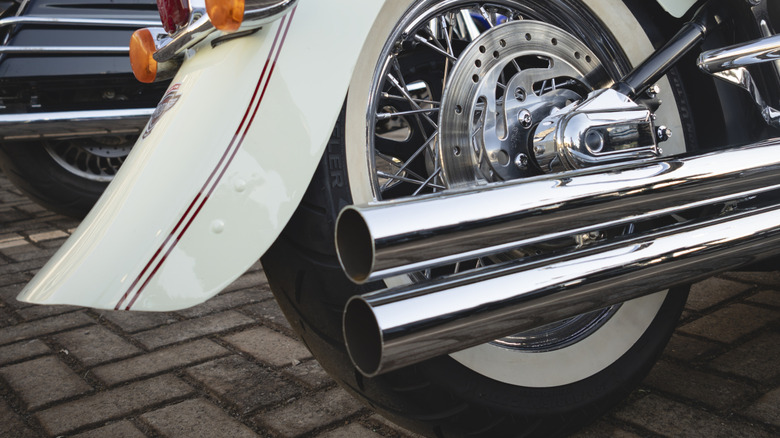
If you're a Harley rider, you probably already know a bit about how they work. Harley has typically not relied on internal balance shafts to offset the bang-bang-rest engine jiggle, allowing the vibration and sound to define the Harley riding experience. A V-twin is already an inherently imbalanced engine, but to put all of the engine's rotating mass on a single crank pin is all the more uncommon. Balancers weren't really employed by H-D until the Softail was introduced for the 2000 model lineup, as it used a solid-mounted engine and needed those vibrations held in check.
When you start your big V-twin Harley the next time, listen closely and you'll be able to hear the individual exhaust valves opening with one right after the other, followed by a rest beat. It's an instantly familiar sound, but you can pinpoint with your ears exactly where the engine is in its rotation. It's fascinating!
Much like Porsche's insistence on putting a 911's engine behind the rear axle, Harley's offset ignition, air cooling, and vibration-heavy V-twin should have been beat out by better tech shortly after it was introduced. But because both brands have leaned heavily on making their flaws into marketing material and defining characteristics of a unique driving/riding experience, these outdated technologies have stuck around way longer than practically purposeful. In fact, Harley has made it such a defining part of their personality, they tried to trademark the exhaust note.
The failed trademark bet
Harley was so confident that its unique exhaust note was an intrinsic part of the brand that it fought to uphold the iconic "potato potato potato" sound as legally belonging to the company. In 1994 the Bar and Shield presented a case to trademark lawyers that the sound of H-D's V-twin engines was uniquely their own, and nine other brands were infringing on that copyrighted sound. "The Mark Consists of the exhaust sound of applicant's motorcycles, produced by V-Twin, common crankpin motorcycle engines when the goods are in use," said the legal claim.
Competitors, including Kawasaki, Yamaha, Suzuki, and Honda however, said different. They refuted the claim that V-twin sound belonged to Harley and Harley alone. The competition argued that similar engine designs, like the ones these companies already built for their own American-style cruisers, naturally create similar sounds. That's just a result of engineering an engine with the same layout.
Harley made quite a few blunders in the 1990s, and this was one of them. After six years in court, Harley eventually withdrew the copyright application. There was no way for Harley to prove that it could claim exclusive rights to a sound created by a 45-degree air-cooled V-twin. There's no telling how much Harley spent trying to get the acoustic rights to its engine notes, but it does help illustrate how important that sound is to the brand.