

Why BMW Went To Single Turbos Instead Of Dual Turbos
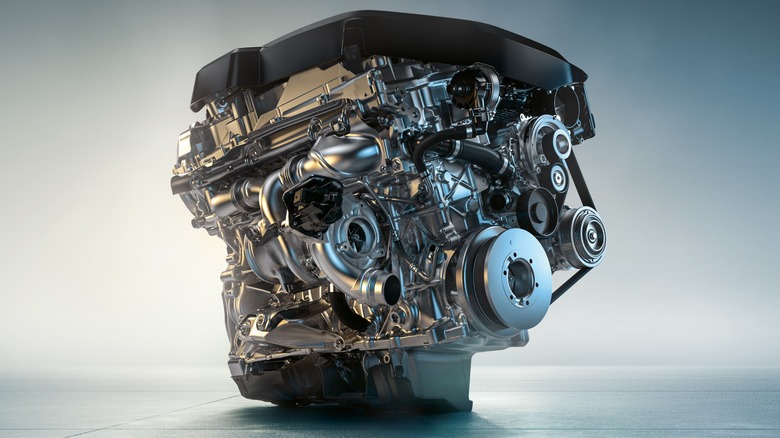
Ever since turbochargers entered mainstream use in road-going, gasoline-powered cars — dating back to at least the first Porsche 930 Widowmaker of the 1970s — automakers have come up with all kinds of methods for minimizing the resulting turbo lag. Simply put, turbo lag is the amount of time it takes to spin the turbo fast enough to force enough air into the engine, which, when combined with the proper amount of fuel, creates a noticeable increase in power output.
A common strategy to avoid turbo lag involves using what's called a sequential twin-turbo setup. In this approach, a smaller turbocharger takes care of lower-RPM power. Its smaller size means it is able to spool up quicker in order to produce peak power. Once the engine's RPMs are high enough, exhaust pressure is redirected to cause the larger turbocharger to come online and deliver much higher peak power. The FD-generation Mazda RX-7's famous 13B rotary engine is a prime example of this.
As technology advanced, automakers such as BMW started switching to single turbos instead of dual turbos. Reasons vary, but they're mainly based on one principle: efficiency. Not only with regard to moving exhaust gases more efficiently, but also by improving fuel economy, emissions, and lower costs by decluttering components under the hood, too.
What is a twin-scroll turbocharger?
In a basic turbocharger setup, exhaust gas pulses feed from each cylinder, through an exhaust manifold, and into a single tube, or scroll. These gases spin the turbine, which is connected via a shaft to an impeller, which draws in and compresses intake air before sending it through an intercooler to reach the intake manifold. The exhaust side is often referred to as the hot side — because it's where hot exhaust gases travel through — whereas the intake side is the cold side.
Here's the thing, though: exhaust gas pulses traveling from each cylinder can overlap and interrupt each other, thus impeding flow, which cuts down on efficiency and restricts power output. One common solution is a twin-scroll setup.
In a twin-scroll turbocharger, the exhaust manifold is arranged so that the pulses can travel to the turbine without running into each other. The four cylinder's exhaust ports are paired up in a way so each pair's exhaust pulses don't interrupt each other. This overall efficiency means the turbo can spin up (or, spool) faster, thus dramatically cutting down on turbo lag.
Does a twin-scroll turbocharger fully replace a twin-turbo setup?
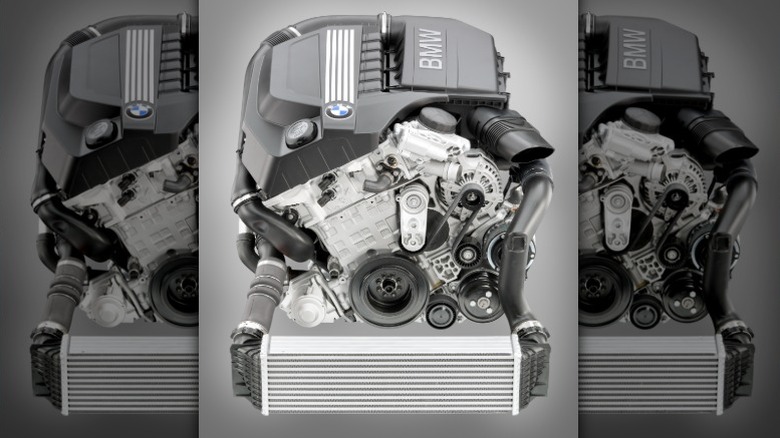
The benefits of a twin-scroll turbocharger are very real. In fact, BMW pointed out their effectiveness when discussing moving from the 3.0-liter Twin Turbo N54 inline-six — a non-sequential dual-turbo setup — to the 3.0-liter TwinPower Turbo N55 inline-six — a single twin-scroll turbo setup — back in 2009. "In comparison with the straight-six featuring Twin Turbo technology and High Precision Injection already featured in several model series, the [TwinPower] engine at the same time offers a further reduction of fuel consumption by up to 9 percent."
Good power, lower fuel consumption, and fewer emissions make this a compelling option and helps explain why BMW went to single turbos instead of dual turbos. It's cheaper to run one turbo and all of its ancillaries than two, and therefore, there are fewer components to replace as the vehicle accrues mileage and they wear out. Additionally, there's more room under the hood to make packaging easier.
However, many engines from BMW and other car companies still utilize two turbos, especially if those engines are separated into banks. The beloved-by-enthusiasts B5-generation Audi S4 is known for this setup, as is the current 992.2 Porsche 911 Carrera and Carrera S. The latter two have a turbo bolted up to each bank on their 3.0-liter flat-six engines. This is not only easier for packaging, but also offers a more efficient path for the intake air to travel through. The shorter the distance between the turbo's cold side and the intake manifold, the better.