

These Were The Only Two American Cars That Offered Four-Wheel Disc Brakes In The 1960s
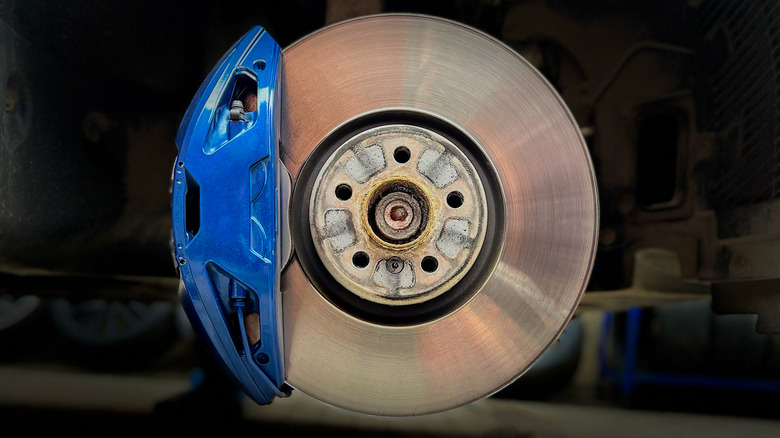
Most modern cars have stopped using drum brakes — though yes, the Audi Q4 e-tron really does have them at the rear — but it's taken a fairly long time to reach this point. Disc brakes, despite being invented by Frederic Lanchester in 1902 — the same year Louis Renault patented drum setups — didn't really become a factor on production vehicles until the 1950s. That's when they began appearing on the likes of British sports cars from Jensen and Austin-Healey, as well as on the legendary Citroën DS. (The Brits were the first to break through on the track as well, fielding a trio of Jaguar C-Type racers at the 1953 running of Le Mans — where they just missed sweeping the podium by finishing first, second, and fourth.)
Disc brakes made particular sense in those kinds of applications since they can provide better stopping performance than drums — which makes them better for enthusiasts — yet are also more expensive, meaning they're more palatable to buyers of premium cars like the DS. The Goddess, remember, additionally featured such advanced-for-their-time technologies as a self-leveling hydro-pneumatic suspension.
As far as U.S. automakers go, disc brakes had a similar debut, first appearing on sporty and/or upscale rides. For instance, Crosley unsuccessfully experimented with disc brakes in 1949 on its Hotshot roadster, and the Studebaker Avanti introduced front discs in 1963. Yet only two domestic vehicles, from a single brand, offered them on all four corners during the decade: Four-wheel disc brakes became standard for the 1965 Chevrolet Corvette and were a limited-production option with the 1969 Chevrolet Camaro.
The C2 Corvette started things off
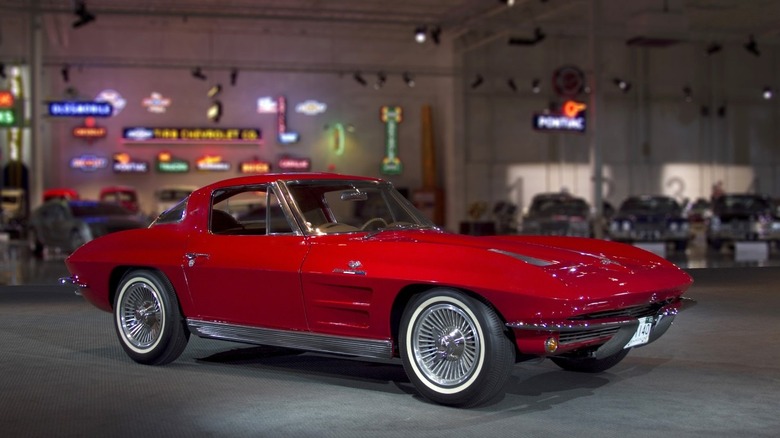
The debut of the second-generation Corvette marked a major transition for the nameplate, taking it from being a sporty-ish cruiser like the Ford Thunderbird and putting it on track to become the supercar we know and love today. Even the design, by Bill Mitchell and Larry Shinoda — who would go on to help create an RV that incinerated your poop with its exhaust system — was stunning. This was especially true during its first year, in 1963, when the Corvette had an attention-getting split rear window treatment. But just as important were the many upgrades for performance.
For example, the engine and passengers were moved rearward compared to where they sat in the C1 Corvette, giving the newer car a better weight balance that, in turn, improved its stability during extreme high-speed maneuvers. On the topic of speed, the Bowtie brand delivered more of that, too. The C2 Corvette featured one of Chevy's classic small-block V8s, in this case the L79 mill that displaced 327 cubic inches and made 350 horsepower. At the time, it delivered the best performance of any 327 engine (with a hydraulic cam).
That got plenty of attention, but the second-gen Corvette got a mid-cycle refresh in 1965 that brought even more ponies to the stable. With its big-block 396-cubic-inch V8, the 1965 'Vette could unleash 425 horsepower and gallop to 60 mph in a brisk 5.7 seconds. Of course, reining in all those horses required major stopping power, and Chevrolet made four-wheel disc brakes standard the same year to help — although they were designed by the same company responsible for the front disc brakes in Ford products of the same era.
The 1969 Camaro came next
The Chevrolet Camaro's road to four-wheel disc brakes actually begins on the track. After debuting for the 1967 model year to compete against the Ford Mustang on the sales charts, the Camaro quickly began taking on its Blue Oval rival in the Trans-Am racing series — which is still a thing and is now presented by Pirelli. The series was developed to showcase American performance in relatively stock cars, meaning the competition vehicles had to use many parts from the street cars. So, what automakers would do is sell a small number of street cars with a racing-style technology, which essentially meant those components could be considered standard factory equipment for at least some models and thus used in Trans-Am racing. (The process is called homologation.)
In other words, to use four-wheel disc brakes on its Trans-Am racecars, Chevrolet first had to offer them on at least some small number of production Camaros sold to retail customers — which is where Chevy's RPO (Regular Production Option) JL8 came into play. This was the option code for the Bowtie brand's four-wheel disc-brake package, and it wasn't cheap. Drivers had to come up with $500 to add the superior stoppers — equivalent to approximately $4,500 today and significantly more than 1969 shoppers would have to pay for the Z/28 package at the time.
Yet pricing wasn't much of a problem for Chevy as getting the necessary parts. Because of ongoing shortages from suppliers, only about 200 1969 Camaros came from the factory with four-wheel disc brakes. As a result, those 200 Camaros can easily fetch six-figure auction prices today. As for the muscle car of tomorrow, well, it's still an open question whether the Camaro will ever come back.