

6.7L Cummins Vs. 6.7L Power Stroke Diesel Engines: What Are The Differences?
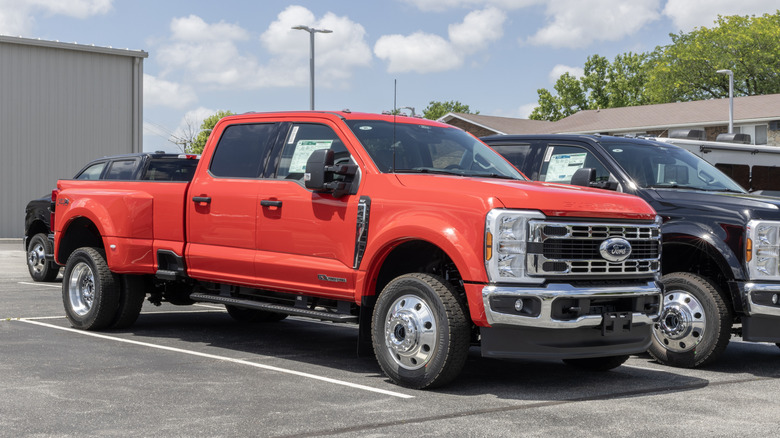
If you ever want to start an argument between diesel enthusiasts, just bring up the topic of the 6.7 Cummins and PowerStroke diesel engines and see the sparks fly. It's a rivalry as old as time itself. Both the 6.7-liter Cummins turbo diesel and Ford Power Stroke engines are titans of the diesel world, and they're known for their prodigious torque outputs, towing prowess, and loyal fan following. One is an Indiana-born straight-six engine that's a staple in Ram trucks, while the other is Ford's beloved V8 seen in its Super Duty pickups. On paper, they do share a few similarities, but there aren't many beyond their displacements.
The Cummins 6.7-liter turbo diesel was introduced in 2007 as a replacement for the 5.9-liter turbo diesel, which was a favorite among Ram pickups. You can even find it under the hood of the 2027 Ram Power Wagon, a diesel-powered off-roader. The 6.7 shared the 5.9's robust cast iron block but featured advancements in performance and had longer service intervals. The engine received an update in 2013, which boosted torque output while seeing a 10% improvement in fuel efficiency. In 2019, the fifth-generation Ram HD got a new engine block made from lighter compacted graphite iron and an updated fuel management system, which pushed peak torque to over 1,000 pound-feet.
The Ford 6.7-liter Power Stroke engine, meanwhile, was introduced in 2011 as a replacement for the 6.4-liter Navistar engines. This was Ford's homegrown V8, code named the "Scorpion" and featuring its own compacted graphite iron block alongside Bosch high-pressure fuel injection. Today, the engine pushes out close to 1,200 pound-feet of torque.
Engine design
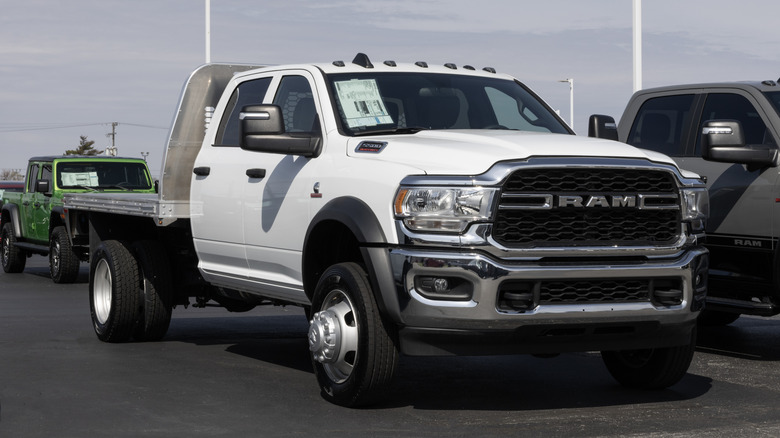
The fundamental difference between the Cummins Turbo Diesel and the Ford Power Stroke comes from the number of cylinders and the way they are arranged. The Cummins is an inline six-cylinder turbodiesel engine, which means the six pistons sit in a straight line and over a long crankshaft. Inline-six cylinder engines are some of the best-balanced, given that their piston placement inherently cancels out both primary and secondary vibrations. Since it uses fewer pistons than the 6.7 Ford V8, it has massive pistons and features a comparatively larger bore and stroke. It also offers better low-end grunt, making it ideal for towing applications. The engine layout also grants it an understressed nature, which means, with proper maintenance, Cummins power plants can easily cross one million miles.
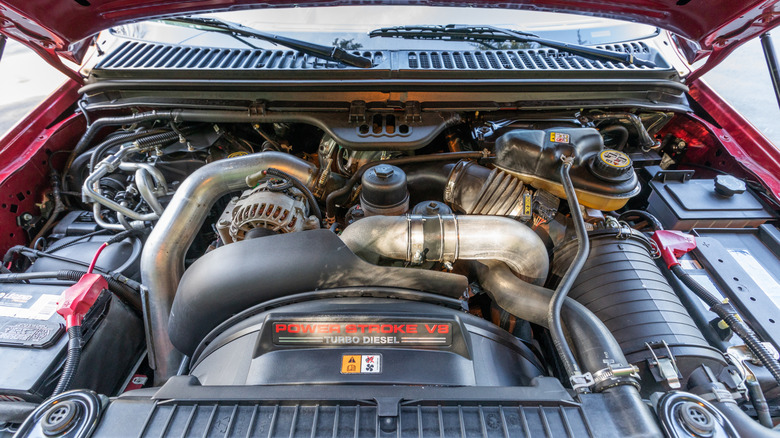
The Ford PowerStroke is a V8 turbo diesel with four cylinders on each bank and a shorter crankshaft. It's also quite a bit more complex than the Cummins. The engine features a reverse-flow header design, which is different from a traditional V8. The latter has the exhaust header on the outer side of the engine banks, while the Ford has exhaust exit from the valley of the engine, directly into the turbocharger. This reduces turbo lag and makes the engine quite responsive. While both engines run compacted graphite iron cylinder blocks, the Cummins uses a traditional cast iron cylinder head, while the Power Stroke uses more lightweight aluminum cylinder heads.
Performance stakes
In diesel vehicles, the most important stat is torque. Both 6.7 engines here deliver prodigious amounts of torque but differ in the way they deliver it, with the Ford 6.7 Power Stroke topping the performance charts. In the High Output version found on top-spec Ford Super Duty trucks, the V8 turbo diesel pushes out 500 horsepower and 1,200 pound-feet of torque. The 6.7 Cummins turbo diesel isn't too far behind on the performance stakes, though, delivering close to 430 horsepower and 1,075 pound-feet of torque. It should be noted that, despite its simplistic build, even its early iterations produced a formidable 370 horsepower and 850 pound-feet of torque.
The peak horsepower and torque numbers only tell part of the story. The Cummins engine delivers its torque over a broader rpm range thanks to its inline six-cylinder engine and turbo setup. This allows it to effortlessly pull heavy loads even on steeper gradients, while the Power Stroke does it with brute force. Its peak outputs are delivered at a slightly higher rpm with more aggressive power delivery, especially in the High Output engine configuration. When it comes to the real world, though, both engines deliver. With its extra torque output, the Power Stroke has a slight edge when it comes to maximum ratings, but that hasn't stopped people from loving the Cummins alternative.
The deep end
Reliability, longevity, and durability form the bottom line for these types of engines. The 6.7 Cummins has a long-standing reputation for bulletproof longevity. Most of that reputation is down to its simple-but-rugged engine architecture, but other considerations make it a favorite amongst long-haul fleet and heavy-duty commercial users. The inline-six configurations leave a lot of space, making repairs and diagnostics easier. These engines also use the reliable Bosch CP3 high-pressure fuel pump for the 6.7, outside of a brief period (2019-2020) where they switched to — and reverted from — the not-so-reliable Bosch CP4.2.
The early 6.7 Power Stroke engines did have some teething issues with their high-pressure fuel pumps and turbochargers. (According to owners, these are the worst years for the Ford 6.7 Power Stroke.) These engines have always used Bosch CP4.2 pumps that were known for their aversion to poor-quality fuel. The newer generation (2015-onwards) Power Stroke engines addressed most of those concerns and featured improved durability and reliability. In terms of serviceability, though, the Ford's V8 engine layout does limit easy access to certain areas. However, compared to Cummins, Ford's massive dealer network means you'll find help even in the most remote regions.
While real-world feedback pushes the Cummins ahead in the durability stakes, modern Power Strokes are pretty reliable as well. Diesel forums indicate both engines will push past the 300,000-mile mark — provided they're properly maintained. Under normal use, most users won't even reach the point of stressing these engines anyway. All they'll need is emissions-related maintenance like periodic DPF regens and EGR cooler cleaning.
Driving experience
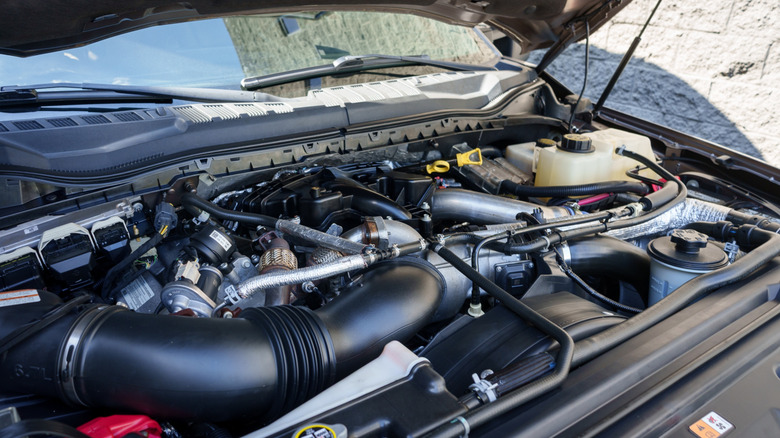
Cummins users are generally impressed by the fact that ample torque is quite accessible even at low revs, affording it the ability to pull heavy loads with minimal fuss. However, its towing speeds are held back somewhat by the lack of gears in the six-speed transmission. The Power Stroke engines feel more eager off the line due to their high power outputs and the way they're paired to the 10-speed automatic transmission, which also massively supplements their towing capabilities.
In terms of fuel economy, the Cummins engine offers comparatively lower miles per gallon while pulling heavy loads. This isn't as bad as it sounds, as some Cummins engines can even run on biodiesel. But the 6.7 Power Stroke offers better fuel economy when driving in laden and highway conditions.
As for driving experience, the Cummins' engine layout gives it an old school diesel thrum while the Ford's V8 configuration emits a rumbling growl. With their emissions control systems deleted, you'd notice that the Cummins sounds like an old-school tractor while the Power Stroke sounds like a jet engine. Overall, both engines are towing champions, but Cummins rigs feel like proper work trucks while the Power Stroke trucks feel like performance vehicles.
The better choice
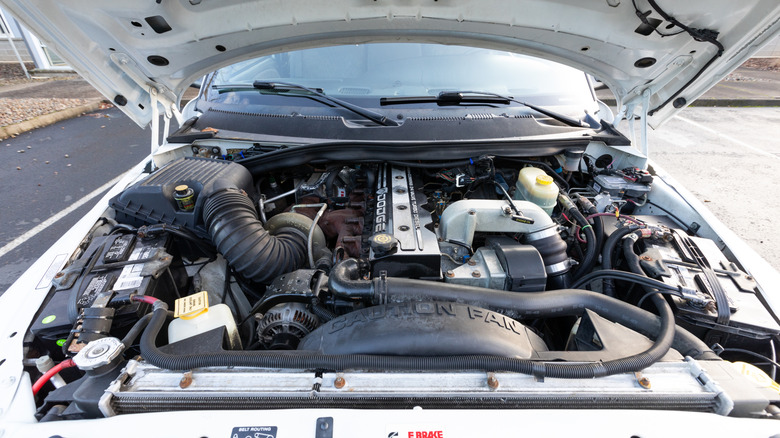
There isn't any outright champion here. The 6.7-liter Cummins Turbo Diesel has carved a reputation for itself thanks to long-haul durability and linear, effortless torque delivery under heavy load. It has a simpler engine architecture with solid internals that boast a proven track record for reliability and serviceability. The Cummins is the purist's choice of power train — a commercial engine that found its way into a pickup truck. It's slow-revving, loud, heavy, and might even outlast you.
In comparison, the 6.7 Ford Power Stroke feels like an extra-capable beast if you consider speed, smoothness, and integrated technology. Compared to the Cummins engine's raw, rugged nature, the Ford V8 is quieter and more sophisticated. The diesel V8 paired to the 10-speed transmission makes for a ridiculously fast ride, and when it comes to towing, it's an effortless experience as well.
While the Cummins feels like the Old Testament of diesel engines, the Ford Power Stroke feels like the future. If you are looking for a proven workhorse, the Cummins-powered Ram is your best bet. If you want a quick pickup truck that can also tow houses if the need arises, the Ford Super Duty should be right up your alley — even with its other compelling engine option, the gasoline-powered 7.3-liter Godzilla V8.