

4 Kei Sports Cars That Prove You Don't Need Big Power To Have Fun
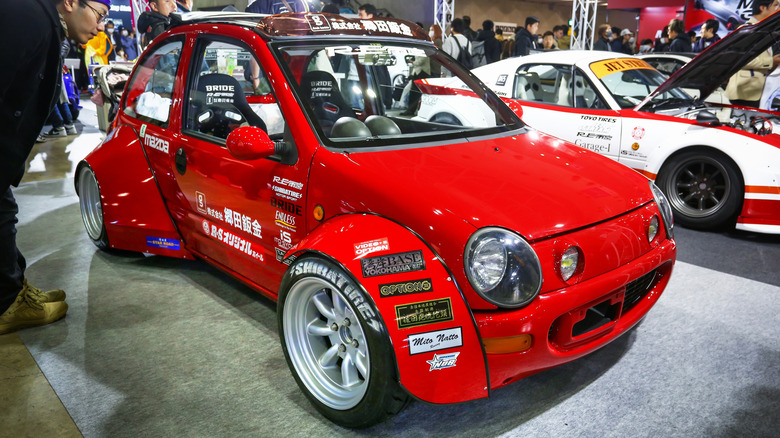
A kei car is a Japanese "light vehicle" (kei jidōsha) created under a special government classification designed to make car ownership affordable and practical in post-World War II Japan. To classify as a kei car, it needs to be up to 11.2 feet in length, up to 5 feet in width, and under 6.6 feet in height. It also needs to have an engine no larger than 660cc, with the upper horsepower limit being about 63 hp.
Inovev reports that 38% of all new cars sold in Japan in 2024 were kei cars, down a bit from 40% in 2023. Although every kei car is limited in displacement, size, and power, they're not all the same. Some are kei campers that let you live large, and others are vans and commercial vehicles. Here we're going to focus on kei sports cars that prove you don't need big power to have fun.
Honda Beat (1991-1996)
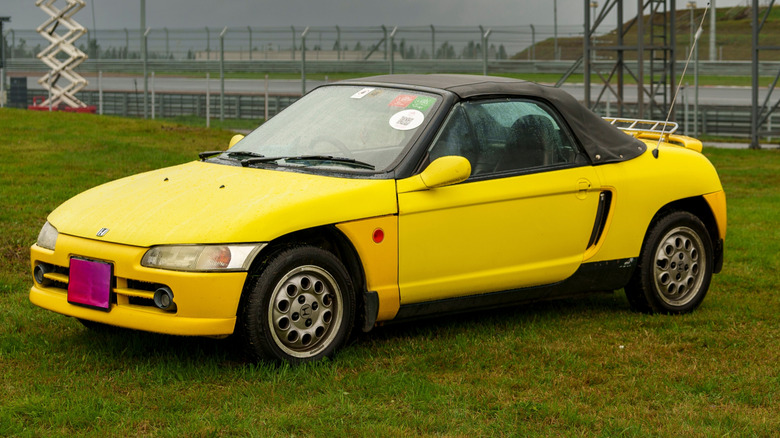
What do a little kei Honda Beat, the Corvette Z06, the Ferrari LaFerrari, and the McLaren F1 have in common that makes all four true driver's cars? Obviously it's not power, trick suspension, or 0-60 times. No, it's mid-engine placement paired with rear-wheel drive, often among the most important defining characteristics of a sporty vehicle.
Placing the engine in the middle of the vehicle dramatically improves a car's balance. This helps all of these cars feel dynamic and gives them a classic "go-kart" feel when turning. And the Honda Beat shares an additional resemblance to the three supercars: a naturally aspirated engine with a rev-happy redline. In fact, the Beat's 8,100 rpm redline is 600 rpm higher than the F1's.
The Honda Beat was able to achieve such a high redline without the massive output of its supercar counterparts thanks to its Formula 1-derived Multi Throttle Responsive Engine Control (MTREC) system. It also pairs a short-throw five-speed manual gearbox with hydraulic rack and pinion steering. This gives it a level of tactile engagement that recalls the connected, mechanical feel you get in a McLaren F1 — just on a delightfully tiny kei-car scale.
The Beat was designed by none other than Pininfarina, a design company known for designing some of the greatest Ferraris of all time. Although it's not what you'd call fast, Jalopnik alum Doug DeMuro noted that "you kind of get the feeling like you're going fast," which often is enough to have fun. Another of our former writers even called the Honda Beat the best car she's ever owned.
Suzuki Cappuccino (1991–1998)
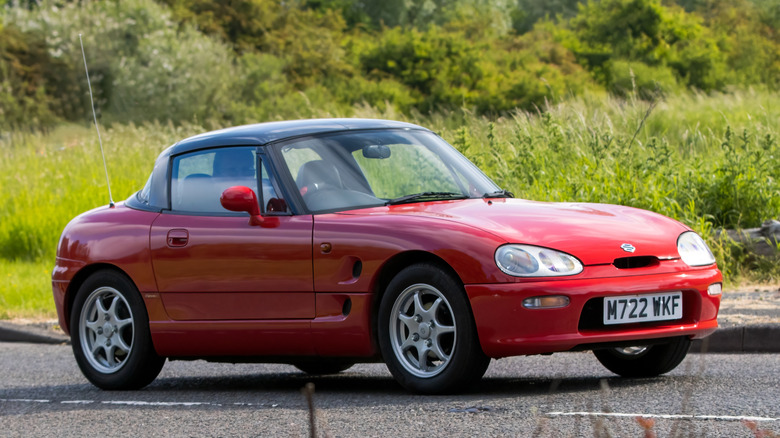
The Suzuki Cappuccino goes about delivering its fun a little differently, and also has one of the best names in the kei car universe. It's a longitudinally mounted, turbocharged front-engine kei car that still manages to achieve a near perfect 50:50 weight distribution. The Cappuccino also offers rear-wheel-drive and a short-throw five-speed manual gearbox. Thanks to front aluminum double-wishbone suspension, a multi-link rear, optional limited-slip differential, and a non-power-assisted rack-and-pinion steering, the Cappuccino communicates every input to the driver.
The Suzuki shows an 8,500-rpm redline on the tach, but it can go a lot higher than that. Tuned Suzuki Cappuccinos were even able to reach 11,000 rpm, sounding like a motorbike in the process.
The Cappucino is lightweight at 1,675 pounds, with a wheelbase that's just 6 feet 9 inches (the Mazda MX-5 has a 7-foot-7 wheelbase), and that makes it nimble and incredibly responsive. Compared to the Honda Beat, though, the Cappuccino is a bit more subdued, so it's more comfortable to drive on a daily basis. Later Cappuccino models got a revised alloy-block engine, power steering, and an automatic transmission that made them still easier to use for mundane tasks.
During a review of a Suzuki Cappuccino on the Zygrene channel, YouTuber Fenton said, "I just love the high- revving small rear-drive cars ... just a blast to drive." That encapsulates why the Suzuki Cappuccino — along with the other kei cars here — belongs on this list.
Autozam AZ-1 (1992–1994)
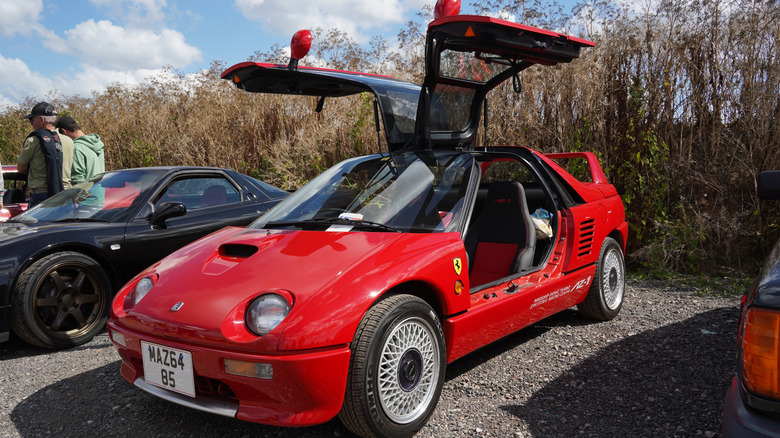
One of the wildest, quirkiest and most dynamic kei cars is the Autozam AZ-1. It features gull-wing doors, a mid-engined configuration, rear-wheel drive, and a turbocharged three-cylinder engine. It also has a five-speed manual, a 7-foot-8-inch wheelbase, and a 9,000-rpm redline. But suspension is where the AZ-1 shines. A MacPherson independent-strut suspension with four-wheel disc brakes and a mechanical limited-slip differential mean the AZ-1 is as darty as cars come.
The cool story about the Autozam AZ-1 is that it was basically a joint effort by Suzuki and Mazda. Suzuki envisioned the AZ-1 but didn't have the capacity to follow up, so Mazda stepped in and introduced the AZ-1 through its Autozam subbrand. When it comes to driving enjoyment, Doug DeMuro says it outshines both the Beat and the Cappuccino: "The AZ1 is definitely the coolest, and in my opinion the AZ1 drives the best."
Moreover, the Autozam AZ-1 is also the rarest of the bunch, by quite a margin. MotorTrend reported that 4,392 Autozam AZ‑1s were built (plus an additional 531 badge‑engineered Suzuki Cara models), versus 28,000 Cappucinos and over 33,000 Beats. With no further ado, here are a few sweet Autozam AZ-1 photos to enjoy.
Suzuki Alto RS-Z (1994-2000)
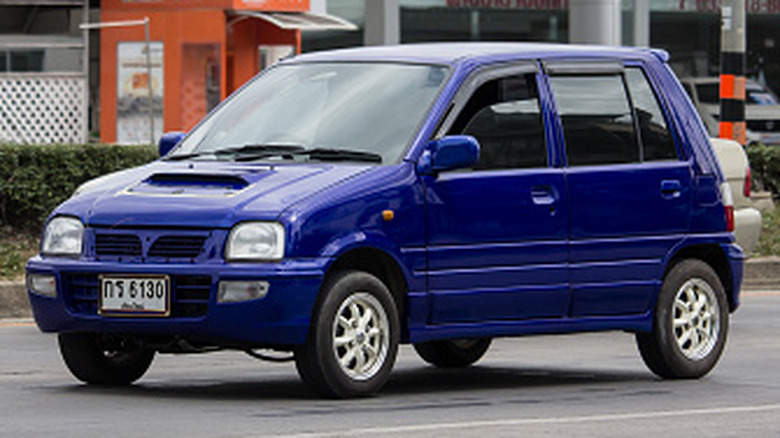
If you want a sports car experience without the roadster styling of the AZ-1, Beat, and Cappuccino, the Suzuki Alto is a perfect "pocket rocket." Out of all of the versions of the Suzuki Alto, the Suzuki Alto Works RS-Z is the driver's choice. It follows a similar outline as the other three: an 8,000-rpm redline, only 1,477 pounds, front-engined, short-throw five-speed, front-wheel drive (AWD was also available), power-assisted steering, and McPherson struts.
The Alto measures a longer wheelbase of 7 feet 9 inches, which makes it more stable at speed. It's powered by a Suzuki K6A water-cooled turbo engine, similar to the one in the Cappuccino. ATL JDM, an Atlanta-based importer of Japanese Domestic Market cars, described the K6A as the "Suzuki's holy grail in K engines." The "Works" trim Alto also got wider performance tires, KYB shock absorbers, ventilated disc brakes, and a rear stabilizer bar, all of which helped make it dynamic, quick, and fun to drive.
One of the best things about the Alto RS-Z is the strong aftermarket support that remains available through Monster Sport. And one of the reasons the Alto is popular outside of Japan is that it was prominently featured in multiple Gran Turismo videogames. For gamer petrolheads growing up, Gran Turismo was often their first introduction to this tiny but spirited kei car.