

Why Did Japanese Automakers Start Taking On European Luxury Brands At Their Own Game?
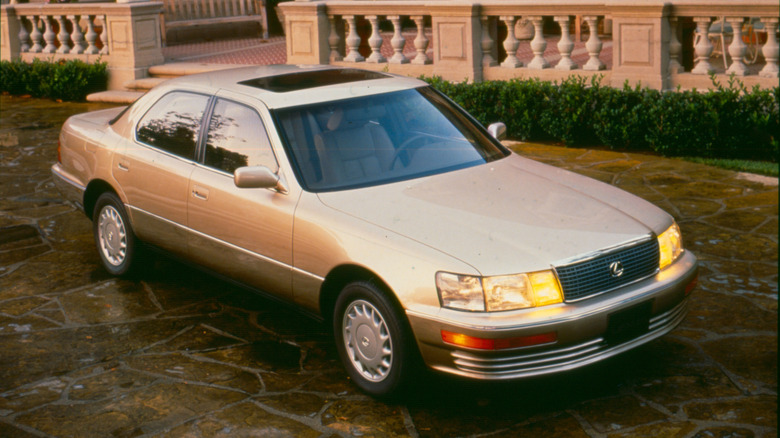
After overcoming initial skepticism as purveyors of cheap products thanks to years of honing a reputation for reliability, Honda, Nissan, and Toyota chose to launch upstart luxury brands for the American market in the late 1980s. Was it to counter the Europeans, to keep brand loyalists in the family, or an opportunistic outgrowth of unique economic conditions? In fact, the answer to all three questions is "yes."
The European game we're talking about starts with auto importer Max Hoffman. He introduced Jaguar, Alfa Romeo, BMW, Porsche, and Mercedes-Benz to the U.S. after World War II as desirable, sporty, mass-market alternatives to American cars. Flash-forward to the 1980s and BMW, Mercedes-Benz, and Porsche were competing for yuppie headspace, while Saab and Volvo brought some of your favorite Swedish cars to the posh party. Meanwhile, American car companies mired in a hot mess of quality shortfalls, layoffs, and possible bankruptcy. As the Europeans set the luxury market, take rates for small, affordable Japanese cars exploded. American University notes that Japan owned 9% of the U.S. car market in 1976, with that percentage increasing to 22% by 1982.
To help stabilize the U.S. auto industry, the White House in 1981 negotiated with Japan an escalating three-year Voluntary Export Restraint (VER) that started by capping Japanese car imports at 1.68 million vehicles per year. Within four years, VERs would lead directly to Acura, Infiniti, and Lexus being formed.
Japanese luxury starts with 'A'
Acura came first. While the American Big Three got their acts together, Japan's automakers had to build plants in the U.S. to accommodate the export restraints, which Japan continued to adhere to until 1994 – a decade beyond what they were bound to. Export limits, it turned out, didn't stifle American demand for their cars, so Japanese automakers simply raised their prices and started stuffing optional luxury equipment in as standard fare.
The Voluntary Export Restrictions gave Japanese manufacturers proof that people would pay more for their cars. But small cars meant lower profit margins, and VERs had unexpectedly funded the way for these brands to move upmarket. Honda realized that an Accord with leather seats wouldn't cut it in the U.S. when customers wanted to move up to something that was more powerful, luxurious, and prestigious — like a BMW, Mercedes-Benz, or Audi. Luckily, in 1981, Honda already had just such a car in the works.
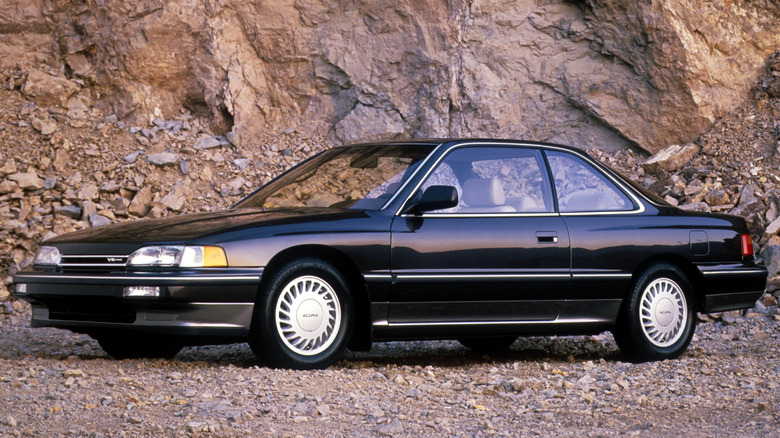
That car would become the 1986 Acura Legend. The JDM Quint-Integra would go on to join it in showrooms as the Acura Integra. Honda became the value brand, while the Acura division brought luxury and performance to the house and was priced to match. Acura quotes Volvo North American president on the day Acura opened up: "With all due respect to the tremendous quality of low-priced Japanese automobiles," he said, "I don't think they will ever be able to penetrate the U.S. luxury market." And yet, one year later, Acura outsold the Europeans.
Resetting the luxury standards
Like Hoffman had done, Acura presented an alternative idea of luxury in a sporty package — albeit somewhat modestly, with V6 power and front-wheel drive. Then, the original 1990 NSX came for Ferrari and Porsche, and it made heads spin with its capability. In part, folks were receptive to Acura's fusion of Honda reliability with upscale execution because the Europeans had become notoriously complex machines. Other Japanese brands like Toyota followed this simplicity — and Toyota also knew a thing about luxury.
When the all-new Lexus LS400 and its silky V8 arrived in 1989 as a 1990 model, it shattered expectations at about $35,000 (nearly $90,000 today), which was less than a comparable Mercedes 420SEL. While Honda sidestepped elevating U.S. market Accords, Lexus gussied up Camrys to create the ES 250, which made for a perfect stepping stone from Toyota to Lexus.
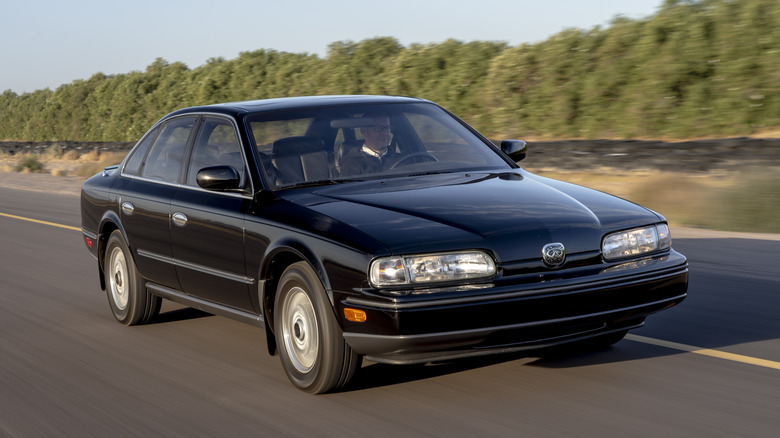
After two years of development, also flush from the VER windfall, Nissan launched Infiniti in 1987. Its understated 1989 Q45 flagship, with its V8 and sporting pretensions, split the difference between Acura and Lexus. It was paired with the M30 Coupe based on the JDM Nissan Leopard. Today, still alive and kicking with performance DNA, the 2028 Infiniti Q50 might even offer a manual transmission. The other Japanese luxury brands are established veterans, as well, and Genesis has charted its own ambitious course in the luxury game. Meanwhile, Toyota has indicated that Century will soon become its own brand above Lexus, aimed directly at Rolls-Royce.