

Mars Rover Can't Escape AI Even On A Whole Separate Planet
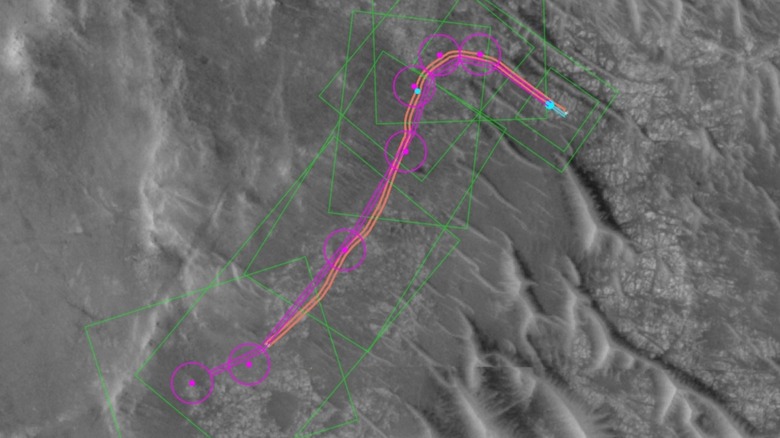
AI is coming for our jobs, and now we can add "Mars Rover Driver" to that list. Last month, the Perseverance rover successfully drove not one, but two trips across the Martian surface planned by AI rather than humans. Even better, the rover lived to tell the tale. From NASA:
NASA's Perseverance Mars rover has completed the first drives on another world that were planned by artificial intelligence. Executed on Dec. 8 and 10, and led by the agency's Jet Propulsion Laboratory in Southern California, the demonstration used generative AI to create waypoints for Perseverance, a complex decision-making task typically performed manually by the mission's human rover planners.
We're not talking about autonomous driving here. We already know that Perseverance is much better at that than Earth cars. We're talking about the meticulous route planning that goes into the rover's movements. Without it, the $2.7 billion rover could crash into a boulder, flip over on uneven ground, or get stuck in a sand trap like the Spirit rover did. That's not a good look for NASA's precarious budget.
Driving the rover remotely in real time isn't possible due to the vast distance between the planets. Even at the speed of light, it takes anywhere from four to 24 minutes for radio signals to reach Mars, and that much time again for signals to return to Earth. Typically, human route planners carefully study all available photos and terrain data of the Martian surface to determine the safest route from point A to point B, upload the route to the rover, and then execute it. In this case, the Jet Propulsion Laboratory ran the data through Anthropic's Claude AI to plan the route.
Where we're going, we don't need roads
NASA didn't just blindly upload the route to the rover and hope for best. After all, AI models are eager to launch nukes in war simulations, so engineers needed to make sure the route wasn't going to yeet Perseverance over the edge of Jezero Crater, maliciously or accidentally. JPL has what it calls a "digital twin" of the rover, a virtual recreation of its programming so that it can test commands to see what will happen before sending them to the real rover. It tested the AI program thoroughly, over 500,000 variables, to make sure it would work as intended on the Martian surface.
On December 8, Perseverance successfully drove a 689-foot AI-generated route. On December 10, it drove another 807-foot route. The rover's autonomous driving systems deviated slightly from the planned route based on real-world data it gathered along the way, but overall the routes worked successfully. From NASA:
"Imagine intelligent systems not only on the ground at Earth, but also in edge applications in our rovers, helicopters, drones, and other surface elements trained with the collective wisdom of our NASA engineers, scientists, and astronauts," said Matt Wallace, manager of JPL's Exploration Systems Office. "That is the game-changing technology we need to establish the infrastructure and systems required for a permanent human presence on the Moon and take the U.S. to Mars and beyond."
Other worlds have their hazards, but human astronauts drove rovers on the moon long before AI was the buzzword of the week, because they were there and could apply human driving skills to the task. Off-world robot drivers also don't have felony stops to roll through, stopped school buses to blow by, or children running out in front of them (unless there are alien children we haven't discovered yet). As much as we joke about AI stealing the route planners' jobs, it would make sense for a rover to be capable of scanning the area and using that, plus existing map data, to plan its own route without waiting for "drivers" on another planet to tell it what to do. It would certainly speed up travel, as JPL says.