

2 Signs High-Mileage Diesel Owners Should Get On This Overlooked Maintenance Task

Diesel-powered vehicles are usually quite specialized. There was a time when the fuel was really getting pushed, and although many automakers trialed it as a mainstream fuel, the industry — in the U.S., at least — soon decided that diesel was really best-reserved for full-size trucks. While they're little agricultural in their sound and in how they perform, diesel engines are incredibly durable and offer great amounts of torque, making them perfect for hauling and towing. As such, diesel-powered trucks often get used hard, piling the miles on as dependable workhorses.
Keeping on top of routine servicing is necessary to ensure your engine continues to operate as smoothly as it should be. But there is one job which you won't see laid out in the truck's service plan: Cleaning the intake manifold. As the miles get piled on, carbon and soot build-up will restrict the manifold's airflow, which could harm both your truck and its performance.
This airflow restriction happens primarily due to the Exhaust Gas Recirculation (EGR) valve, which is a standard emissions-reducing advice fitted to modern trucks. The EGR valve takes a portion of the exhaust gases and reintroduces them into the combustion chamber via the intake manifold. This reduces harmful emissions and can even improve fuel economy, but it also invites that thick layer of carbon into the intake. You don't need to pry off your intake manifold at each service to see how it's handling itself. Instead, try looking out for reduced performance or fuel economy, which are signs that it needs to be cleaned.
Reduced performance is a clear sign that your intake may need cleaning
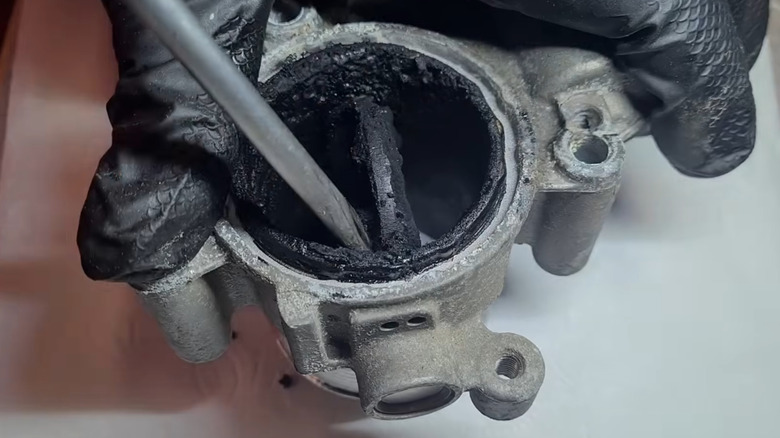
The intake manifold channels air into your engine. If the intake manifold is compromised due to having a thick layer of carbon on the inner walls, then less air will be able to get in. This will have a direct effect on how your truck moves down the road. It might start to feel sluggish, you might need to work it harder to maintain steady speeds on highways, and you might notice the truck feeling far more strained as you try to accelerate.
Sure, there are a whole heap of reasons as to why your truck might not be performing as strongly as it used to. But if no engine codes are showing and you're struggling to diagnose the issue, this could be the answer. A clogged manifold is also commonly accompanied by a lumpy idle as the engine struggles to intake the correct and desired amount of fresh air, so that could be another sign that your intake manifold might need cleaning.
Fortunately, cleaning the manifold is usually not a very difficult job to carry out, although it can sometimes be time-consuming. If a new intake manifold is cheap enough, you might consider just fitting a new unit instead of refurbishing your old one. It's suggested that intake manifolds will need cleaning every 30,000-45,000 miles as an estimate, so this isn't something you'll need to be worrying about with every oil service or inspection.
Sinking fuel economy figures could mean your intake needs some attention
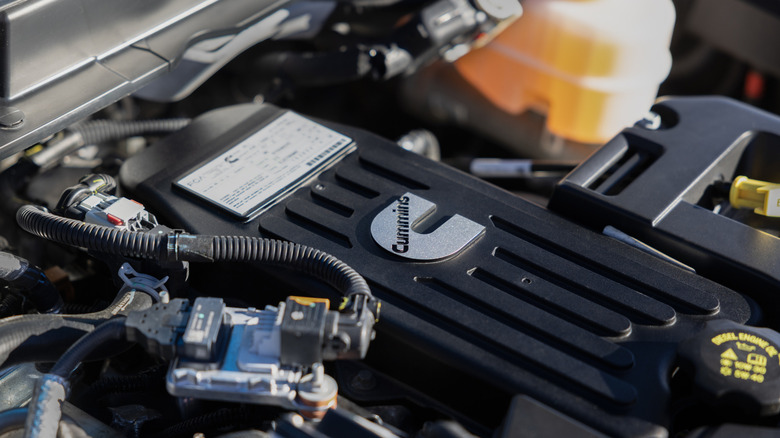
Many diesel truck owners will cover heaps of highway miles each and every year, so a drop in fuel economy is likely to be noticed. While a clogged intake manifold doesn't directly change your vehicle's fuel consumption, if performance is reduced and acceleration is sluggish, then you'll likely begin working the engine harder just to maintain comfortable speeds.
If you're noticing that fill-ups are becoming a little more frequent, and that your monthly diesel bills and climbing ever-higher (which is especially noticeable, seeing as how diesel fuel is more expensive than gas), stop and consider the last time your intake manifold was cleaned. There are numerous ways in which you can clean the manifold, with some involving the removal of the unit. Not every method requires this, but if you want to ensure a thorough job was carried out, removing it will let you physically see when all the carbon and grime has been removed.
If the cleaning has been successful, you should immediately know during your next drive. Your idle will have been restored, the truck's performance will be back where it should be, and you will hopefully notice an improvement in fuel consumption. Though, you might need to wait for muscle memory to wear off so you're no longer flooring it just to get around.