

3 Compact SUVs Consumer Reports Rates Higher Than Honda's 2026 CR-V
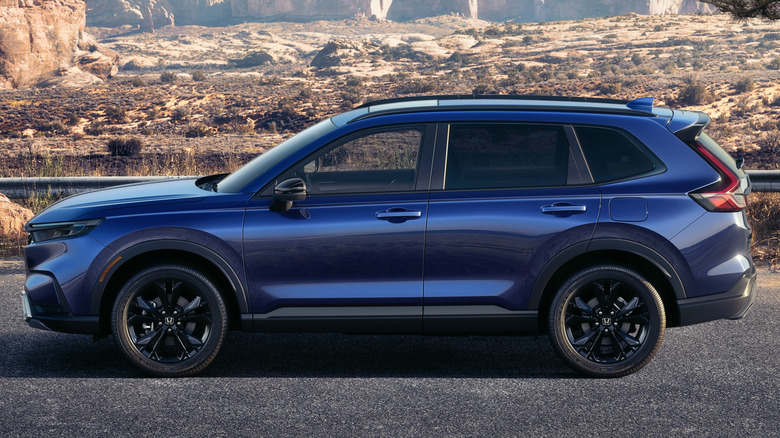
The Honda CR-V continues to be a popular choice if you're looking for a compact SUV, as it was the second-best-selling ride in the segment for 2025 — and the 2026 edition improves things further, in the form of the Honda CR-V's TrailSport Hybrid trim that's new for the model year. Our Logan K. Carter summed his experience up by saying the CR-V "remains one of the most refined, composed, spacious, and user-friendly options in the compact crossover segment."
But that segment is filled with good choices. For instance, Consumer Reports recommended both the hybrid and non-hybrid 2026 CR-V, but it did the same for 20 other compact SUVs. The magazine even published an article called "5 Reasons Not to Buy a Honda CR-V Now" in the summer of 2025, after the 2026 CR-V debuted. The bottom line was that while the Honda can still make sense, it has a few drawbacks compared to today's impressive crop of compact SUVs.
Which brings us to the only rivals to outscore the higher-scoring CR-V, the hybrid model. We think there were three: the Subaru Forester, Toyota RAV4, and the Mazda CX-5. Consumer Reports — because it treats hybrids and non-hybrids as different models — lists four: the Subaru Forester Hybrid, Subaru Forester, Toyota RAV4 Plug-in Hybrid, and Mazda CX-5. We'll cover all of them, noting that the overall score of the non-hybrid CR-V was lower than for 10 of its compact SUV rivals.
2025 Mazda CX-5
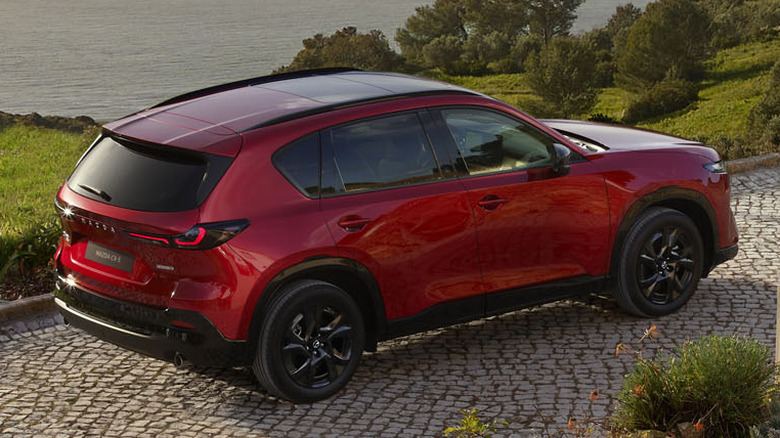
First off, keep in mind that Consumer Reports hadn't tested the 2026 Mazda CX-5 when its rankings were published, instead listing the 2025 model. Checking the tale of the tape between it and the gas-only CR-V tells us a key difference between them is their predicted reliability. The Mazda CX-5 had the best results in the class in this measure, which is based on Consumer Reports' annual membership survey covering hundreds of thousands of vehicles. Nor was the CR-V exactly close behind, since its CR predicted reliability score was nearly 25% lower than that of the CX-5.
That said, it was the CR-V with a noticeably better driving experience despite any lingering zoom-zoom capabilities from the Mazda. They did have about the same owner-satisfaction grades, though.
The 2026 CR-V also will have to contend with an all-new CX-5 when Mazda moves its small SUV to the next model year. Only the 2026 Mazda CX-5 won't be quite as small as before. Among the many things being changed is the CX-5's length: Its overall length and its wheelbase each grow by about 4.5 inches. What may confuse shoppers is that the CX-5, despite its new length (184.6 inches) and low-ish starting price — $31,485 (including destination) — is still more expensive than the slightly larger CX-50 at 185.8 inches and $31,395 (again with destination).
2025 Toyota RAV4 Plug-in Hybrid
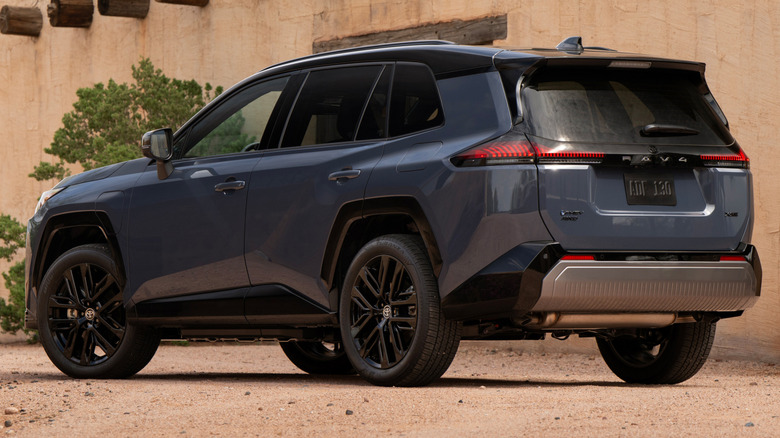
As with the Mazda CX-5, the Toyota RAV4 Plug-in Hybrid was a model year behind for Consumer Reports testing when its story was written, so we're comparing the 2025 Toyota to the 2026 Honda. And this time we're using the CR-V Hybrid as our benchmark since Honda doesn't sell a plug-in version.
The RAV4 Plug-in had a slightly higher overall score, driven by better grades for both reliability and customer satisfaction. While only one other compact SUV outscored the RAV4 Plug-in for predicted reliability — the Mazda CX-5 — the CRV Hybrid ranked in a tie for 9th place in this measure, on par with the Buick Envision. Significantly more RAV4 Plug-in owners would go back and repurchase the vehicle again, based on their current vehicle's history, than would re-buy the CR-V Hybrid, too. (That's how CR measures overall customer satisfaction.)
The reason the CR-V Hybrid keeps its overall score so close to the RAV4 Plug-in's is the Honda's healthy advantage on the road. Part of this no doubt had to do with the Toyota's brakes, which CR described as "touchy" and delivering stopping distances it considered "a bit long," but the CR-V Hybrid earned plenty of praise, too, with the second-best road-test scores in the segment. No. 1 was the 2026 Hyundai Tucson Hybrid, which was a point ahead of the CR-V Hybrid for driving experience and tied with it for overall score.
The future looks bright for both RAV4 hybrids when the 2026 models do go on sale. Our Daniel Golson says they don't innovate but should continue to dominate.
2026 Subaru Forester
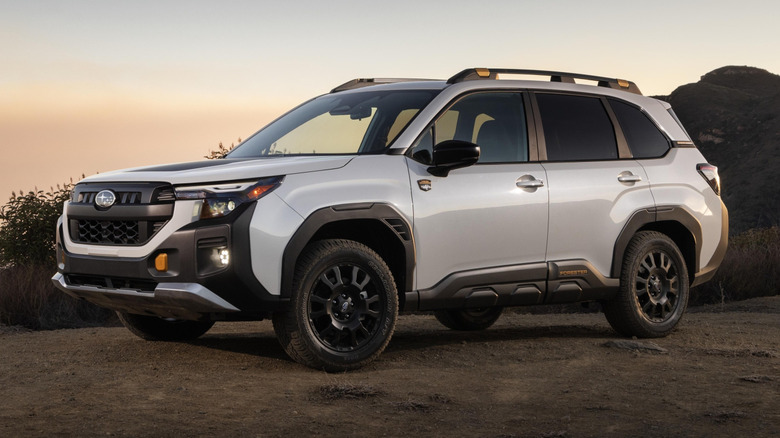
Since Consumer Reports considers the same models with different power trains distinctly different vehicles, it's no surprise that it follows this template with the 2026 Subaru Forester — owner of the second-best overall CR score among compact SUVs. (That means the Forester Hybrid, No. 1 in the rankings, is covered below.)
Subaru's position at the top of the compact SUV segment makes sense, of course, as it was also the top name in the industry on CR's list of brands that make the best cars. The gas-only Forester stands out with an overall score and road-test results a few points higher than those for the gas-only CR-V, but the outcome was the other way around when comparing predicted reliability. The main factor distinguishing the two, according to Consumer Reports, was owner-satisfaction — there, the Forester clocked in with a double-digit points advantage over the CR-V. Drilling down yet further, the Forester additionally out-pointed its Honda rival in the specific sub-categories of driving experience, comfort, value, and styling.
The Forester has a fairly major edge in pricing as well. The entry-point for the Subaru is $31,445 with standard all-wheel drive (destination included), but a similarly equipped CR-V will set you back $33,870 (destination included). In fact, the AWD Forester is less expensive than the front-wheel drive CR-V that opens at $32,370 (again, with destination).
2026 Subaru Forester Hybrid
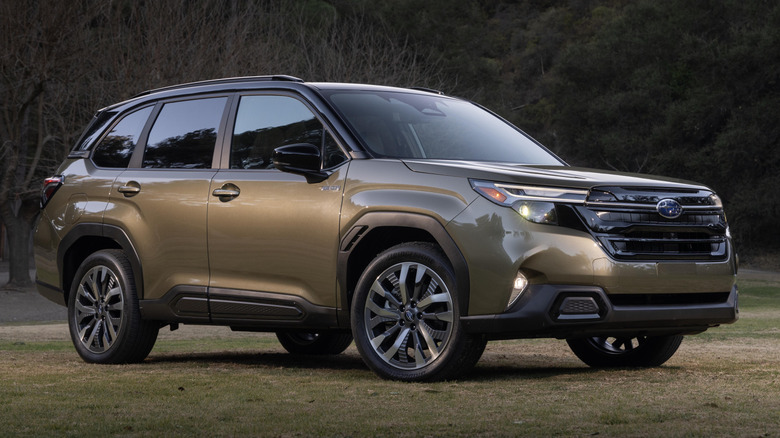
Before seeing how the 2026 Subaru Forester Hybrid stacks up against the CR-V Hybrid, let's take a quick peek at how it matches up with the gas-only Forester in a few relevant aspects. That current-generation non-hybrid Forester comes with a 2.5-liter four-cylinder boxer-style engine making 180 horsepower with EPA ratings of 26 mpg city/33 mpg highway/29 mpg combined. The Forester Hybrid adds an electric motor to raise output to 194 horsepower with an EPA line of 35/34/35.
From a Consumer Reports perspective, it's the No. 1 compact SUV for overall score versus the No. 5 CR-V Hybrid (which was actually in a fifth-place tie with the 2026 Kia Sportage Plug-in Hybrid and the Hyundai Tucson Hybrid). The main contributor to the CR-V's lower overall score? There was actually a common thread running though all our Honda CR-V comparisons today, and it was weak owner-satisfaction grades.
The CR-V, hybrid and non-hybrid alike, didn't just trail today's entire quartet of key rivals for overall score, it trailed all but the Mazda CX-5 for owner satisfaction as well. Zeroing in on the Forester Hybrid and CR-V Hybrid shows a fairly typical outcome: The two vehicles earned very close scores for road tests and predicted reliability, yet the Subaru had a double-digit lead when it came to keeping owners satisfied.
Although this may come as a shocker, the CR-V hydrogen fuel-cell vehicle isn't doing much to help in the happiness department. For some reason, Consumer Reports hasn't tested the latest Honda CR-V e:FCV, but the automaker recently had to recall 388 of them for potentially leaky fuel-cell stacks.