

Mopar's 5.9-Liter Magnum Vs. HEMI V8: What're The Differences?
"Hey," you're thinking, "one's got hemispherical combustion chambers, and the other doesn't. Case closed!" Congratulations, yes, that's the biggest difference. But maybe you're wondering why wedge-head Magnums generally make less power or, say, whether it's cheaper to go with a modded Magnum or stuff your Dodge Dakota 5.9 R/T or Jeep Grand Cherokee 5.9 Limited full of Gen-III Hemi (let's stick with the similar-displacement 5.7 Hemis for comparison's sake).
Speaking of cheaper, that brings us neatly to the other most important difference: cost. There's a reason Hot Rod referred to the Mopar 360-cube Magnum V8 as a "junkyard jewel." What started as a cheaper alternative to the larger 383 B-series, and the de facto successor to the 340, became Chrysler's go-to small block V8 to muscle up an otherwise boring truck or SUV (it's how we got the Dodge Li'l Red Express pickup).
That "cheaper" part hasn't gone away, either. You can pick up 5.9 Magnum long blocks for as little as $1,700, and possibly less than $1,000 if you check scrapyards. Heck, ATK sells remanufactured long block 5.9s that will get you over 310 hp and 400 pound-feet of torque for around $2,800. Meanwhile, a remanufactured Hemi long block from someplace such as Powertrain Products Inc. is around $3,600, and anything under $4,000 is considered cheap for a Gen-III Hemi.
Buying a higher-horse crate motor reveals even more stark price differences. Performance Unlimited has a 450-hp 5.7 Hemi that'll run you north of $14,000, while BluePrint Engines carries a 408-cube Magnum stroker with 465 hp for about $10,000. Factor in also that these engines use different motor mounts, so you'll have to use a conversion kit if you retrofit a Gen-III Hemi in place of a Magnum V8, and you're likely going to need a standalone wiring harness, too.
Okay, let's talk wedge vs. hemi chambers
Let's address this first; non-Magnum 360s (1971 to 1992) are about 80% different from 5.9 Magnums (1993 to 1998), though they can trade their stock nodular iron cranks and cast pistons. The cranks can handle up to 600 hp, and the stock rods are stout forged steel. 5.7 Hemi cranks are also nodular iron, but the pistons are hypereutectic and the rods are powdered metal. Both engines use iron blocks, though Chrysler considered making Hemi blocks aluminum.
The reason 5.9 Magnums make 230 to 260 hp and 300 to 345 lb-ft, but 5.7 Hemis make 330 to 395 hp and 375 to 410 lb-ft is largely the efficiency of hemispherical chambers. Higher-horse 5.7s also use variable valve timing (VVT; more on that later). 5.7 Hemi compression ratios are higher, too, at 9.6:1 to 10.5:1, while Magnums are 9:1.
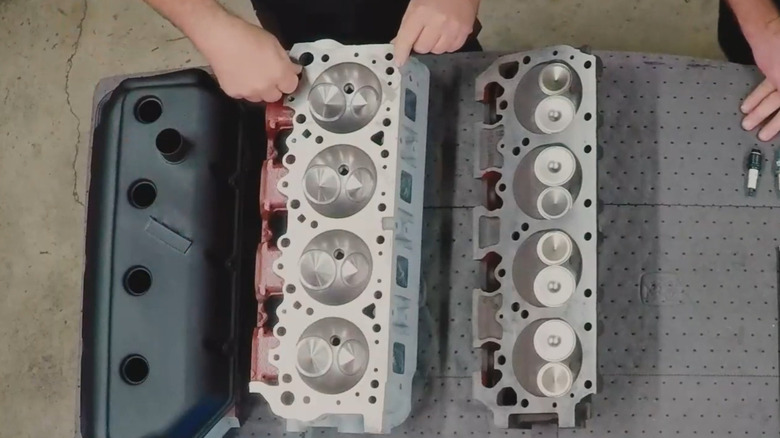
Yes, Gen-III Hemis aren't "true" Hemis because the chambers aren't half-grapefruits like those Gen-II heads in the above image, but Gen-IIIs still have that crossflow just-used-nasal-spray clear breathing. Hemispherical chambers allow for two massive valves, and those valves are splayed out so they both open away from the cylinder wall, which lets air sprint through with alarming haste. They also have 16 spark plugs to the Magnum's eight to get a more complete burn.
Magnums have wedge-shaped chambers with two parallel vertical valves. This design is less complicated and more compact, but more prone to detonation, than Hemis. That's because modern emissions-conscious wedge-shaped chambers have less quench area, which leads to higher head temps. Gen-III Hemi chambers have quench pads and less surface area relative to the chamber's volume than wedge chambers, which means less heat escapes the cylinder as wasted energy, instead staying in the chamber to increase pressure during combustion.
March of technology
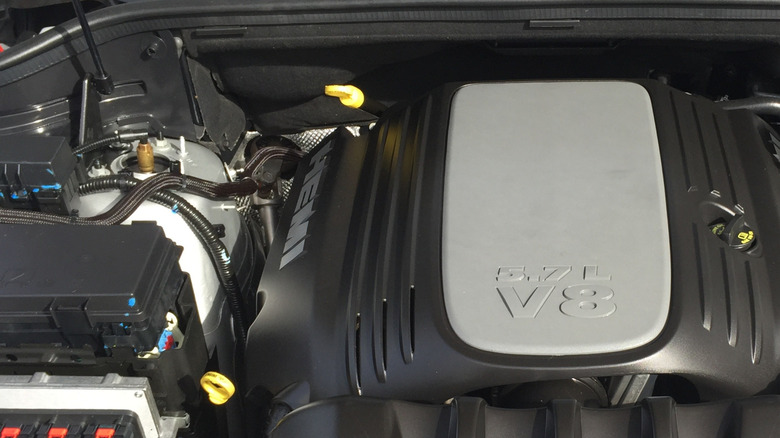
The Gen-III Hemi is much newer than the 360 Magnum and has more modern tech. While 2003-to-2008 5.7 Hemis don't have VVT and 2009 and newer 5.7 Hemis do, most have a multi-displacement system (MDS). MDS can be deleted, but from the factory, it shuts off four cylinders under light loads to improve fuel economy. The 5.7s with manual transmissions don't have MDS, nor do early truck versions.
VVT in the '09-and-up Hemi uses a camshaft phaser to adjust timing. It doesn't alter cam profiling, but rather the amount of the air/fuel mixture the engine allows into the combustion chamber. The 5.9 Magnum has no such tricks. It also doesn't have a valve seat dropping issue, but it seems Chrysler fixed that beginning with the VVT Hemis.
As long as we're addressing heads, Magnum heads from the factory are heavy cast iron, while Gen-III Hemi heads are lighter aluminum. And yet the Magnums weigh in the 500-to-550 pound range, and Hemis are 560 or so. Sorry, Hemis, your cons include a complex valve train that necessitates wider heads, resulting in more weight. Still, while Hemis may be famous for their width, too, a reputation largely thanks to the 426, people who've measured the engines have found that 5.7 Hemis are 26 inches wide and 360s are 25 inches wide.
245-or-so horsepower may sound quaint now, but in 1998 the 5.9 Magnum was an omen that a new horsepower war was afoot:
It helped push the Jeep Grand Cherokee 5.9 Limited to 60 mph in 6.8 seconds that year, while a contemporary Mustang GT was just two-tenths quicker. The 2003 debut of the 330-plus-horsepower Hemi spelled the Magnum's doom, but the modern Gen-III monsters owe a debt of gratitude to their wedge-headed forebears.