

Before Tire Companies Made Tires For Drag Racing, Drag Racers Had To Get Creative
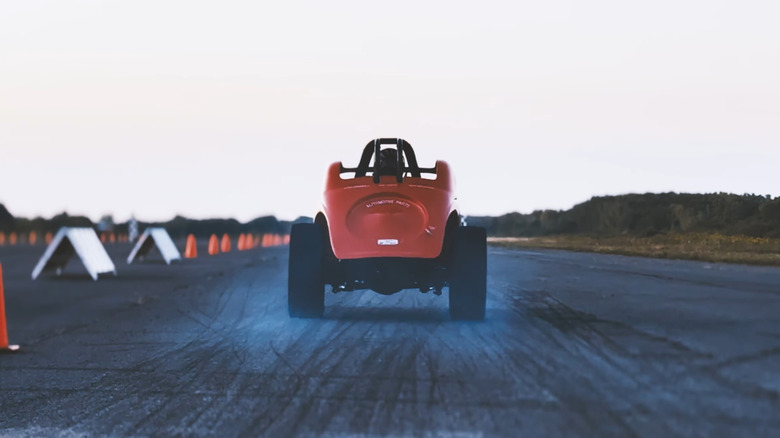
In 1952, the brilliant Rod & Custom magazine writer Roger Huntington did some math to figure out the quickest possible quarter-mile time drag racers would ever achieve: Just 9.1 seconds at 166 mph. He has since been proved wrong, of course, but as a member of the Society of Automotive Engineers (SAE), it's not as if Huntington was unable to understand the capabilities of drag cars and the technology involved. His prediction was based on a thorough understanding of one of the most essential ingredients for maximizing acceleration: tires.
At the time, assuming a traction coefficient of 1.0 G was perfectly logical, as that's all the tires were capable of. There was no PJ1 Trackbite, no Goodyear drag slicks with sidewalls that wrinkled like Shar Pei skin, and certainly no tires wide enough to shroud your average home's water heater from top to bottom. In that era, tires were skinny, hard, and came with zig-zag treads that hurt traction at the strip.
The real mistake that Huntington made wasn't failing to account for then-non-existent stickier tires, but underestimating the lengths people will go for ultimate speed. One popular tactic in the early '50s was simply carving away tire treads to create a flat, even surface. This led to incredibly uneven thicknesses of hard rubber around the cords, though, so then drag racers turned to having tires retreaded, or "recapped." An early source for recapped tires was Arizona's Bite By Bruce or Inglewood Tire Sales, which would wrap tires in more uniform, higher-quality slick rubber. But even without sipes or grooves in the road-grabbing part, there was still the problem of unyielding tire compounds.
Oh, drag racing rubber, you old softie
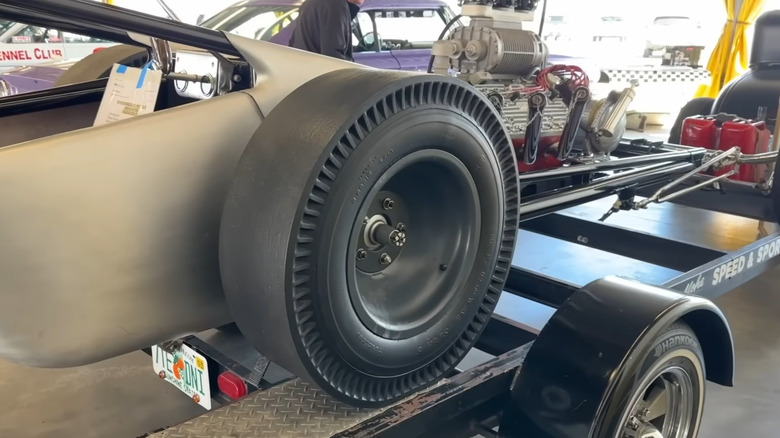
According to drag racing pioneer Tom "The Mongoose" McEwen, drag racers tried wiping down tires with gasoline to soften the rubber prior to a launch. Everyone knew hard tires were a hindrance, but racers were stuck with what was available. Worse, the stiff "piecrust" shoulders that widened the tread following the recapping process made the tire profile too square, and under launch, the shoulders were the only parts of the tire that would bite. McEwen went to work recontouring his tires to give them the bulged-in-the-middle shape slicks have today, making the tires grip throughout the width of the tread surface. But what drag racers really needed were gooier rubber compounds.
Then came Marvin Rifchin, a stock car racing enthusiast who figured poor-performing recapped tires should go extinct. He was working for Denman Rubber in the mid 1950s, and managed to convince his boss to take a passenger car tire mold, strip off its treads, and pour in soft oval track racing rubber. The result was so effective, Marvin partnered with his father, Harry, to form M&H tires. Starting in 1957, the M&H Racemaster was the first bespoke drag racing tire with properly soft rubber.
There were still several problems, though. The first was width. Even M&H's dedicated drag racing tire only had a tread width of 6.5 inches when they first appeared. Drag racers such as Top Gas' Eddie Hill and his twin-engined Double Dragon doubled up rear tires for added traction, so M&H and other manufacturers such as Firestone responded with 10-inch-plus tread widths. Hoosier even debuted a 12-incher. Second, tires were slipping on the wheels, so sandblasting the inner rims and/or gluing tire beads became common. Clamping tires to rims with beadlocks fixed that, too.
A new wrinkle and a sticky situation
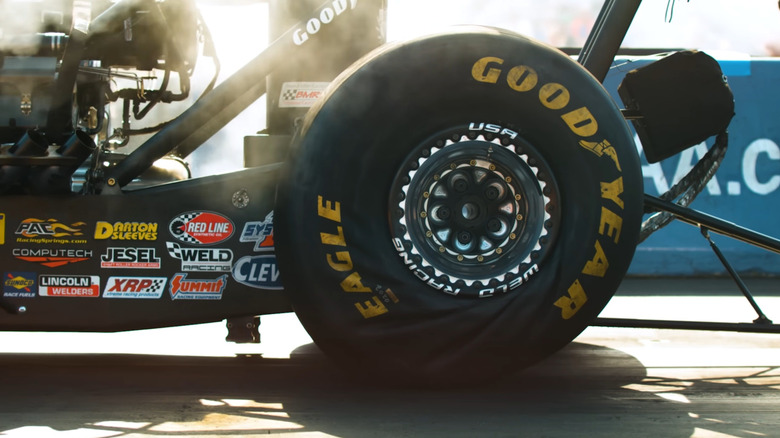
With bulging-middle slick-surfaced treads, sticky compounds, widened contact patches, and firm-grabbing rims, drag racing tires were coming into their own. But, there was still room for improvement. Possibly the most visually captivating advancement was Goodyear's "wrinkle wall" tires first offered in 1964.
Upon introduction, the Goodyear racing slicks were only 10 inches wide, but it's how they responded when the power surged through them that was a revelation. By using strategically placed nylon plies that numbered between two and six, Goodyear's slicks could deform the sidewalls to flatten the tread and create a massive contact patch, especially at low pressures (as low as six psi), yet be strong enough to withstand the immense twisting forces for multiple races.
Once tires became the inflated gumballs they needed to be, racers turned their attention to the track itself. The first substance they tried applying was rosin, meaning the "who needs rosin?" circles of violinists, baseball pitchers, and 1960s drag racers comprises the thinnest overlap of any Venn diagram ever. By tossing rosin in front of the tires, then doing a burnout or dry hop, the rosin would heat up and allow the tires to stick. Plus, dry-hopping looked absolutely sick:
The quest for stickiness wouldn't end with rosin, though. Somehow, someone found that NASA's high temperature coating manufactured by Sperex was perfect for making drag strips so viscous that they could pull your shoes off. So, in 1972, Sperex's VHT label began producing PJ1 Track Bite, and the acceleration puzzle was complete. With wide, soft, grippy tires and glue-coated tracks, the acceleration war took off, and now Brittany Force can hit 341.85 miles per hour at the drag strip. Roger Huntington would be proud.