

These Are The Best Car Tires Of 2026, According To Consumer Reports
Everyone thinks they're a great driver. As a matter of fact, one should take pride in their awareness and capabilities on the road, but the universe doesn't pick favorites on the I-5 freeway, and more likely than not, the tires you are running on your daily driver will decide what happens when it all goes wrong. They are the great equalizer, a divine force that, at one point in the future, could decide your fate.
Tires can dictate whether you successfully avoid a deer or acquire some puffs of fur and a side of venison in your grille. They will decide if you stop in time for that surprise bumper-to-bumper traffic up ahead, or end up having a long chat with your insurance provider later that night. And of course, they can decide whether you win that race at the drag strip or go home $100 poorer with a bruised ego.
The key is knowing what tire is best for your particular vehicle, environment, and budget. Fortunately, Consumer Reports has dug into its extensive data and published its favorite car tires for 2026. In its testing, Consumer Reports evaluates every tire's characteristics (dry braking, wet braking, handling, hydroplaning, snow traction, ice braking, ride comfort, noise, and rolling resistance), assigning scores to each category and an overall score. Today, we're diving into Consumer Reports' top choices to find the best tires of 2026.
Best all-season tire: Michelin Defender2
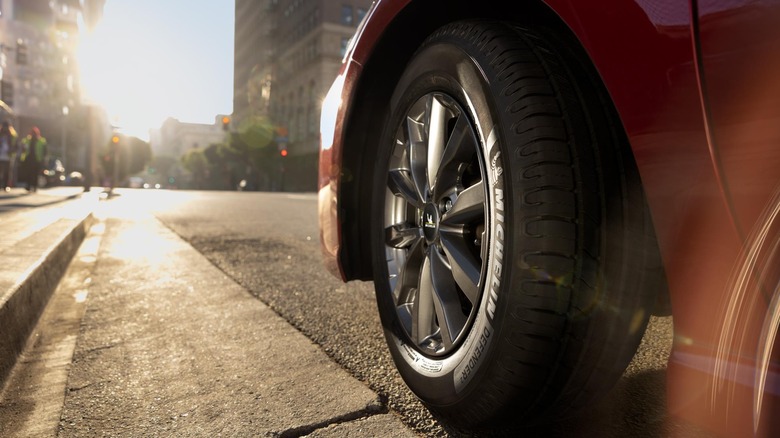
Spoiler alert: Michelin will be a regular on this list. It's no secret that the French-based company manufactures some of the highest-rated rubber in the industry (and is one of the most satisfying tire brands), but while the praise is certainly deserved, you'll also find there are quality alternatives that match or come close to some of the Michelin products featured here. Anyways, about the tire. The Defender2 is Michelin's quintessential all-around rubber, and currently the best all-season tire you can buy.
Though it doesn't get perfect marks in any specific category, it boasts an above-average overall score and will keep you in a straight line throughout the year. The tire is rated average in categories like wet braking, handling, ice braking, and ride comfort, but improves to above-average in other areas such as dry braking, hydroplaning, snow traction, noise, and rolling resistance. Other impressive characteristics come in the form of the Defender2's 100,000-mile estimated tread life and 80,000-mile treadwear warranty (an 80,000-mile warranty is on the higher end of Consumer Reports' stated average).
On Michelin's own website, it touts that in a sanctioned test between the Defender2, Bridgestone Alenza AS Ultra, and Continental TrueContact, the Michelin had a treadwear life nearly twice as long as the Bridgestone, and about 35,000 miles more than the Continental (it also outbraked both in dry testing). Listed at around $200 per- ire, the Defender2 isn't cheap, but its all-season performance probably justifies the price.
Recommended alternative all-season tire: Hankook Kinergy XP
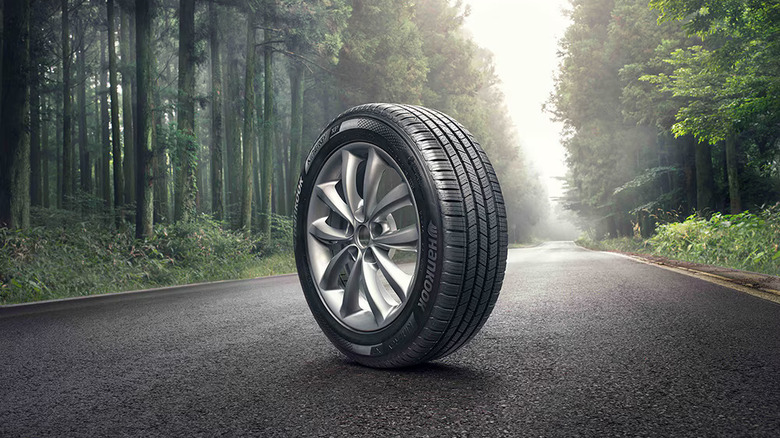
It didn't quite edge out the Michelin for the top spot, but Hankook's Kinergy XP all-season tire scores in the same above-average range as the Michelin and provides some attractive counterpoints. Right off the bat, the Hankook is about $180 per-tire, or about $20 cheaper per corner, saving you around $80 on a full set. Additionally, the Kinergy XP offers a 75,000-mile warranty (only 5,000 miles fewer than the Michelin).
Interestingly, in Consumer Reports' testing, the Hankook got overall better scores in the individual categories. It was highly rated in dry braking, wet braking, handling, hydroplaning, snow traction, noise, and rolling resistance, only receiving average scores for ice braking and ride comfort (the Michelin received the same scores for those two categories).
According to Hankook, the Kinergy XP provides measured improvements in just about all areas of tire performance when compared to its older predecessors, thanks to a new rubber compound and carefully redesigned tread patterns, among other items. Obviously, Consumer Reports agreed; however, the same can't necessarily be said for its customers. Another metric Consumer Reports tracks is owner satisfaction, and while the Michelin Defender 2 we just covered boasts a near-perfect score, Hankook's score is far below average.
Best EV tire: Hankook Ion Evo AS
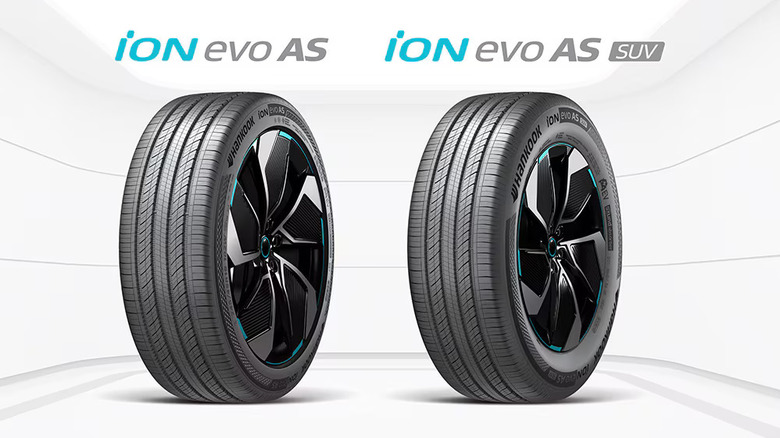
You may not have realized that EV tires are different from regular tires. It's true. Factors such as extra weight from heavy batteries, instant torque loads, and the desire for less rolling resistance for better efficiency all go into the manufacturer's design process. Considering that EVs also represent an ever-growing market share in the car industry, it's no wonder we need to know which one's the best.
According to Consumer Reports, the answer is Hankook Ion Evo AS. Its strong, above-average overall score makes a good first impression, though the details are a little more varied than the overview suggests. Its outstanding characteristics were in the handling and noise categories, scoring perfect marks in each. It also receives near-perfect scores for dry braking, snow traction, hydroplaning, and rolling resistance. Where it suffered most was in wet braking, ride comfort, and ice braking, the last of which received a below-average score, while the others were handed middle-of-the-road marks.
Tread life is rated at around 60,000 miles, and the treadwear warranty only goes as high as 50,000 miles, a number on the lower end of Consumer Reports' stated average. Unfortunately, similar to the Kinergy XP, the Ion Evo AS takes a hit with its poor overall owner satisfaction score. Prices hover around $235 per tire.
Recommended EV alternative: Hankook Ventus S1 AS T0
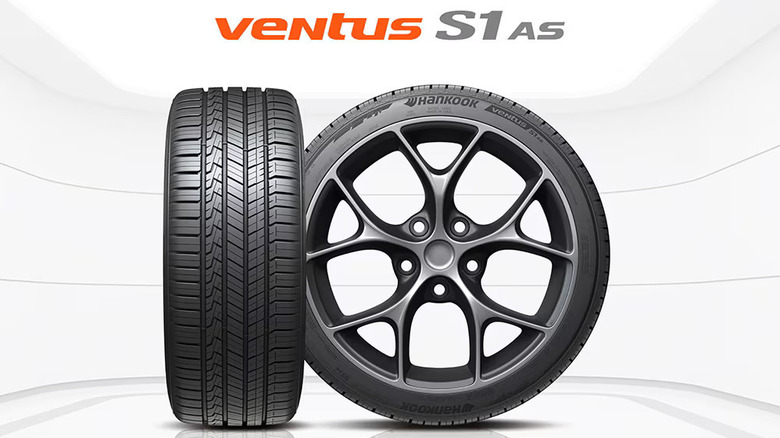
Hankook has once again stepped up to the plate in Consumer Reports rankings, with the Ventus S1 AS T0 coming in a close second to the Ion Evo AS. Firstly, let's disclose that this tire has the same low owner satisfaction score as the previous one. That alone might seem like a disqualifier as a top-rated tire, but before casting judgment, you should know that the T0 designation in its name indicates that Tesla uses it as a factory tire. Let's see why.
Similar to the Ion Evo AS, this tire has a hot and cold mix of strengths and weaknesses across Consumer Reports' data. Aside from its decent overall rating, it clearly excels in four of the nine total categories, boasting perfect scores in dry braking, handling, noise, and rolling resistance. On the other end of the spectrum, the worst score it received was for snow traction. The remaining items, such as wet braking, hydroplaning, ice braking, and ride comfort, all received average scores.
Unlike the Ion Evo AS, this Tesla tire doesn't come with a treadwear warranty at all, and sports an estimated tread life 10,000 miles worse than its sibling at 50,000 miles. Though, as always, there's a trade-off. The S1 AS T0 will cost about $25 less than the Ion at $209, whilst delivering better dry braking and rolling resistance scores.
Best ultra-high-performance all-season tire: Michelin Pilot Sport All Season 4
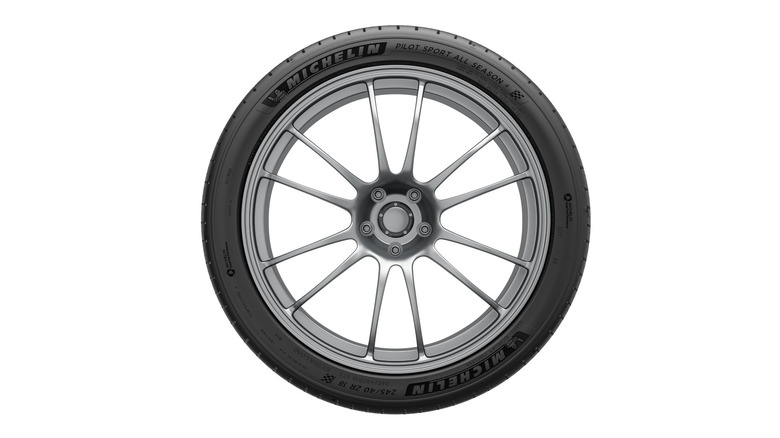
All-season tires are the most popular type on the road, offering a catch-all experience that saves you money by letting you buy fewer sets. But for the enthusiast, a regular all-season might not be quite enough to quench their desire for grip. Welcome to the world of the ultra-high-performance all-season tire, a category unsurprisingly dominated by Michelin.
Consumer Reports chose the Pilot Sport All-Season 4 as its best-in-breed, giving the product a solid, above-average overall score. Being a sporting tire as well as an all-season tire means that the mileage estimates for tread life aren't on par with other long-lasting all-seasons. This one boasts a 50,000-mile life expectancy alongside a 45,000-mile treadwear warranty, all for a price of about $195 per tire.
Diving into the tire's individual strengths, rolling resistance represents the tire's worst category, presumably due to its prioritization of grip, and ice braking and ride comfort are just marginally better with average results. The bar is then raised by just about every other categorical score. Its dry and wet braking, handling, snow traction, and noise all attained near-perfect marks, with hydroplaning being its most excellent category. Other reviews highlight its ability to put down power under cornering loads, citing Michelin's larger outer tread blocks that handle lateral forces.
Recommended alternative ultra-high-performance all-season tire: Continental ExtremeContact DWS 06 Plus
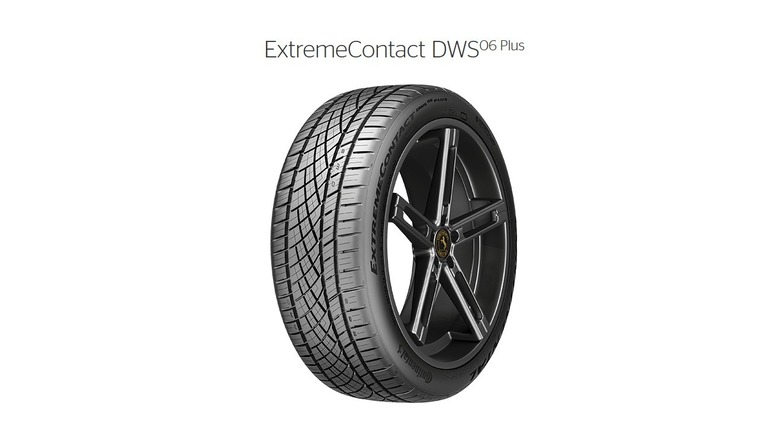
The second-place Continental ExtremeContact DWS 06 Plus isn't separated from the Michelin by much — scoring a slightly lower, but solid above-average overall score compared to the other tire — and depending on what individual customers value, this Conti might be the better option. To kick things off, the Continental matches Michelin's 50,000-mile tread life estimate, 60-day trial, and roadside assistance perks, and actually beats its treadwear warranty (50,000 miles vs. 45,000 miles).
Not just that, but the Continental's scores were slightly more stable, avoiding below-average scores in any category and scoring nothing but average or higher across the entire test. It was marked as average in rolling resistance and ride comfort, even better in wet braking, handling, snow traction, hydroplaning, ice braking, and noise, and perfect in dry braking. These scores put the Continental ahead of the Michelin in terms of dry and ice braking and rolling resistance, and trailing only in hydroplaning.
The Drive's testing seemed to echo Consumer Reports' assessments of above-average braking performance, wet-weather capabilities, and above-average grip. Customer satisfaction, while not entirely on par with Michelin's, was certainly better than what Consumer Reports cites for Hankook, giving the ExtremeContact DWS 06 Plus an above-average rating in this area. If you need any more proof that this is a solid alternative, the Continental costs around $170 per tire, which is about $25 cheaper than the Michelin. That's a Benjamin in savings for a set of four.
Best ultra-high-performance summer tire: Michelin Pilot Sport 4 S
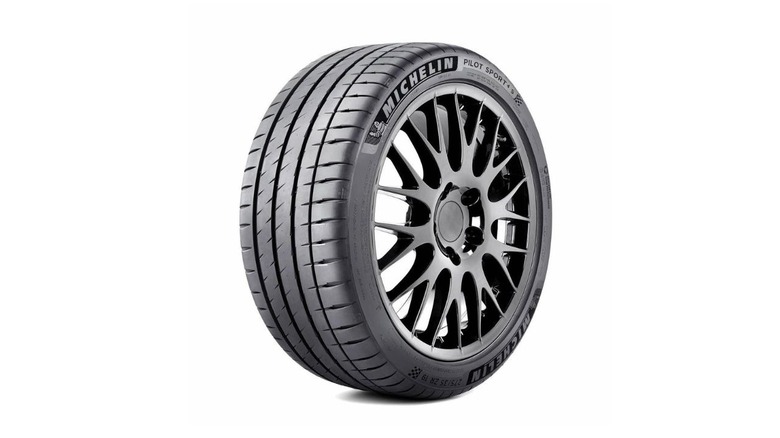
At just under $250 per tire, the Michelin Pilot Sport 4 S is among the most expensive entries on Consumer Reports' list. If you just thought, "Well, it better be the best damn tire ever," surprisingly, you wouldn't be wrong. Its overall score is the highest mark of any tire in Consumer Reports' findings. To be fair, this is the ultra-high-performance summer tire category, meaning these tires have a less-demanding job description, and Consumer Reports doesn't even test these kinds of tires in snow or ice (for obvious reasons). Still, the Pilot Sport 4 S is undeniably a benchmark product in its field.
The Michelin's highest scores are right where you'd expect them to be, boasting outstanding marks in the dry braking and handling categories (it also received a perfect score in hyproplaning). As for noise and wet braking, the tire was just shy of excellent in each, both overshadowing the ride comfort and rolling resistance categories, which received average and below-average scores, respectively.
The areas in which the tire saw weaker performance (rolling resistance and comfort) are not necessarily a given for this grade of tire, but are certainly typical characteristics for the ultra-high-performance summer tire category as a whole. Notably, Consumer Reports made it a point to mention the Pilot Sport's 30,000-mile treadwear warranty, something that isn't usually offered for this kind of tire.
Recommended alternative ultra-high-performance summer tire: Continental ExtremeContact Sport 02
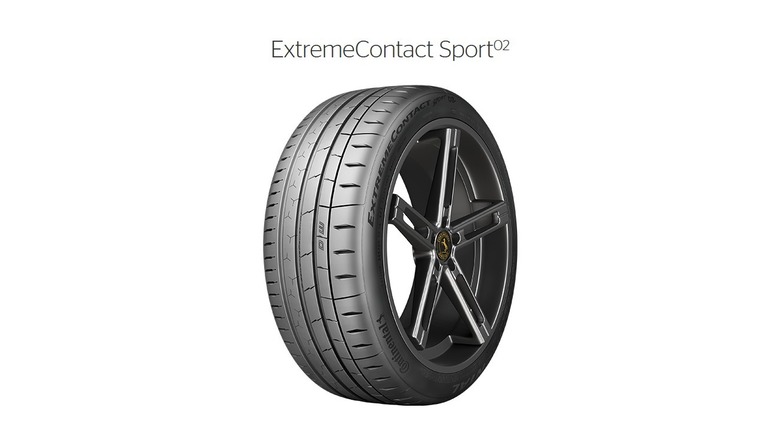
In the many battles between "Best" and "Recommended Alternative" we've already seen, the competition for the best ultra-high-performance summer tire might be the closest yet. The Continental ExtremeContact Sport 02 is right on the tail of the Michelin's high overall score, and makes a great argument for itself in contrast to the long-time industry leader.
In Consumer Reports' testing categories, the two tires almost matched with their individual scores — perfect in dry braking, handling, and hydroplaning, and above average for wet braking and noise. The Michelin is rated as average for comfort and slightly worse than that for rolling resistance, whereas the Continental essentially switches those scores around, with below-average scores for comfort and average for rolling resistance. Plus, they both come with 30,000-mile treadwear warranties (good on both brands for giving a summer performance tire such perks).
The performances of each tire are hard to distinguish, but the tradeoff is clear when you look at the big picture. With the Michelins, you are getting the best-rated performance tire on Earth (backed by an incredible customer satisfaction score), but the price is about $242 per tire. On the other hand, the Continentals provides 99% of the Michelin's performance for a lower price at about $200 per tire), but its barely above-average customer satisfaction score is in a league below that of Michelin. Our advice: Peruse message boards or ask someone who has owned both which one they would buy again.
Best winter/snow tire: Nokian Tyres Hakkapeliitta R5
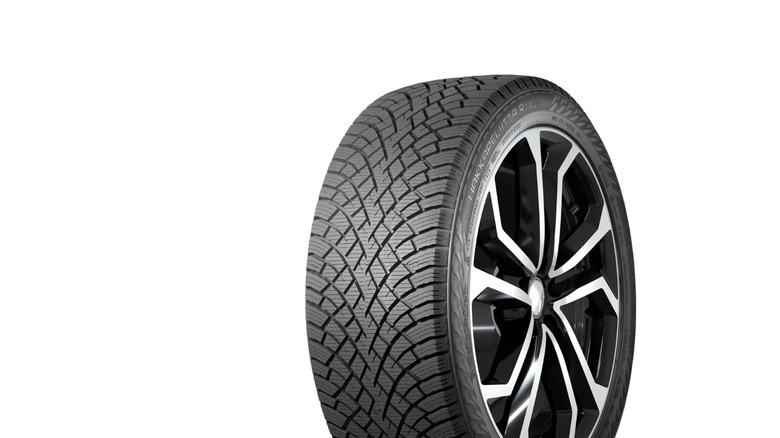
We won't rule out the possibility that a few of you clicked on this article for this snow category specifically. If you don't want to be a dumb winter driver, you're in luck, because Consumer Reports' top pick isn't just highly rated, it also has the most fun name, too. The Nokian Tyres Hakkapeliitta R5 (with an upper echelon overall score) is a very impressive tire, considering it's a dedicated winter tire that shines in both frosty and dry-weather performance.
For example, its scores for handling and dry braking are both average — not the best, but it will get the job done. We then get to ride comfort and noise (which aren't particular strong suits of winter tires), where the Nokian earns another pair of middle-of-the-road scores. The most impressive statistic, however, is its rolling resistance score, posting a perfect mark. Chunky winter tires are notorious for eating fuel economy because of the added friction of their aggressive treads, but the R5's design is a delightful exception to that rule.
Of course, it wouldn't be the "Best Winter Tire" if it didn't score high on the cold-weather categories, and it meets expectations with excellent scores in both snow traction and ice braking. Unfortunately, Nokian knows it has a good product, and the $189 price tag reflects that. But considering customer satisfaction scores are through the roof with the Nokian, it seems the people are just fine with paying a little extra.
Recommended alternative winter/snow tire: Continental VikingContact 7
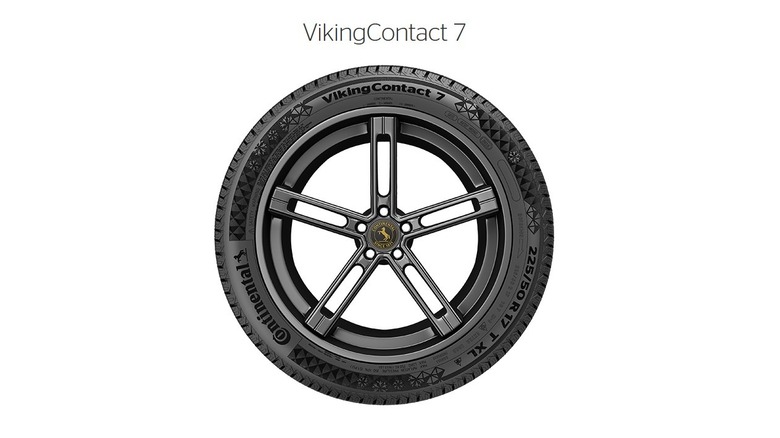
Continental makes its third appearance of the day with the VikingContact 7, Consumer Reports' recommended alternative winter option. Continental released this tire in 2019, focusing on improved winter-weather performance (duh), but also the ability to perform in between seasons, where we experience a mix of wet and dry conditions.
Looking at the Consumer Reports data, those goals appear to be achieved. The VikingContact 7 matched the Nokian Hakkapeliitta R5's scores in wet and dry braking, hydroplaning, ice braking, snow traction, and rolling resistance. In the two remaining categories, noise and comfort, the Continental actually outscored the Nokian, so why is it in second place?
In Consumer Reports' rankings, it doesn't just consider individual performance ability. It also applies customer feedback to its rankings, and when comparing the Nokian and the Continental, the Nokian's satisfaction rates were magnitudes higher. The cherry on top of this battle is price. Remember how the Nokian was the second-most expensive winter tire? Well, that's because the VikingContact 7 hits the wallet for $203 per tire. But don't let our dramatic comparisons fool you — the fact remains, the VikingContact 7 is still a fantastic winter choice.
Best performance winter/snow tire: Michelin Pilot Alpin PA4
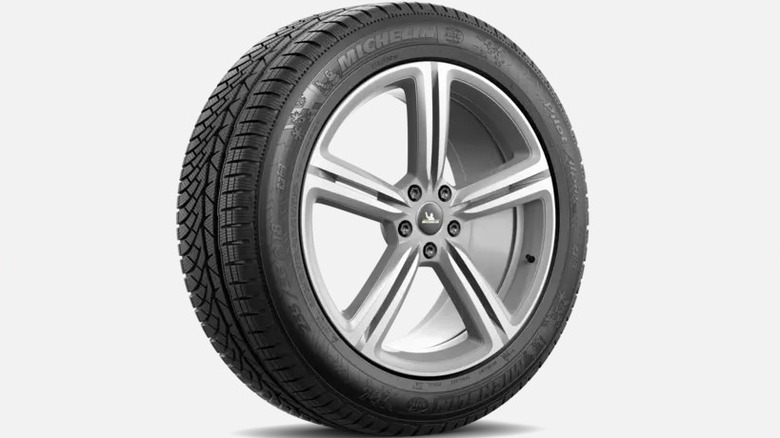
Unfortunately, the car enthusiast's illogical need for speed doesn't go into remission for winter. For some people, the lack of traction makes it even harder to resist, and a few companies are happy to oblige this delusion. Michelin, for example, will sell you the Pilot Alpin PA4, its premium winter performance tire that also happens to be Consumer Reports' favorite. But don't get too eager, because these niche-centered tires aren't cheap, and can run anywhere from around $250 to $285 per corner.
The Pilot Alpin PA4's Consumer Reports ratings are incredibly straightforward. In all three categories of hydroplaning, ice braking, and snow traction, the Michelin receives perfect scores. For everything else (handling, dry and wet braking, ride comfort, noise, and rolling resistance), it has to settle for just average results. We'll reiterate, though, that a snow tire collecting average marks for anything other than winter-related tests is fairly impressive. In fact, Consumer Reports specifically states that there are "no shortcomings" in the cons section of its review.
Michelin also continues its dedication to customer fulfillment with the Pilot Alpin PA4, offering a rare-for-this-segment 30,000-mile treadwear warranty and securing an excellent customer satisfaction score from Consumer Reports.
Recommended alternative performance winter/snow tire: Hankook Winter i*cept evo 3
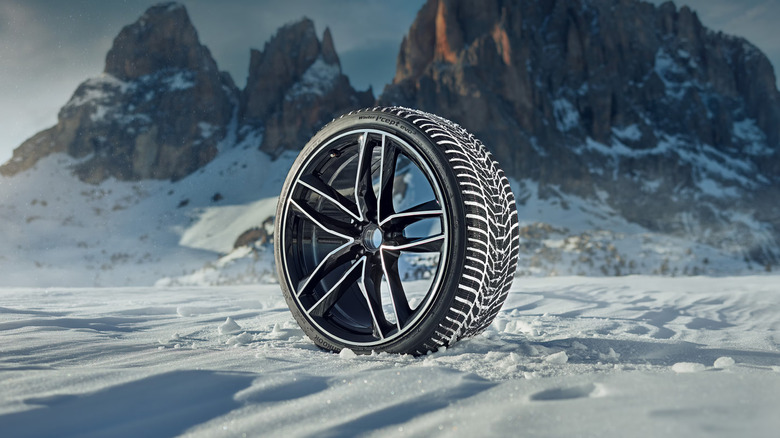
The case with the Hankook Winter i*cept evo 3 is one of extremely clear positioning and stunning performance. What we mean is that both the Hankook and Michelin have exactly the same categorical statistics — everything from snow traction to rolling resistance is matched between the two products. Consumer Reports declared both to lack negative traits, and shine in snow and ice conditions, as well as in hydroplaning.
The Hankook, while sporting a slightly lower overall score, clearly positions itself as the cheaper alternative. At $214, the i*cept evo 3 is $35 cheaper than the Pilot Alpin PA4. However, the Hankook's customer satisfaction scores are (here we go again) not nearly as high as the Michelin's.
The only thing left to judge might be that pesky treadwear warranty, something the Hankook does not offer for this particular tire. Taken altogether, the enthusiast who purchases these ultra-specific tires will have to decide between immediate savings and long-term protection. For now, we'll leave this decision, and all the rest, up to you.