

Yes, There Are Engines With Three Spark Plugs In One Cylinder
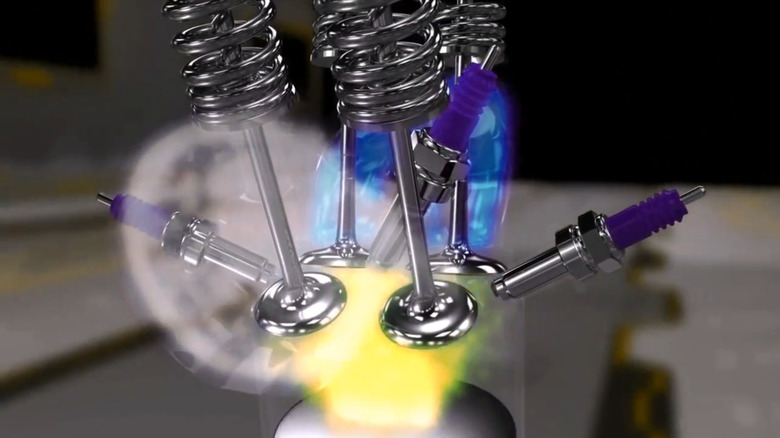
Oh, your Gen-III Hemi has two spark plugs per cylinder? Cool, cool, but let's up the ante, shall we? Oh, yes, three spark plugs per cylinder, now we're talking! Three-plug engines are to two-plug engines what $10,000 bills are to $100 bills. You've likely handled a $100 bill, but you probably don't know anyone who's even seen a $10,000 bill in person.
Before getting to an actual example, let's discuss why three plugs would be desirable. We'll use the known benefits of dual-plug engines — that is, ones with two plugs per cylinder — as a launching pad.
In two-valve heads, those valves are usually next to each other, pushing the plug to one side or the other (unless you've got that half-grapefruit Hemi chamber). This makes for slow, uneven combustion, which can be solved with symmetrical plugs placed on either side. You can better tailor ignition advance with two plugs and ensure more complete burning of the fuel in the chamber, too. Plus, a little redundancy in the system doesn't hurt in case a plug fails.
Theoretically, triple plugs would be even more effective. Drag racing legend Dale Armstrong thought so, which is why he tried developing a three-plug head (in addition to a two-speed supercharger). The National Hot Rod Association (NHRA) feared these inventions would be too expensive to implement or make the cars too quick, and they were banned before Armstrong could even try them. A patent for a three-valve, three-plug head was issued in 1996 to inventor and engine designer Jim Fueling, a man who took nominative determinism to its logical extreme. Now, if a three-plug version has made it into meatspace, I can't find one, so unlike nouns that are persons, places, or things, this one seems to just be an idea.
So are there any actual functioning three-plug engines?
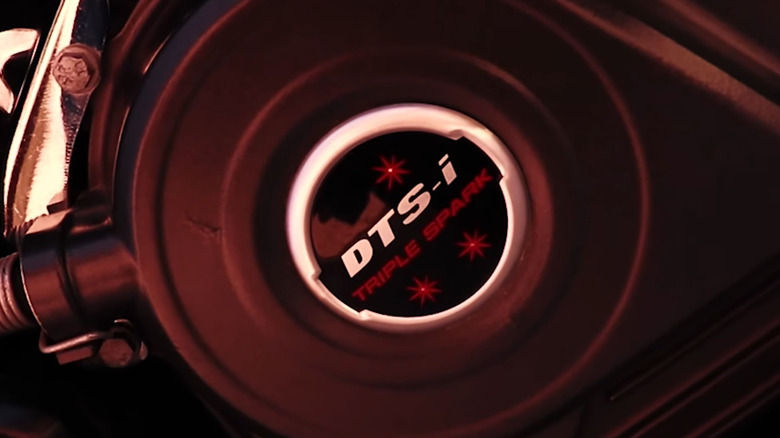
In America, the name "Bajaj" likely holds little significance, but not only is Bajaj the second largest motorcycle manufacturer in India, it's the third largest in the world. The company even formed a partnership with Triumph to produce the Speed 400 and Scrambler 400 X. If you know Bajaj, you might be familiar with its Pulsar NS200 sports bike, powered by a 199.5cc single-cylinder. If you go to the Bajaj website and check out the downloadable brochure, a closeup of the engine reveals some lettering that reads, "DTS-i Triple Spark." Yes, here we go, a commercially available triple-plug engine!
To explain why a crowded cylinder head with three spark plugs and four valves is worth the engineering torment, Bajaj claims tripling the plugs allows for 27% faster flame propogation than with a dual-plug design, and 50% faster than with a single-plug design. Engine output is listed as 24.5 PS, or 24.16 horsepower. Bajaj apparently also uses Triple Spark for its Dominar 400, which makes 40 PS (39 horsepower).
If 24-ish hp doesn't sound like all that much, note that the goal of Triple Spark wasn't just more horsepower, but lower emissions, smoother high-rpm operation, easier starting, and reduced plug fouling. Bajaj also claims the triple plug design eliminates knock, but that would seem to be at odds with one of the biggest drawbacks to cramming three devices that create arcs of electricity into a confined space: heat. It's no surprise then that the Pulsar NS200 uses liquid cooling, and Bajaj admits that a cooling failure can result in severe engine damage.
Why is no one else reaping the triple-plug benefits?
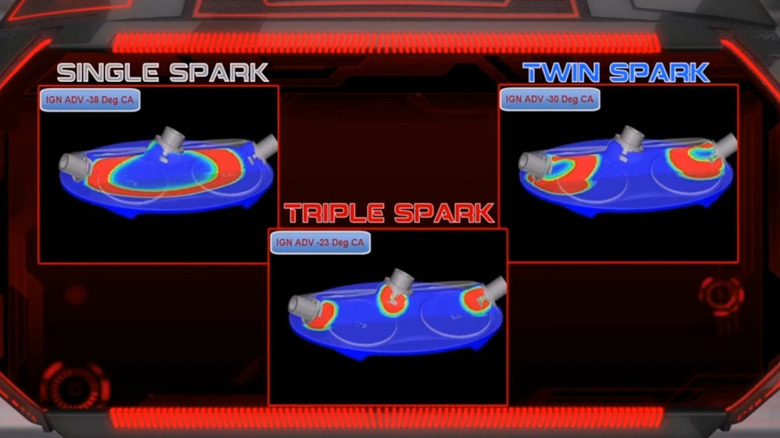
Aside from heat, there are other downsides to three spark plugs per combustion chamber. First is the crowding that comes with snaking spark plugs and wires between camshafts, valves, injectors, and everything else needed to keep the engine running. Second, adding another spark plug adds weight thanks to the plug itself and the associated hardware necessary to fire it.
But hey, it's all about the results, right? And 24.16 horsepower out of a 200cc single-cylinder engine isn't bad. Except that KTM manages 25 PS, or 24.66 horsepower, in its 200 Duke with just a single plug. And users report both the Pulsar NS200 and the 200 Duke get darn similar fuel economy at around 76 or 78 mpg as tracked by users on Fuelly, though someone with a 2015 Pulsar NS200 is rocking 83.6 mpg. Bajaj says that while the two bikes admittedly perform about the same at high revs, the Pulsar NS200 is far more efficient at low revs. Either way, Bajaj bought KTM last year, so pitting the bikes against each other would just be infighting now.
In all honesty, it seems three-plug designs are overkill and dual plugs are just fine. After all, the NHRA noped Dale Armstrong's three-plug heads out the door, and it's not as if two-plug dragsters are hurting for horsepower. Dual spark plugs were perfectly sufficient for Kenny Bernstein to reach 300 mph in 1992, the first driver to do so (by the way, Dale Armstrong was Bernstein's crew chief at the time). And, after the death of Scott Kalitta, the NHRA cut drag race distances by 1,000 feet, so the organization probably isn't itching to approve modifications that make yet more power.