

Seriously, Why Aren't Tires Solid Rubber?
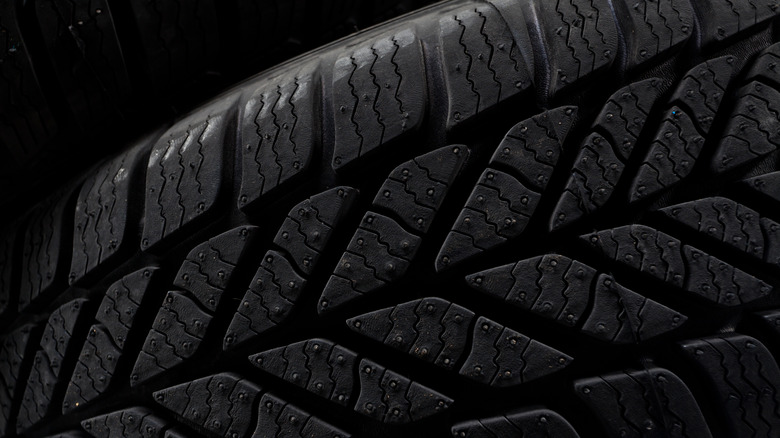
Hey there, construction and agriculture professionals, we're not talking to you right now. This discussion doesn't revolve around forklifts, excavators, or skid steers with solid tires. We're talking about why cars and trucks use pneumatic (aka air-filled) tires, and not several-inch-thick rubber, because we'd all like to stop dealing with flats, thank you very much. But as long as we're acknowledging that industrial equipment often uses solid rubber tires, let's discuss why.
When you've got a 100,000-pound wheel loader, pneumatic tires can pop like bubble wrap. Industrial vehicles that have to drive around construction sites with errant screws and nails lying around or navigate warehouse concrete at walking speeds can get away with tires that are just rubber from rim to road. Solid tires have fantastically long operating lives, experience little wear, have low rolling resistance, and shrug off scrapes or stabs that would send pneumatic tires to their next lives as playground swings.
Cars and trucks treat tires far differently, though. When you take a turn, part of what keeps you from skidding into the weeds is the tire's contact patch staying flat against the road. Modern radial tires have sidewalls that deform on purpose to keep tread touching street, rather than riding on the tire's edge. This is why radials represented such a technological leap over bias-ply tires. Those now-vanished whitewall bias-plies had exceptionally stiff sidewalls that made them act as one solid unit with relatively little deformation, causing the tires to bound over the slightest bumps and lose whatever grip they had. Now take these negative attributes and multiply them exponentially once you replace air with more rubber.
Okay, couldn't we just keep the tires permanently vertical?
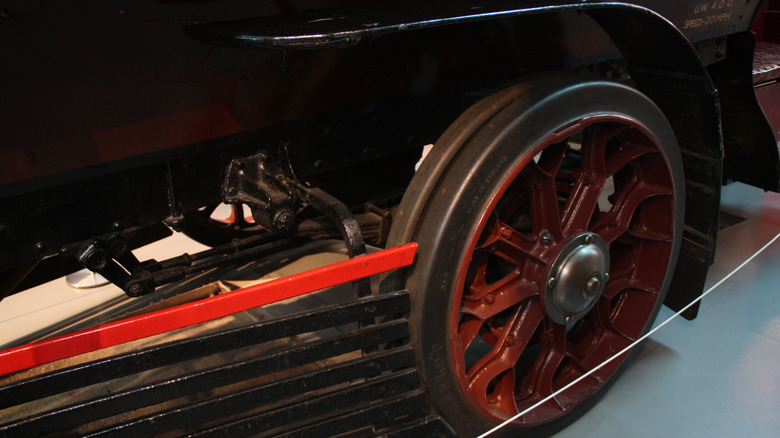
Even if you were running unequal-length control arms or solid axles that could keep the tires perpendicular to the road around turns, solid rubber tires are still a terrible idea for anything you'd want to drive daily. Not only does a pneumatic tire's cushion of air let it bend and flex over a road's surface to maintain as much contact as possible, it keeps every bump from being a spine-compressing event. Your car's suspension and seats are but two of the links in the chain of ride quality, a chain that will snap with solid rubber tires. Rubber will transmit far more shocks to, well, the shocks — as well as the rest of the suspension, the frame, the seat, and your butt — than air ever will.
But let's say you're only interested in driving on a smooth race track and you can handle the stiff ride. Solid rubber is still an awful solution. Rubber is much heavier than air, and with solid rubber tires, you'd be adding lots of rotating mass and unsprung weight to your wheels. The result is that you'll hamper acceleration and make it so any bumps you encounter will cause the wheel to bounce into the air far more than they would with a softer pneumatic tire. Imagine installing lightweight wheels, only to slap on thick, dense, heavy tires. Could those tires be made exceptionally thin to save weight? Sure! Then all the impacts from bumps will go right to the rims, probably causing them to bend. And curb rash will be all but guaranteed.
Fine, are there any other problems with solid rubber tires on cars?
Let's say you ignored the downsides and still wanted to try solid tires. How are you planning on getting them onto your wheels? Pneumatic tires have thin beads that get forced onto a wheel's rims, but solid tires would be far more resistant to being stretched and prodded in that way. Solid skid steer tires, for example, are often pressed on over perfectly cylindrical wheels with no raised rim and held in place by friction. Cars exert considerable lateral forces when taking turns, so that likely wouldn't work. You might be able to use a two-piece wheel that sandwiches rims around the inner section of the tire, but then you'd be adding more complexity, and likely weight, as well.
The thing is, we've known the negatives of solid tires for hundreds of years because there were no air-filled tires before 1847. That's when Scottish inventor and engineer Robert W. Thompson invented pneumatic bicycle tires. Up until then, you could probably feel through the handlebars whether that coin you ran over was heads or tails.
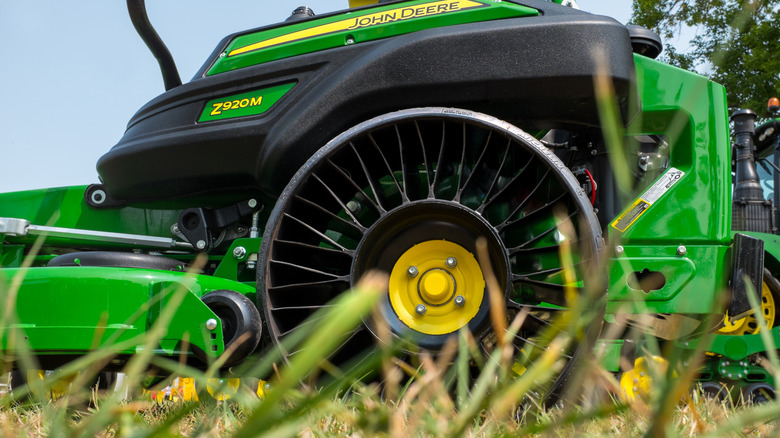
None of this is to say that manufacturers aren't working hard on airless tires, they're just not solid rubber. Look at Michelin's "Tweel" tires that use a series of rubber supports rather than a cushion of air to keep the tread in contact with the surface. But while flatless tires are pervasive in the marketplace for mowers, ATVs, forklifts, and industrial equipment, they're not on cars yet. There are still huge issues to overcome such as heat buildup, noise, weight, manufacturers' need to retool to make them, and safety regulations. For now, you'll just have to keep that jack and space-saver spare in your trunk.