

Could Sports Mode Be Your Secret Weapon For Better MPG? It's Complicated
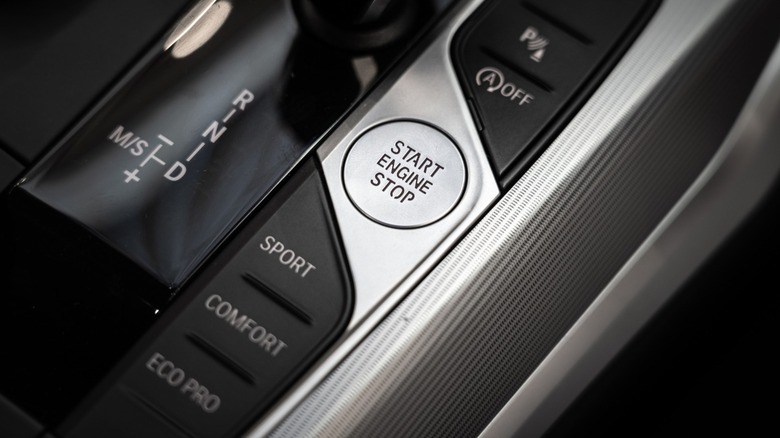
So cars have modes now. You'll typically find a knob or series of buttons with options like "Eco," "Normal," "Comfort," and "Sport." Automakers keep adding more drive modes, yet there is still no "Batmobile" mode. Get on that, automakers! Anyway, the name of the first mode we listed there — "Eco" — is self-explanatory. It's designed to optimize fuel economy. The last one, "Sport," is also self-evident in that NASCAR is a "sport." It prioritizes performance over gas mileage and enables the car to accelerate more quickly, among other things.
And yet, you'll find comments all over the Internet by drivers who claim that they get better gas mileage when driving in Sport mode. On paper, this is not what Sport mode is designed to do. Even auto manufacturers like Hyundai say in their owner manuals that Sport mode may decrease fuel efficiency. So why do these drivers insist they're getting better gas mileage? Are they just bad at math? Well, just like the Facebook relationship status of your friend who keeps breaking up and getting back together with her ex, it's complicated.
Sport mode can possibly improve your gas mileage, depending on how you drive, when and where you use it, and how long you use it. For example, your car isn't going to take as long to get up to speed on the freeway when in Sport mode. Unless you have a lead foot, Sport mode could be more fuel efficient in that brief instant. But it is hardly a secret weapon when it comes to gas mileage, and shouldn't be used all the time if you want fewer trips to the pump.
What does Sport mode do?
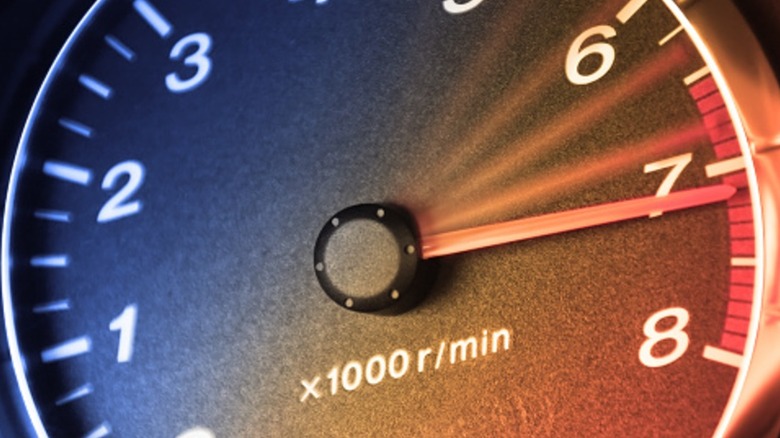
So, how does Sport mode enable your car to accelerate faster? What does it do? It is exactly the opposite of Eco mode, which forces you to drive more efficiently. Whereas Eco mode reduces throttle response, Sport mode makes the throttle more responsive. Eco mode causes your engine to run at the highest effective gear, while Sport mode waits to shift at higher RPMs. In some vehicles, Sport mode increases the torque and horsepower, while Eco reduces it. Basically, if Eco mode is that stern babysitter who wouldn't let you snack before dinner, Sport mode is the cool babysitter who would let you hold the cookie jar.
Depending on your vehicle, though, Sport mode will do more than just help your car accelerate faster. It may make your vehicle more responsive overall. For example, it might also make your car's steering tighter and the suspension stiffer, enabling you to corner around curves better. Engaging Sport mode in some cars makes the exhaust louder, while other cars make an exhaust sound through the speakers to give the illusion of a loud exhaust — in case you were wondering, your cheap exhaust sounds like garbage. The dash will light up in some cars when Sport mode is turned on.
Sport mode will also turn off certain gas-saving Eco mode features. You know that unnerving thing your car does by turning off the engine when you're stopped at a light, then restarts the engine when you let off the brake? That's called "Engine Start/Stop", and Sport mode turns that off (check out our article on whether Engine Start/Stop saves gas). Eco mode also sends less power to your air conditioner, while Sport mode lets it run at full power.
How can you use Sport mode to improve your gas mileage?

If Sport mode sends more gas to the engine, runs at higher RPMs, increases throttle response, and turns off Eco mode's gas-saving features, how could using it improve gas mileage? Sport mode could still be the more efficient mode in certain circumstances, mainly because of the quicker acceleration. There are times when everyone needs to get up to speed as quickly as possible, like when we need to merge onto a freeway or get around a semi. We might also need to step on the gas when going up a steep hill.
Trying to get up to speed while in Eco mode stretches out acceleration time, which is not good for gas mileage, especially since many drivers in Eco mode will try to compensate by mashing down on the accelerator. In Sport mode, the acceleration time is shortened, and the driver often needs only to lightly step on the gas. What happens when you get up to speed, especially on a flat stretch of highway? That's the time to go back to Eco or Normal mode. Staying in Sport mode will keep the car at higher RPMs, which is bad for gas mileage.
Feathering the gas is the key if you want to save gas while using Sport mode. But the quick acceleration and tight handling of Sport mode is too much for some drivers to resist. Instead of babying the accelerator, they treat it like they're trying to make pole position at the Grand Prix. No matter what mode you've turned on, you will not get great gas mileage if you drive your car like you stole it. Sport mode is not exactly a secret weapon for great gas mileage, but it does have its uses.