

Here's How Much A 2020 VW Golf GTI Has Depreciated In 5 Years
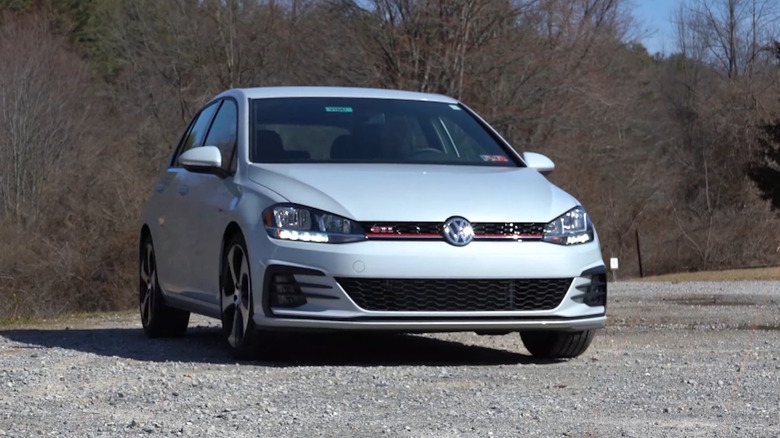
The Volkswagen GTI helped define the hot hatch segment when it launched half a century ago. Even in today's SUV- and truck-centered market, there's still room for a small, efficient liftback. However, with a starting price of $36,320 (including destination charges), a factory-fresh GTI may not be in everyone's budget.
The obvious alternative is shopping for a used VW GTI to take advantage of the depreciation that affects most models. Targeting the 2020 model year makes sense here. CarEdge reports a five-year depreciation rate of almost 41%, making this edition relatively affordable. Also, every trim from this year features driver-assist goodies like automatic emergency braking and blind-spot monitoring. Enthusiasts may have an additional reason to shop pre-owned: Volkswagen delivered the last GTI with a stick last year. Autotrader listings reveal that half of the 2020 GTIs with a clean title and accident-free history offer a row-your-own-gears setup.
We'll look at data from both CarEdge and iSeeCars for a more complete picture of GTI depreciation, focusing on the five-year benchmark. Even if you're selling or trading in a 2020 GTI, you'll want a better understanding of what happens to your vehicle's value. Buyers may also be curious about how the 2020 GTI's depreciation compares to other compact sporty cars. So, we'll add the Honda Civic Si to the mix. Sure, it's not a hatchback, but it comes close to the GTI's engaging spirit. The Mazda3 hatchback was also included in the match-up, even if its 186 horsepower is underwhelming next to the 228-hp GTI. We stayed away from the Subaru WRX, Hyundai Elantra N, and a few others because they either had only all-wheel drive (the GTI is front-wheel drive) or weren't available for the 2020 model year.
Five-year depreciation for the Volkswagen Golf GTI
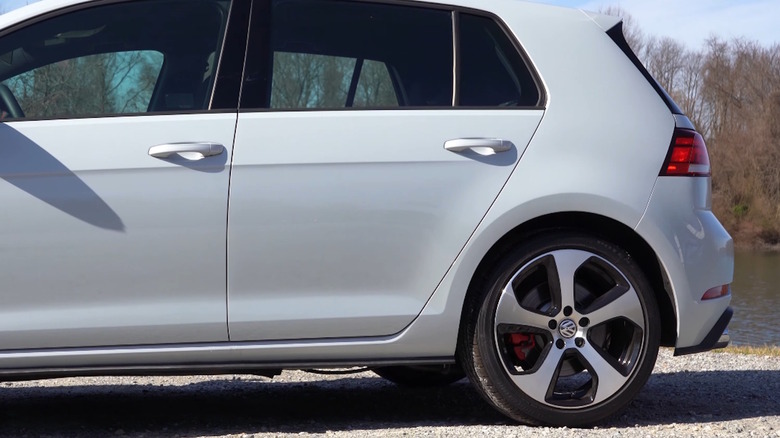
According to CarEdge, a 2020 Golf GTI drops 40.92% of its original value over five years. That works out to a residual value of $23,634 on a car that sold for $40,003 when new. These calculations are based on a good-condition example that averages 13,500 miles annually. Autotrader shows that most used 2020 GTIs with similar characteristics fall into the $20,000 to $24,000 price range, with a few outliers on either end. So, the CarEdge projection appears to be on the money.
Depreciation data from iSeeCars shows an almost identical 41.4% loss in value over the same period. At the same time, the company reports that compact cars, as a class, depreciate by 35.2% over five years. In short, the GTI loses value sooner than many competitors.
Over the longer term, CarEdge estimates that a 2020 VW GTI will depreciate by 46.14% over seven years and by 56.75% after 10 years. However, iSeeCars takes a dimmer view of the GTI and value retention. It projects depreciation rates of 52.5% and 65% over the same periods, respectively. If you'd rather not lose value at this pace, consider that six of the top 10 slowest-depreciating cars in 2025 are Toyotas.
Volkswagen Golf GTI vs. Honda Civic vs. Mazda 3
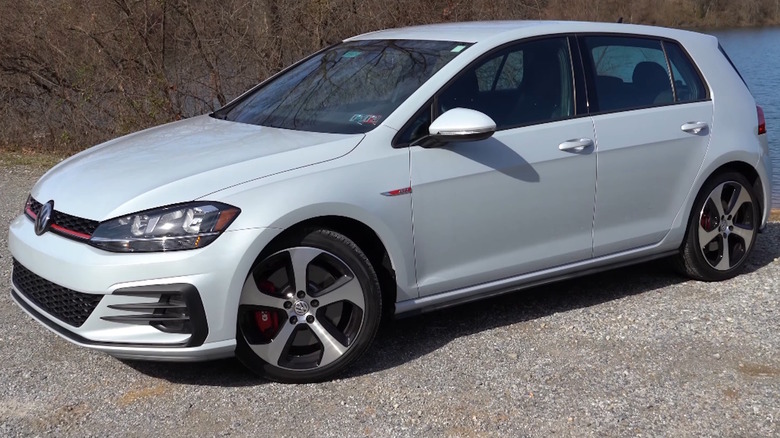
As iSeeCars reveals, the GTI is already behind the depreciation curve, compared to other compact cars. The numbers are even more against the GTI when compared to the Honda Civic Si, which Jalopnik called a "budget-friendly sports sedan" for the 2025 model year. The Mazda3 may not have the sportiness of a GTI or Civic Si, but it offers the same hatchback versatility as VW (the Si is a sedan).
Over five years, the 2020 Civic Si loses 32.65% of its original value, according to CarEdge, versus 40.92% for the GTI. The Civic continues to leave the GTI in the dust value-wise beyond half a decade. This Honda depreciates by 38.82% over seven years and 50.85% after 10 years. The five-year value loss for the Mazda3 Hatchback is almost spot-on with the GTI's 41.1%, based on CarEdge data. However, the Mazda's longer-term depreciation numbers — 49.88% for seven years and 65.22% — are worse than the VW's.