

Why Headlights Went From Warm And Yellow To Retina-Searing White
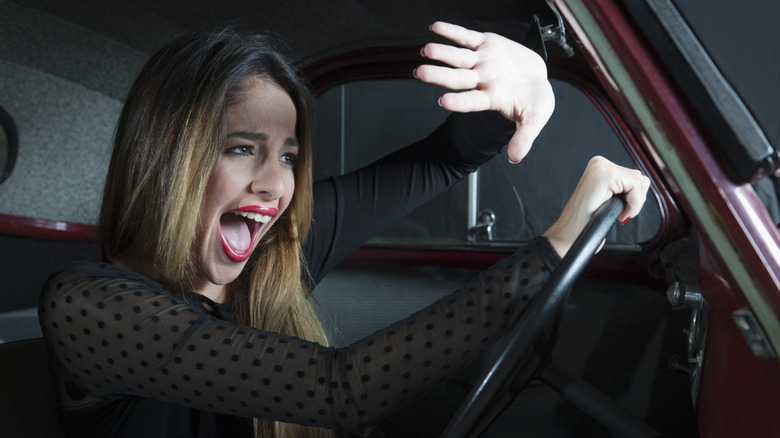
We're a far cry from the soft, warm amber and yellow of sealed-beam headlights, and while we shouldn't pretend they were perfect, they didn't cause retina sparks either. The main reason manufacturers push intense headlight brightness and white/blue color temperatures is that they make distant objects easier to detect at night. The better the visibility, the more likely it is that manufacturers will score better ratings from the Insurance Institute for Highway Safety (IIHS).
Safety sells, but by turning brightness into an arms race, we're stuck with miniature gamma ray bursts for headlamps. While there are headlight brightness laws, Jason Cammisa's Carmudgeon podcast discussed what he calls "Lighting-gate," and he alleges that engineers design headlights with dark spots to fool testing equipment into thinking that the lights aren't as bright as they really are. Remember in 2022 when the National Highway Traffic Safety Administration (NHTSA) legalized adaptive driving beam (ADB) systems? They were supposed to rescue us from headlights that could weld aluminum. Well, the Federal Motor Vehicle Safety Standard 108 (FMVSS 108) is still so strict that carmakers' existing ADB systems can't meet American requirements.
Yes, Rivian and Tesla made ADB work for U.S. customers by going to great lengths to comply with the NHTSA standard, but, so far, no other automaker has been able to do so. Part of the issue is that the NHTSA requires lights to react faster than the EU and Canada do. Also, the NHTSA is concerned about glare and even claims that other standards, including the Society of Automotive Engineers' (SAE) standards, don't fully address glare risks from ADB systems, despite the fact that one of their selling points is glare reduction.
The march of headlight progress
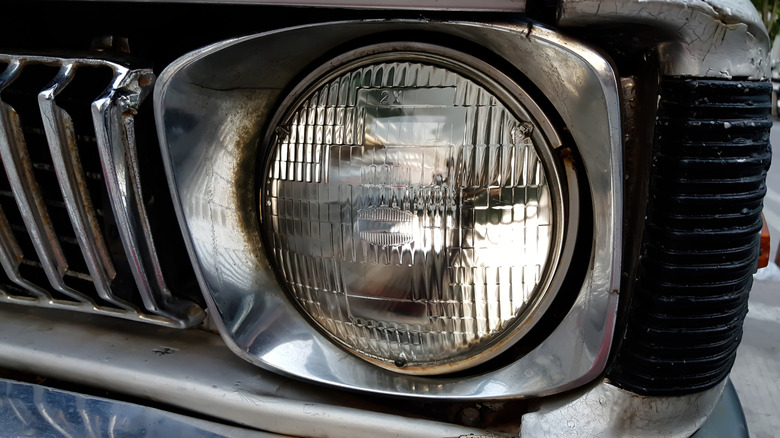
From 1940 to 1983, U.S. cars had two relatively dim 7-inch incandescent sealed-beam headlights by law. But beginning in 1957, manufacturers could install four smaller 5.75-inch headlights instead. That's why 1957 Corvettes have two headlights, but 1958 models were redesigned with quads. Regardless of what vehicle you bought, from a Ferrari 250 GT to a Willys Jeep (which had a seven-slot grille specifically to accommodate those bug-eyed 7-inch sealed beams), you got the same headlights.
Then came H1 halogen bulbs in 1962. Well, that's when they arrived in Europe. They weren't legal in the U.S. until 1997. Halogen bulbs were brighter than sealed beams with their 1,200 lumens or so, but they also caused a ton of glare and didn't come in sealed beams, so no dice for America. Then, Sylvania incorporated halogen technology into sealed-beam headlights for the 1979 Lincoln Versailles. However, it wasn't until dual-filament 9004 halogens arrived in 1983 that sealed headlights' reign ended. Ford famously advocated for halogens, because they could be installed in composite headlight units for superior aerodynamics, not to mention the ability to replace a single bulb rather than a massive sealed unit. It's also one of the reasons pop-up headlights disappeared, as such wind-cheating tricks stopped being necessary.
Still, halogens began the move from candle-like yellows to eyelid-piercing white, as the color temperature jumped from 2,700K (K for Kelvin) for the old sealed beams up to the 3,000 to 3,200K range. Drivers using halogen headlights were seeing better than ever, but a photon flood was about to be unleashed.
These lights go to 11
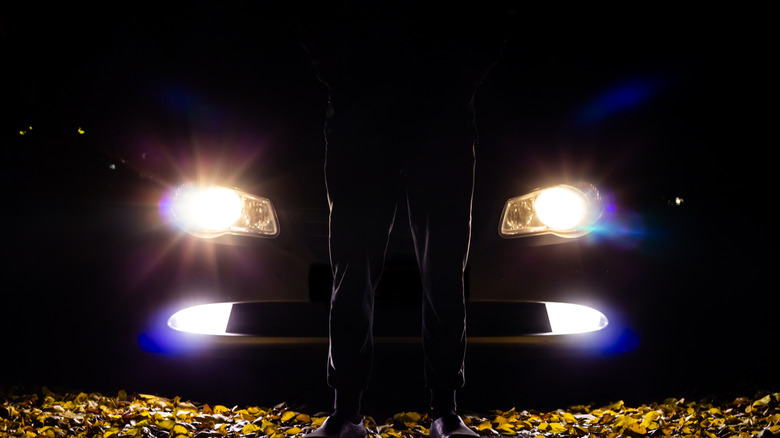
In 1991 (Europe) and 1996 (America), high intensity discharge (HID) headlights, or xenon headlights, became available, which work by passing electric arcs through xenon gas. At 3,000 to 3,500 lumens, they were triple the brightness of halogens. HID headlights also upped the color temperature to white-as-reality-show-host-teeth. While HID headlights come in a range of colors these days, it's that stark white, bordering-on-blue 4,000 to 6,000K range they're infamous for.
Next came LEDs with the 2004 Audi A8. LEDs were more efficient but boosted illumination to the 3,600 to 4,500 lumen range. Less energy was lost as heat, and, as a bonus, headlights became bright enough to pierce the human soul. Ironically, LEDs are also what made adaptive matrix headlights possible. Because they can be so miniscule, thousands of them can make up a projector array.
In 2014, Audi and BMW's short-lived laser headlights arrived, which could shine 600 meters or almost 2,000 feet (U.S. law restricts distances to 250 meters or roughly 820 feet). They also lived in a color temperature range of 5,500 to 6,000K. There's no easy source for finding laser headlight lumens, but U.S. law limits headlights to 150,000 candela, or about 11,900 lumens, and America never got full-power laser headlights, so draw your own conclusions.
Yes, bright headlamps make it easier for drivers to see nighttime surroundings. It's just that those surroundings often contain human eyeballs trying to shrink their pupils, lest rods and cones turn to ash. Super-bright lights absolutely cause glare issues, particularly for older people. Until manufacturers either pull a Rivian and engineer U.S.-compliant headlights or the NHTSA revises its standards, Americans are stuck with whiter-than-bleached-rice supernova beams, while Europe gets headlights smart enough to preserve ocular nerves.