

GM Is Officially Barred From Collecting, Sharing Driver Data... For Five Years
Good morning! It's Thursday, January 15, 2025, and this is The Morning Shift, your daily roundup of the top automotive headlines from around the world, in one place. This is where you'll find the most important stories that are shaping the way Americans drive and get around.
In this morning's edition, General Motors has to wait five whole years before it can collect and share driver data through OnStar again, Tesla's Canadian sales dropped like a rock in 2025, Audi ended the year well (but it wasn't enough to stop a sales skid) and Honda is aiming for a big 2026.
1st Gear: GM's OnStar gets five year data collection ban. That'll teach 'em
Taking your customers' data and selling it without their knowledge or consent is a really rotten thing to do. That's why the Federal Trade Commission is throwing the book at General Motors for doing just that — officially barring the automaker from sharing certain consumer data with consumer reporting agencies for five entire years. I know, I know. Sounds like a tough sentence, but if you can't do the time, don't do the crime.
GM first agreed to this sweetheart settlement with the FTC in January 2025 over allegations it stole data from millions of customer vehicles "without adequately notifying customers and obtaining their affirmative consent." Now, the settlement has officially been agreed upon.
Don't worry, GM will also have to pay a hefty financial penalty of zero dollars. From the Detroit Free Press:
"As vehicle connectivity becomes increasingly integral to the driving experience, GM remains committed to protecting customer privacy, maintaining trust, and ensuring customers have a clear understanding of our practices," [a GM] statement said.
In the initial complaint, federal regulators alleged GM's enrollment process for OnStar's connected vehicle service and OnStar Smart Driver features was misleading; customers were not aware their data was being sold to third parties.
A New York Times investigation in March 2024 concluded that GM sold customer data to global data broker LexisNexis, which ultimately found its way to auto insurance companies that in turn increased premiums for certain drivers. One month after that report, GM discontinued Smart Driver across all GM vehicles, unenrolled all its customers, and ended third-party telematics relationships with LexisNexis and Verisk.
[...]
The final order imposes a five-year ban on GM for disclosing consumers' geolocation and driver behavior data to consumer reporting agencies, the agency said in a news release, also noting that "this fencing-in relief is appropriate given GM's egregious betrayal of consumers' trust."
The agreement with the FTC will last for 20 years, and GM will be required to obtain affirmative express consent from customers before collecting, using or sharing data. It'll also have to create a method for all GM customers in the U.S. to request a copy of their connected vehicle data, with the ability to delete it. Additionally, it will have to allow customers to disable geolocation data collection for their vehicles, and it must provide a way for customers to opt out of geolocation and driver behavior data collection "with some limited exceptions."
I'm sure this tap on the wrist will teach GM its lesson.
2nd Gear: Tesla sales drop 60% in Canada due to self-immolation
Tesla had a really rough 2025 in Canada, and while there were some external issues — like President Trump's trade war — the company, and CEO Elon Musk, did a lot of the heavy lifting to tank sales in the country. As a result, Tesla's Canadian sales dropped 63.5% in 2025, with the company managing to sell just about 20,000 vehicles. That's down from the nearly 55,000 it sold in 2024. It should be noted that these figures are estimates, as Tesla doesn't break down its sales by country.
Of course, the EV market as a whole is down in Canada, but Tesla was hit particularly hard. EV sales declined 43% through the first three quarters of 2025, compared to the same period in 2024. To go along with the death of a $5,000 federal EV incentive, a 25% counter-tariff imposed on U.S.-built vehicles had a pretty substantial impact on Tesla's sales throughout the year. Of course, we cannot forget about Elon Musk's far-right antics and alliance with Trump, which seem to have rubbed many Canadian's the wrong way. From Automotive News:
CEO Elon Musk courted controversy in the United States in early 2025 with his active role at the Department of Government Efficiency, which aimed to reduce federal spending. His close connection with Donald Trump and amplification of the U.S. president's threats to Canadian sovereignty pushed Canadian buyers away from the brand. In a February post on X, formerly Twitter, Musk wrote, "Canada is not a real country." The post was later deleted.
The company faced bouts of vandalism and determined protests at its showrooms across Canada in early 2025. In March, it was forced to withdraw from the Vancouver International Auto Show because of threats of violence expected at on-site demonstrations.
The spotlight did not buoy sales.
[...]
The company began shipping its Model Y to Canada from its plant in Germany in the fall, skirting Canada's counter tariffs on U.S.-built vehicles and lowering costs to consumers. Tesla pricing for the Model Y rose to a peak of $84,990 plus delivery in spring. The Model Y from Germany starts at $49,990, not including delivery fees.
It's fairly likely that this massive downturn for Tesla in Canada could lead to it losing its EV seller crown in the country to General Motors once full-year registration data becomes available. GM says it sold 25,502 EVs in 2025. That's down from the 31,460 it sold in 2024, but the 22.1% decline is far duller than the 60+% drop Tesla saw.
3rd Gear: Solid EV sales weren't enough to save Audi's 2025
Audi was oh, so close to hitting its 2025 sales target, but a strong final quarter wasn't enough to make up the delta caused by tariffs and a competitive market. The automaker had previously cut its full-year profitability forecast twice as it looked for ways to deal with challenges in the U.S. and China, as well as restructuring costs and technological setbacks.
Audi saw a 12.2% drop in North American sales and a 5% slump in China as total sales fell 2.9% to 1.62 million vehicles. It missed its target of somewhere between 1.65 and 1.75 million sales. From Reuters:
Strength in Europe and emerging markets could not fully offset these factors, the company added, though it was more upbeat on the outlook for this year, pointing to rising monthly sales from September onwards.
Deliveries in North America were hit particularly hard last year by the 25% tariffs imposed by the U.S. in April, though they were lowered to 15% in August.
[...]
German automakers have been losing market share in China to domestic brands such as BYD though Audi's global deliveries of fully electric models rose 36% last year to 223,000 vehicles, with EV orders up about 58%.
Audi wasn't the only German automaker to see sales drop in 2025. Volkswagen, Audi's parent company, sold 0.5% fewer vehicles in 2025 than in 2024. BMW's sales dropped 1.4% and Mercedes-Benz's sales were down an even-greater 9%.
4th Gear: Honda is looking to over-perform in 2026
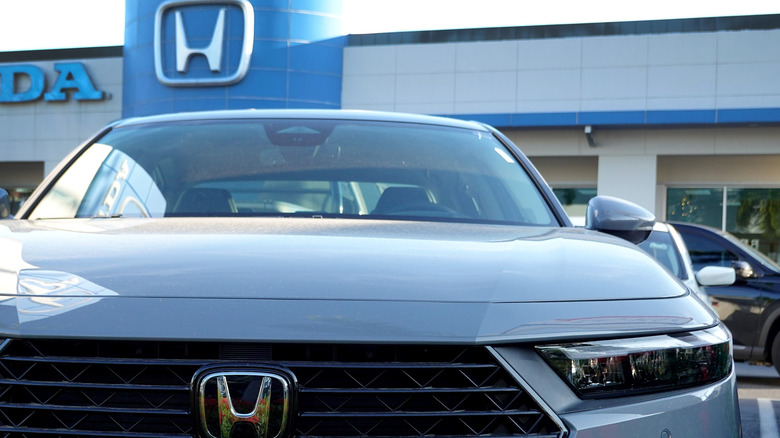
Honda says it's looking to hit 4% sales growth in 2025, targeting about 1.5 million total sales and flying in the face of a challenging U.S. market. That outlook also comes despite the fact that its expected U.S. new vehicle sales are expected to contract 2.4% to 15.8 million units in 2026 after a stronger than expected 2025. Hell, even Acura is aiming for a 1.1% bump to about 135,000 vehicles. From Automotive News:
America Honda sales chief Lance Woelfer said a balanced strategy blending hybrids, gasoline models and EVs positions Honda and Acura for growth in a fragmented, increasingly price-sensitive market.
[...]
The positive momentum is expected despite a significant challenge. Production of the current-generation RDX, the brand's second-best-selling model, will be suspended this year due to a parts supply shortage.
[...]
Inventory challenges are expected early in 2026, stemming from the Nexperia microchip supply disruptions and robust demand late last year.
"It's a challenge we'll deal with at the start of the year, with our days' supply at about 30 days coupled with a high turn rate," Woelfer said.
[...]
To tackle affordability in a softening market, Honda will increase production of lower-priced trims of its most popular combustion models.
"This means adjusting our production mix to include more lower-priced, gas-powered models for these bestselling products," Woelfer said.
Despite cooling EV demand in the U.S., American Honda remains bullish on the segment. The company plans to start production of its first next-generation electric crossover by year end.
It's certainly a ballsey call from Honda to look at the automotive environment as a whole and say "we can actually beat that," but in all honesty, I think it can. Honda has been on an absolute tear for a while now, and I don't see it slowing down anytime soon.
Reverse: Sully, the greatest to ever do it
 History.com
Imagine doing something so goddamn badass that Tom Hanks decides he needs to play you in a movie? Sully was operating on another level that day, and we thank him for it. If you want to learn more about Sully's heroics 17 years ago, head over to History.com.
On the radio: Talking Heads - Once In A Lifetime
Friends, it's nearly the weekend. And, I don't know about you, but I really need it. May your day be as weird and wonderful as David Byrne.