

MacPherson Struts Vs. Double Wishbone: How Do The Suspension Designs Compare?

Double wishbones and MacPherson struts are among the most common suspension systems found in modern cars. Engineers design and develop the suspension to isolate the cabin from bumps while providing responsive handling with minimal body lean. Much has been said about the track-ready attributes of double wishbone suspension, but sporty cars like the BMW M3, the Porsche 911, and the now-more expensive Honda Civic Type R all have MacPherson struts for their front suspensions.
This begs the question: If double wishbones are best for cars that demand pinpoint handling and relentless grip, then why do some of the finest handling Porsches, BMWs, and Hondas all have MacPherson struts instead? Answering the question requires a deeper dive into the pros and cons of each suspension design. In particular, the double wishbone design is difficult to manufacture but offers solid handling attributes, while MacPherson systems are lighter and more compact — and they offer better smoothness on the highway.
Double wishbones came before the MacPherson strut
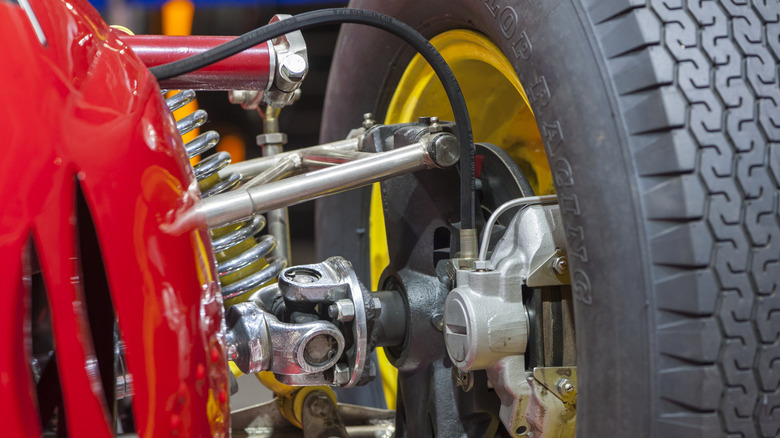
The double wishbone suspension design was first seen in early Citroen and Packard models from the 1930s. The "double wishbone" refers to the upper and lower control arms that connect to shock absorbers and coil springs. The upper arms connect to the chassis while the lower arms connect to the steering knuckles. The design enables double wishbones to fine-tune the wheel's movement and ensure its grip on the road.
Later derivatives of the double wishbone design include the short-long arm suspension, which is essentially a double wishbone with shorter upper arms and longer lower arms. The update enabled the inside wheel's camber to remain neutral or positive camber while the outside wheel gains a bit of negative camber when cornering. That's why double wishbones are renowned for their sportier track-tuned attributes.
Despite its all-conquering reputation, the double wishbone has drawbacks. Its upper and lower control arms involve more codependency; more parts can break at once when one fails. Furthermore, the complex design eats into more room and makes it heavier than other suspension designs. For some, though, the benefits are worth the compromises. Because double wishbones can maintain more consistent grip, they're able to provide the car with better traction, steadier handling, and a more predictable driving feel.
MacPherson struts are simpler and more economical
Earle MacPherson developed the MacPherson strut design while working as Chevrolet's Chief Engineer in the mid-1940s. He was personally responsible for the front suspension design of the brand's "Light Car" concept after World War I. That model eventually became the Chevrolet Cadet, which was especially revolutionary thanks to its independent front suspension with no upper control arm.
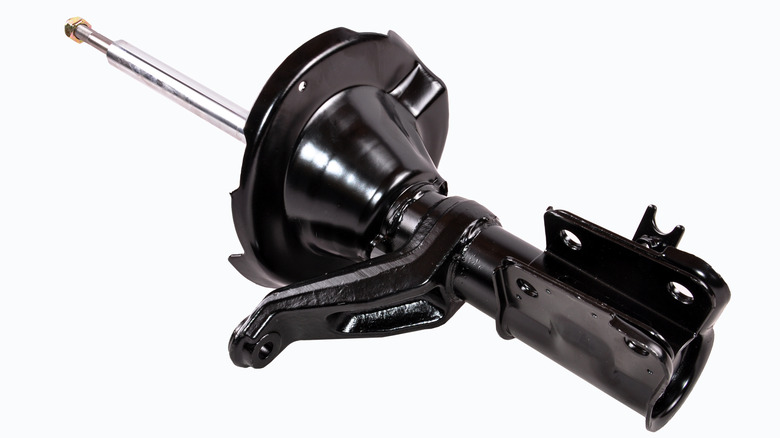
General Motors axed the Cadet small car project before entering production, but it didn't stop MacPherson's revolutionary design from garnering attention. MacPherson struts are essentially vertical struts with coil springs and shock absorbers in the center, with the top bolted to the body of the car. The lower part of the strut connects to the bottom of the steering knuckle.
The simplistic design grants a great deal of space and allows MacPherson struts to be lighter than double wishbones. On the other hand, the tall design can raise the center of gravity of the car, and it can lead to a higher ride height. And since MacPherson struts are part of the steering, they're not as efficient in keeping solid contact with the road when turning or cornering at speed. The design also makes it trickier to maintain the ideal camber angle when the suspension deals with upward and downward movements.
Are double wishbones better than MacPherson struts?
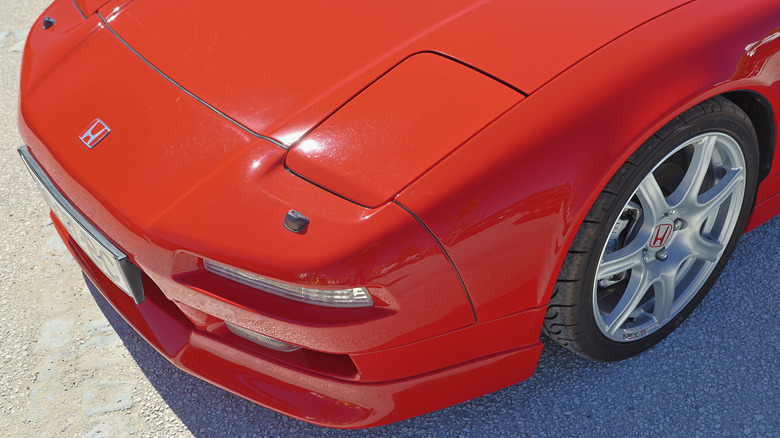
Double wishbones are better than struts from an engineering and kinematic standpoint. The double A-arm architecture inherent in most double wishbones is equal to none in maintaining the ideal wheel camber when cornering. Moreover, wishbone designs are shorter than struts, making them beneficial to low-slung sports cars and hypercars.
However, MacPherson struts more compact and lightweight. They can also be well-used by small cars, larger crossovers, and unibody SUVs. From an economic standpoint, MacPherson struts rule over double wishbones, but only if performance takes a backseat to day-to-day comfort and driving feel. Considering how most cars are not meant for shaving milliseconds at every lap, it's no wonder that most cars have MacPherson struts instead of double wishbones.
Regardless of which one you use, the suspension of your car demands the same level of care and attention as the engine and transmission. Both MacPherson struts and double wishbones are fairly reliable and can last a long time, but preventive maintenance is key to ensuring their longevity and performance. It's a good idea to get regular wheel alignments and to inspect the suspension every 50,000 miles. Of course, it's also wise to replace worn-out parts immediately, before the damage spreads to other components.