

The Massive Engines That Made The SS United States The Fastest Ocean Liner In History
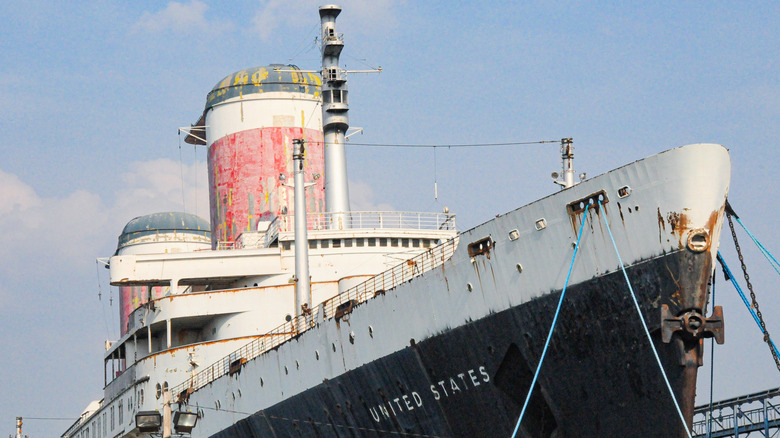
Americans are no strangers to big engines. The biggest engine ever fitted to a production car – Cadillac's 500-cubic-inch V8 — hails from the U.S., and bigger engines still would likely have followed had the EPA not stopped the fun in the 1970s. However, if really big engines are your thing, then it's best to move away from cars, and start focusing on other, larger bits of kit.
Forget trucks and planes, and instead take a look at what's out on the water. America knows how to screw together a decently large and powerful ship engine as it happens, and arguably the best ever example of this is the mighty SS United States. The gargantuan ocean liner completed its maiden voyage in 1951, although it really made a name for itself the following year. Sailing from New York to Cornwall, England, in record time, it can still lay claim to the fastest-ever transatlantic round trip ever.
To achieve such a feat in an almost-1,000-foot-long ocean liner requires some serious grunt — way more than a fleet of Caddy engines would provide — so the $78 million SS United States instead used four 1,000-psi steam turbines and eight boilers, which could muster up a scarcely comprehensible 240,000 horsepower. That's enough grunt to push the 53,330-ton ship through the water at 44 statute miles per hour, which is certainly a statistic worth celebrating.
A closer look at the record-breaking ocean liner
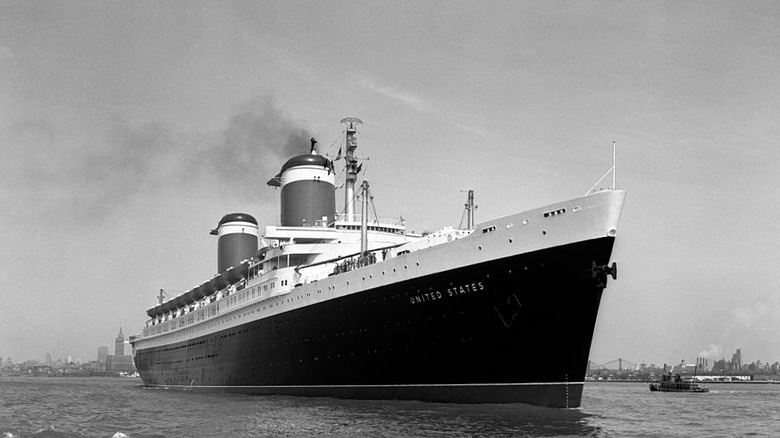
Revisiting the engines that powered this mighty vessel, the system was a smart one designed to favor not only performance — as was clear from the speed of the ship — but reliability, too. Of the eight boilers, four were kept offline while the other four worked.
The four steam turbines were Westinghouse double-reduction-geared units, which operated at 5,240 rpm. Elsewhere, you could find six 1,500-kilowatt steam turbo generators and a pair of 250-kilowatt diesel emergency generators to back them up. While the vessel was capable of a 38-knot top speed, it generally cruised at 30 — and its highest speed recorded in service was 36 knots.
Aluminum was heavily used in the construction of the SS United States too, in order to keep weight down to a minimum. Sure, at more than 53,000 tons it was hardly the Miata of the seas, but use of the strong, lightweight material certainly worked to keep the mass in check. In fact, more aluminum was used in the ocean liner's construction than in any previous construction project in the world — a stat which helps to demonstrate the sheer scale of the SS United States. Incredibly, though, even larger and more potent ship engines have rocked up since, like the 44-foot-tall Wärtsilä-Sulzer RTA96-C, otherwise known as the most powerful piston engine ever built.
The SS United States is soon to be repurposed
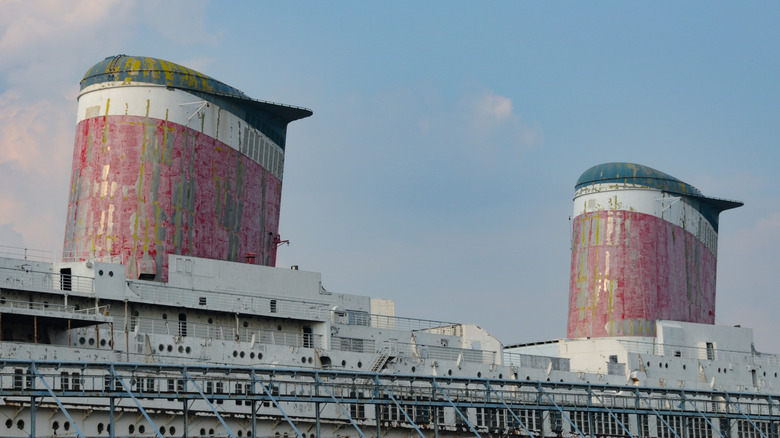
It's difficult to downplay the significance of the SS United States; it's the fastest ocean liner in the world, and a symbol of American greatness. However, despite its clear importance, the vessel has been left to decay over the last 30 years, and the cost of returning it to its former condition would be just as mind-blowing as the power once produced by its now-removed engines.
That doesn't mean to say that the ocean liner can't enjoy a new chapter, though, as there are plans are for it to be sunk and turned into an artificial reef off Florida's Gulf Coast. Some will see this as a miserable end for the vessel — some argue it should be restored and treasured, given its significance to America — but others see the plans as a fitting end for the world's fastest ocean liner.
Should it be scuttled as planned, it will once again be a record breaker, sitting as the world's largest artificial reef. And the funnels that provide the vessel's iconic silhouette will be removed prior, and placed as centerpieces in the upcoming SS United States Museum and Visitor Experience in Mobile, Alabama.