

Why Do Spark Plugs Have Different Tip Shapes And What Are The Differences?
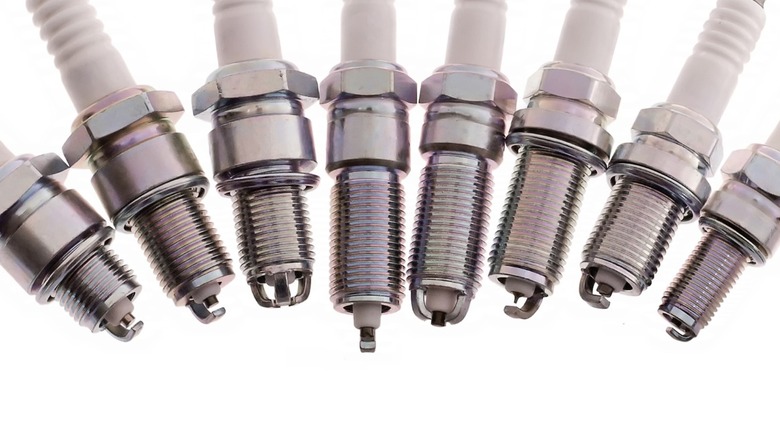
If you're like us, you've done a lot of thinking lately about the different shapes and lengths of spark plug tips. But odds are that you're nothing like us (good for you), and you've given absolutely no thought to why the tips on some spark plugs are different from others. Maybe you've had more pressing things to think about, like, oh, we don't know, literally any other topic. But that's why we're here, to answer the questions you've never asked.
Bear with us, though, there are important reasons why spark plug tips are different lengths and widths, and learning about those different reasons can help you understand how spark plugs work. Alternatively, you may decide to excoriate us in the comments for the stuff you think we got wrong. Either way, welcome! While you're at it, check out these common myths about spark plugs.
The main reason that spark plug tips have different shapes has to do with the different needs of performance engines compared to your run-of-the-mill car or SUV. The cylinders in racing engines and those that are turbocharged run hot with a lot of pressure and need cold spark plugs that don't stick down so far into the cylinder. Common consumer vehicles run better with hot plugs that fire close to the piston. That's why a lot of modern plugs have a longer thread area and center electrodes that stick out past the thread. The ceramic part of the tips differs for hot and cold plugs, and the shorter ones are used for performance engines because they dissipate heat better. Then you have single-ground electrodes, multiple-ground electrodes, and surface gap plugs with no ground electrodes, for similar reasons.
Projecting and non-projecting spark plugs
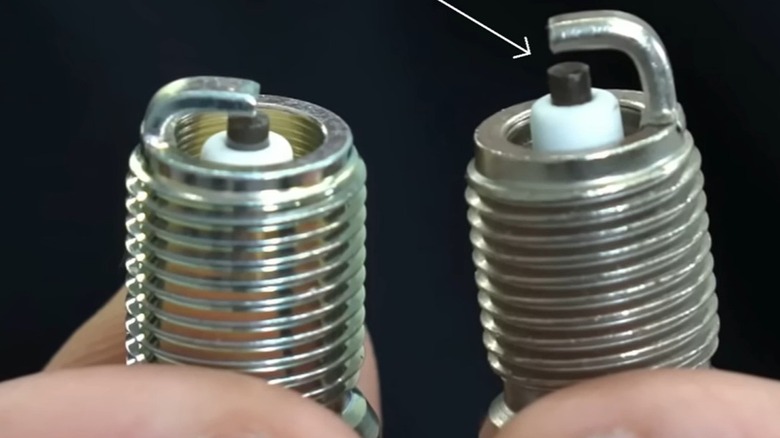
Have you noticed that spark plugs have gotten a little longer over the years? You're not imagining things. As internal combustion engines have improved, it occurred to engineers that it would be more efficient to have the spark happen closer to the piston. They've accomplished this in two ways: thread reach and projection.
What are projecting spark plugs? No, it doesn't refer to spark plugs that attribute their own negative traits and thoughts to other plugs. On projecting spark plugs, the center electrode pokes out from the middle of the thread. On non-projecting spark plugs, which is what nearly all spark plugs were at one time, the middle electrode sits flush with the thread. On both spark plug types, there is normally a ground strap or electrode that sticks out on the end of the thread and curves out over the center electrode. That ground strap is the little part you adjust when you gap your spark plugs. Yes, we know that spark plugs come pre-gapped now, but you should still at least double-check the gap against the recommendations of your car's manufacturer. The other way that spark plugs have been extended is by increasing the length of the threaded part, known as thread reach.
Shorter, non-projecting spark plugs are still used on high-performance and racing engines. In high-performance engines, longer plugs can ignite the air/fuel mixture too soon, causing piston damage. Also, forces inside the cylinders in these engines are pretty rough on the little ground strap, so plugs that don't stick so far down the cylinder tend to last longer.
Size matters – electrode diameters have gotten smaller
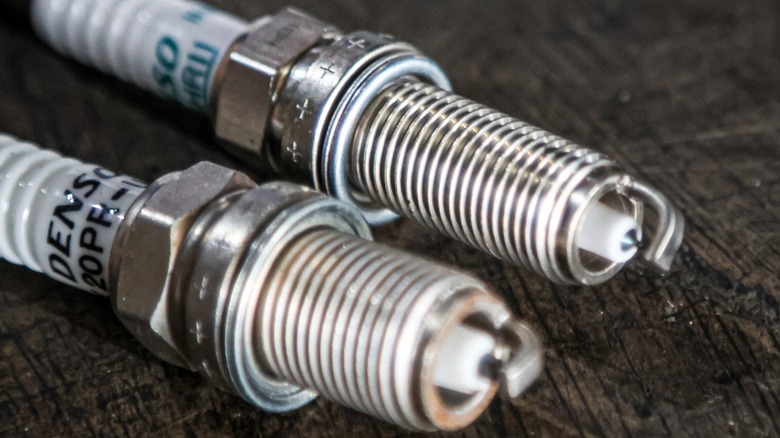
Sometimes less is more. That's certainly the case with electrodes in spark plugs. While spark plugs themselves were getting longer, the center electrode was getting smaller, at least in premium plugs. Traditionally, spark plugs have been fitted with electrodes that are 2.5 mm in diameter. Nowadays, premium spark plugs can have electrodes between .4 mm and .6 mm in diameter.
Why the change? It's because premium spark plugs use precious metals, like iridium and platinum, instead of nickel or chrome for the center electrode tips. Non-precious metals used in traditional copper spark plugs are softer and require larger tips than Iridium. Spark plugs sold today as "copper" plugs actually have center electrode tips made of a nickel and chrome alloy. Iridium is six times harder than copper. Its melting point is 4,435 degrees Fahrenheit (2,446 degrees Celsius), which is almost 1,800 degrees hotter than nickel's melting point (2,651 degrees Fahrenheit, 1,453 degrees Celsius).
That means that iridium will take much longer to erode. It also means that an iridium tip can be much smaller and still do the job. It's true that iridium doesn't conduct electricity as well as copper, but, believe it or not, that's not as important as ionizing the gap using as little power as possible, which is what the smaller size of the iridium tip does. That doesn't mean that smaller is always better. WeaponX released a whitepaper showing that the performance of a .4 mm tip is actually worse than a .5 or .6 mm tip, which seems to be the sweet spot. That said, high-performance and racing engines still often use copper center electrode plugs because the smaller tips don't handle heat as well and can form hot spots.
Hot spark plugs and cold spark plugs
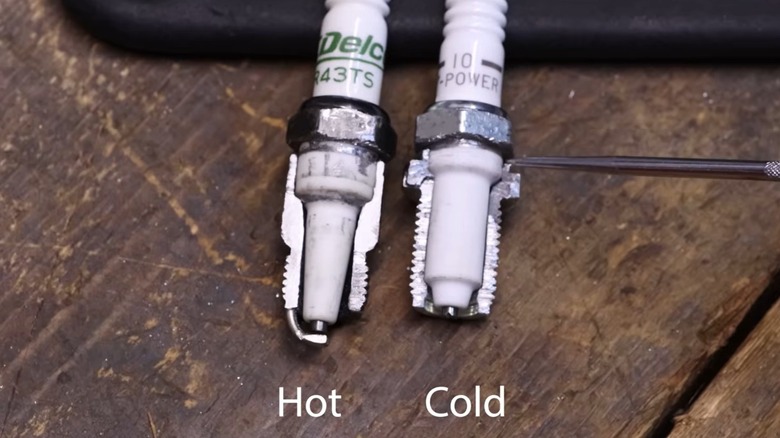
Did you know there is such a thing as a cold spark plug? These plugs aren't really cold, it's just that they are at the low end of the heat range for spark plugs. High-performance and racing engines, which get pretty hot anyway, need spark plugs that run at lower temperatures. Plugs that run too hot in higher temperatures can ignite the air/fuel mixture too early. Cold plugs, on the other hand, provide a shorter space for the heat to dissipate, keeping it from the core.
But you don't want a plug that runs too cold. Most consumer vehicles have hot plugs that run in the higher end of the range. The cylinders in these engines don't run as hot as high-performance engines. If your spark plug runs too cold, it can get fouled a lot more easily. Obviously, you want plugs that are specifically in the right heat range for your specific vehicle.
How can you tell whether a spark plug is hot or cold? One way is to look for a number printed on the side of the plug. The problem with that is that every manufacturer has its own numbering system, so you'll have to look it up to know what the number means. Another way you can tell, and the reason why we're talking about this in this article, is to look at the ceramic tip of the insulator that holds the electrode. If you look down inside the plug (or at the cross-section image above), there is a gap between the insulator and the body. The deeper the gap goes, the hotter the plug, because it's dissipating heat deeper into the plug, instead of dispersing it close to the end.
If one ground strap is good, surely four are better, right?
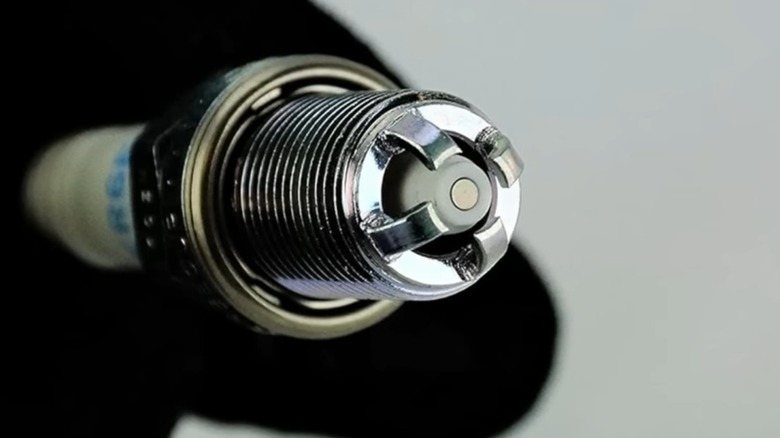
As we mentioned earlier, anyone who has ever gapped a spark plug is familiar with the ground strap or ground electrode, even if they didn't know what it was called. It's an important part of the plug, because the actual spark happens in the gap between it and the center electrode.
You likely knew that already. But did you know that some spark plugs come with as many as four ground straps? This configuration is supposed to help the plug to last longer. You see, even if there are four ground straps, there will still be only one spark when the plug fires. And the spark will follow the path of least resistance. So, if one strap is fouled, dirty, or worn, the spark will go to one of the other three straps, cutting down on plug failure and extending the life of the plug. And even if all four straps are good, wear and tear can be spread across them, since no one plug will necessarily be hit by the spark all the time. Do four-strap plugs perform better than single-strap plugs? No, but that isn't the point. The point is that they are supposed to last longer.
Is it worth it to upgrade to a multi-ground electrode plug? They do last longer, but since single-strap iridium plugs are expected to last 100,000 miles anyway, is this really an issue? In fact, some drivers never change their spark plugs. We don't recommend that, of course. The longer plugs are in there, the more likely they are to break off or damage the cylinder threads when you do try to remove them.
Ground straps? We don't need no stinking ground straps
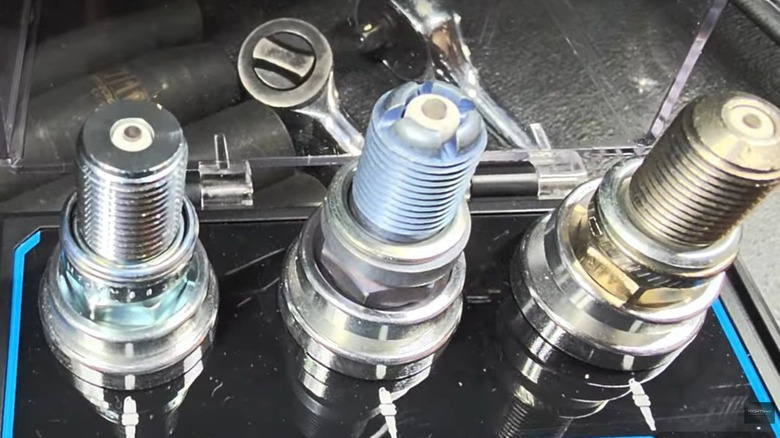
While some spark plug designs have added multiple ground electrodes to the tip, other designs have gone the exact opposite direction and have taken out ground straps completely. On these surface-gap plugs, the spark goes directly from the electrode to the spark plug body. They are made for high-performance engines, turbocharged systems, and cars that use nitrous. They run very cold, which makes them ideally suited for engine cylinders that operate with a lot of pressure, but not for common consumer vehicles. And without the ground strap sticking out, there's less of a chance for pre-ignition. Is it worth it to upgrade to one of these plugs? If you're operating a racing vehicle or have a high-performance engine, you should probably consider it. However, these plugs run too cold for most street vehicles.
Are you wondering if you should upgrade to some of the other types of plugs we mentioned? Auto manufactures have already made most of those decisions for you. The decisions most customers need to make have nothing to do with tip shape, but whether to get the cheaper chrome/nickel plugs or the longer-lasting iridium or platinum plugs. So, check out our helpful guide to the different types of spark plug materials.
Spark plugs look pretty simple on the outside, but don't let their looks fool you. There is a ton that could be said about spark plug design — more than we have the space for here. We could probably write a whole book about it. However, nothing is stopping you from sharing what you know in the comments. Are there things about the shapes of spark plug tips you think we missed? Let us know down below.