

These Are The Best SUVs Under $40,000, According To Edmunds
According to S&P Global, just four segments of utility vehicles (three SUV categories and pickup trucks) account for more than 50% of all new vehicle sales in the U.S. If you count all SUVs and trucks, according to J.D. Power, it's actually more like 83%. Let that sink in. Combine all other categories, whether that be economy sedans, compact hatchbacks, sport coupes, roadsters, or motorcycles, and they can't come close to the utility vehicle's market share. But of course, if you've spent any decent amount of time on the roads over the last decade, you know this. The U.S. has doubled down on its desire for more space when, let's be honest, they could find the same level of usability in a wagon. But the people have spoken, and it's our job as journalists to inform those consumers.
As tempting as it is to compare the latest sports car or limited production supercar, as purveyors of automotive information, reviewing affordable family cars has a far more realistic and immediate impact on the public. And considering SUVs, in particular, are king nowadays, it seems a large-scale comparison of relatively affordable SUVs is the most pertinent content one could publish.
Luckily, our colleagues over at Edmunds have done exactly that. Towards the end of 2025, they took a group of 10 SUVs priced under $40,000 (in base trim) and put them to the test. The reviewers assessed everything from comfort to tech, cargo space, value, and, of course, how they drove, presenting each with an overall score out of 10 to determine where they sat in the rankings of the segment. Today, we're guiding you through the results.
Chevrolet Equinox (10th place)
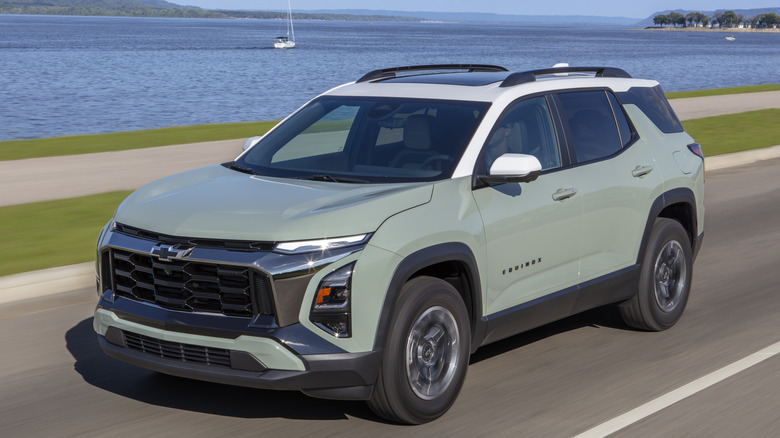
Based on price alone, Chevy's small Equinox SUV may be the most attractive on this list. Among the other nine competitors, the Equinox has the second-most affordable base MSRP in Edmunds' comparison, sitting right around $30,000 after taxes and fees. But, as you can see, the 10th-place result suggests a deeper and mostly underwhelming story.
Let's start with what Edmunds liked about the Equinox. The most glaring positive had to be its technology. Two screens, one for the driver's display and the other for the center console infotainment, were praised for their user-friendly interface and seamless incorporation into the interior, also allowing for bountiful charging ports and the use of multiple features at one time. Also of note was its cabin room, which provided ample space both in front and rear. Unfortunately, the rest wasn't so good.
The first and most obvious issue is the Equinox's drivetrain, which features just one engine option — a turbocharged 1.5-liter inline-four that produces 175 horsepower and 203 pound-feet of torque. At heavier loads, Edmunds says that drivers will wish for more passing power and throttle response. The chassis dynamics represented another demerit, where handling felt disconnected and unpredictable at times. Add in a lack of small-item space, an awkward rear door that makes entry difficult, and sub-par towing capabilities (1,500 pounds for AWD, 800 for FWD), and the Equinox was sure to bring up the caboose in this comparison. It simply needs something special to differentiate itself in a bloated segment like this — something we concluded in our own review of the previous 2025 Chevy Equinox.
Subaru Forester Hybrid (9th place)
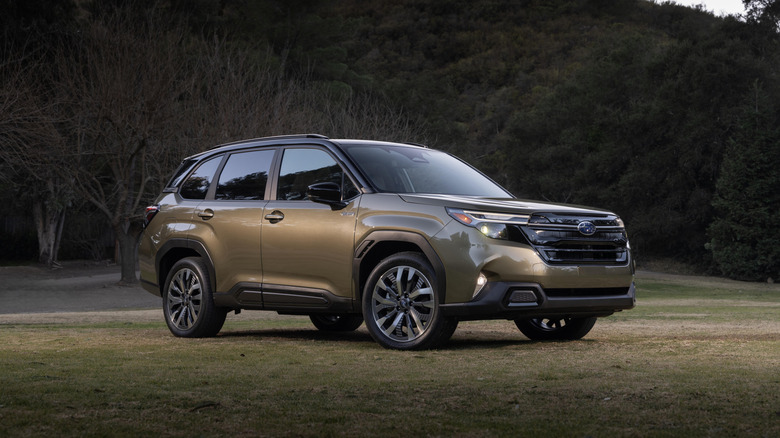
For decades at this point, Subaru's Forester has enjoyed a dedicated and loyal buyer pool that swears by its standard AWD, practicality, and general reliability. Now, in its sixth generation (launched in 2025), the small SUV has a lot more competition to worry about compared to when it debuted in the late 1990s. That means while the Forester philosophy is still attractive, it needs a few degrees of additional pull to stand out, and according to Edmunds, it didn't quite hit the mark.
Funnily enough, the thing Edmunds reviewers loved the most about the previously mentioned Equinox was one of their biggest complaints about the Subaru – tech. While generally easy to use, they mentioned that almost every facet of the system seemed dated, from the graphics to the response time of inputs on the 11.6-inch touchscreen. Also of note was a lack of small-item storage, which wasn't up to par for a vehicle with a outdoorsy legacy.
The hybrid part of this Forester includes a 2.5-liter flat-four coupled with one A/C electric motor that produces a total system output of 194 horsepower and 199 pound-feet of torque — a system that Edmunds found smooth in operation and nicely complementary to the plush ride. However, the driving experience was only half-baked, with the report noting that the driver aids (e.g., lane-keep assist, adaptive cruise control) felt unrefined and poor in their response. A ninth-place finish is certainly not what Subaru envisioned for one of its keystone vehicles, but if it's any consolation, the Forester is still the cheapest car to insure that's also recommended by Consumer Reports.
Ford Bronco Sport (8th place)
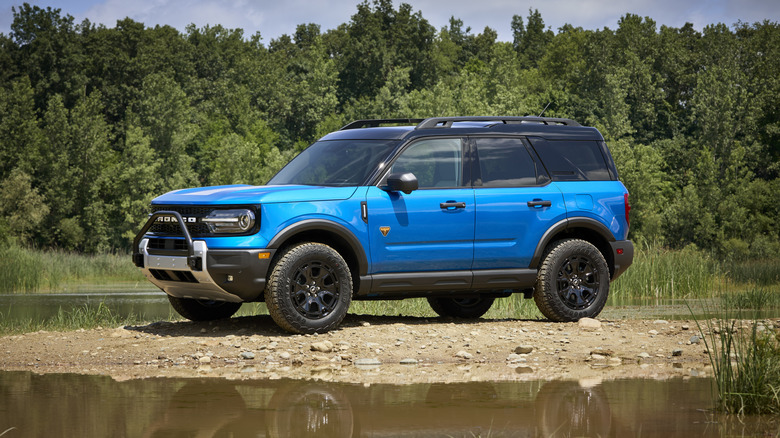
The Bronco Sport, also known as the little brother Bronco, seems to evoke differing opinions among journalists. Obviously, the folks at Edmunds weren't entirely thrilled about their experience in the small SUV, ranking it ninth place out of their 10 contestants. However, Car and Driver's comprehensive review gave the same car an impressive 9/10 points within its own scoring system, and MotorTrend gave it an 8.4/10. So, what gives? Let's start with the basics.
The Bronco Sport offers two distinct engines, a 180-horsepower 1.5-liter three-cylinder and a much more powerful 250-horsepower 2.0-liter inline-four, both of which are turbocharged and paired with an eight-speed automatic transmission. Outside, the Bronco's outfit plays the gritty all-terrain persona to perfection and backs up those looks with almost more off-road capability than it needs. In other words, it has that X-factor that the lower-ranked Equinox and Forester are lacking. These sentiments were echoed by other major publications, but Edmunds' take went a little deeper into points that it viewed as deeper flaws.
Starting in the interior, reviewers noted that the front seats, while spacious, lacked any meaningful support and bolstering, a trait that doesn't translate well when traversing uneven, off-road surfaces. Additionally, the team highlighted the rear seating area, citing its lack of leg room for adults, as well as increased difficulty of entering at the back. Truthfully, space was the main demerit, including notes about cargo room being sparse for an SUV in its class. As for value, its willingness to reach the mid $40,000 range in top-trim models was another reason why the Bronco was slated so far down the finishing order.
Nissan Rogue (7th place)
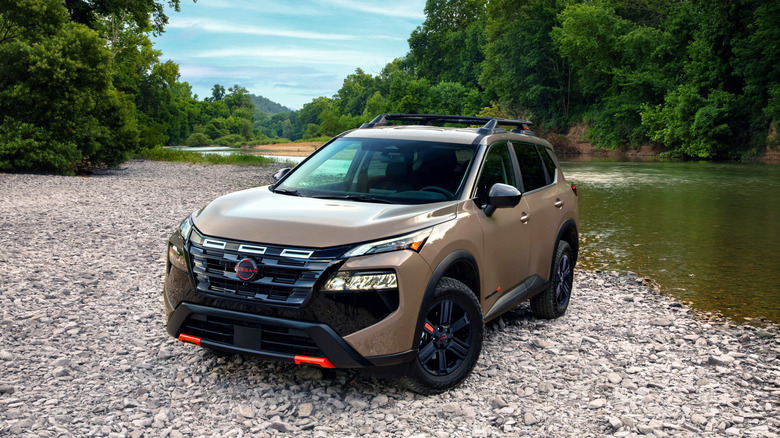
Edmunds' seventh-place vehicle is the Nissan Rogue. Now, though it landed in the bottom half of the list, Edmunds' in-depth review of the Rogue provided a more nuanced outcome than its overall rank suggests. For example, the strong 201-horsepower 1.5-liter turbo-four delivers a punch above its weight and, on its own, is a decent powerplant. But its CVT transmission, says Edmunds, wasn't nearly as responsive. On the road, the Rogue's chassis felt brittle over bumps and generally unrefined, only compounded by the louder-than-normal wind noise heard from within the cabin at highway speeds.
Regarding the interior, there were even more conflicting items. While reviewers appreciated the cushy front seats, easy-to-use and traditional HVAC controls, and practicality of the rear seats when it comes to ease of entry and child-seat securing, the infotainment system was largely a letdown for the crew. Its standard (and small by current norms) 8-inch display is the only one available in the low-to-mid-tier trims, and it doesn't include basic features like Android Auto and Apple CarPlay that were standard on every other vehicle Edmunds reviewed.
Continuing down the list, we get to cargo room. The Edmunds' team enjoyed its overall cubic footage and abundance of smaller features like floor panels that could be reconfigured for different applications. Plus, when it comes to fuel economy, Edmunds noted that the Rogue's 30+ mpg were the best among the gas-only-powered SUVs in the bunch. In the end, however, there were certain factors like build-quality issues, the lack of refinement, and poor driving experience that cemented its relatively low ranking.
Mazda CX-50 (6th place)
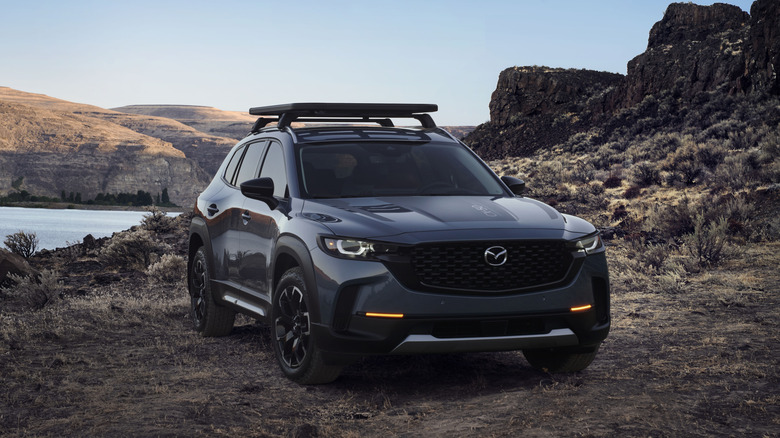
For a while now, Mazda's SUV lineup has consistently punched above its weight in the quality and driving experience departments. Unsurprisingly, Edmunds' review reflects those exact strengths. In the review, Edmunds said that the Mazda's interior was among the best of the entire group, featuring a level of quality that is hard to find at this price point. Powertrain and driving dynamics praises followed, citing an upbeat handling feel and tight road presence that made it fun to drive. Engine options include a naturally aspirated 2.5-liter inline-four (187 hp), a Toyota-sourced hybrid powertrain (219 hp), and a turbocharged 2.5-liter inline-four (256 hp).
Ergonomically, the CX-50 also impressed the reviewers in many ways, with its simple and straightforward climate controls, wide door openings, a multitude of seat adjustments, and a nice driving position. But it wasn't all sunshine and rainbows. To start, its 31.4 cubic feet of cargo room (with the rear seats upright) is small for the CX-50's segment, and though its small-item storage is well thought out, Edmunds' journalists were left wanting more room in the rear cargo space.
Another biggie came in the form of price. Edmunds notes in their in-depth review that the CX-50 is one of the most expensive in its specific segment, which to us, certainly prompts a discussion around value. What you get for the money is fantastic quality, a great driving experience, and good general attention to detail. But on the flip side, if you just want a cheap reliable car and don't care about trivial stuff like chassis dynamics, then there are more affordable options with many of the same standard features.
Honda CR-V (5th place)
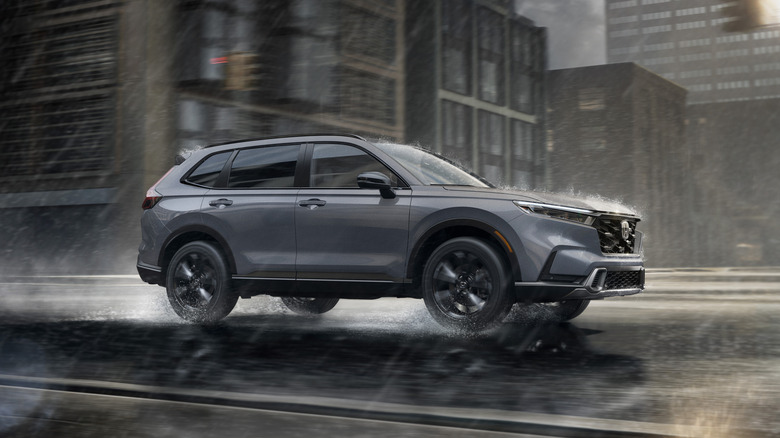
It feels hard to fault Honda for the small stuff, because, for decades, it has executed the meat and potatoes nearly perfectly. From easy-to-use controls to simple and effective functions, Honda just knows what it's doing. Much of that continues into the newest CR-V — the car excels in the important departments and once again delivers a compelling driving experience. For example, Edmunds was pleased with the smooth, 190-horsepower turbocharged 1.5-liter inline-four, its responsive steering, strong brakes, and predictable on-road handling. Inside, the review continued to praise items such as seating position, cushioning, the impressive amount of legroom, and big door openings.
Other highlights from Edmunds' review included outstanding ride quality, a bigger-than-average cargo space in the rear, and a fit and finish that feels upscale in this segment. Interestingly, we also checked out other publications' reviews of the CR-V and found they were even more impressed, with MotorTrend and Car and Driver giving the CR-V scores of 8.6/10 and 10/10, respectively. Car and Driver even lists the Honda as its highest-ranked compact SUV currently. So, why did it only achieve a middle-of-the-pack result for Edmunds?
From what we gathered, the CR-V's downfall was mainly an issue of value. The Edmunds team points out that the Honda's standard equipment, especially in lower trims, felt outdated and lacking. The base in-cabin screen is only 9 inches, far smaller than the industry standard. Additionally, the special Google Built-In integration is not available on any trims below the most expensive choice. The CR-V also refuses to offer seat coolers, a panoramic sunroof, or advanced exterior cameras as standard when other manufacturers do.
Volkswagen Tiguan (4th place)
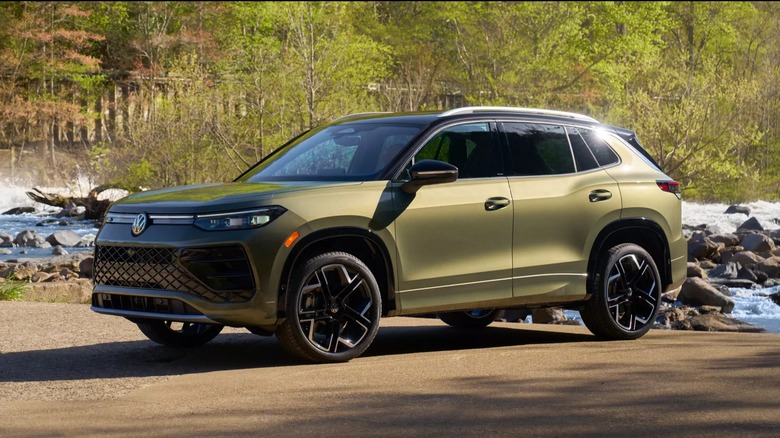
The Hondas, Toyotas, and Mazdas of the world may have always overshadowed the Volkswagen Tiguan in the $40,000 SUV space, but not anymore, according to Edmunds. This newest generation of the compact SUV feels more like a cohesive package than it ever has before, and because there wasn't much Edmunds didn't like about it, let's start with the negatives.
Firstly, fuel economy is bad. At 26 mpg (tested by Edmunds), it recorded one of the worst efficiencies in the entire 10-car group. Matters are made even worse in this area, considering Volkswagen doesn't yet offer a hybrid version of the Tiguan in the U.S. The other major complaint regarded the powertrain, not for its lack of power (the standard 2.0 turbo-four produces 201 hp, while the top-trim SEL R-Line Turbo packs a 268-hp 2.0-liter turbo engine), but rather the way it gets off the line. In testing, both Edmunds and other publications like Car and Driver cited a noticeable stumble when giving it throttle from a stop. Edmunds also noted slow (but smooth) shifts from the transmission.
On the sunny side of things, well, there are many. What stuck out most was the improvement in genuine quality across the board. To Edmunds, the interior nailed the German luxury aesthetics and feel, with comfortable seats only adding to the overall impressive experience. Going back to driving dynamics, other than the from-a-stop bogging, the Tiguan showcased a comfortable ride over bumps, enjoyable characteristics around corners, healthy levels of power, and mostly competent driving aids. Its tech felt new and intuitive, and with decent cargo room in the back, reviewers were even able to overlook its relatively pricey MSRP compared to its other competitors.
Toyota RAV4 (3rd place)
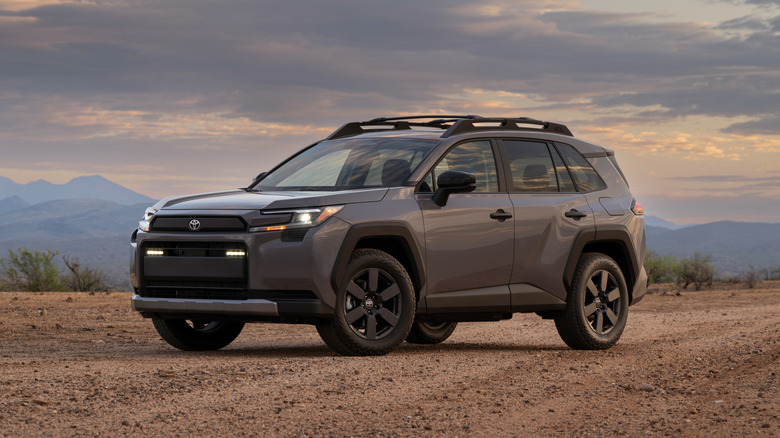
Now for the podium. In third place, we have the Toyota RAV4. It is the first vehicle so far to hit over eight points in this comparison, earning Edmunds' "Excellent" badge. Be honest, are you surprised? The RAV4 is one of those cars that essentially pioneered its own segment and has consistently set a high standard within the space it created. Sitting this high up on the list means the RAV4 has once again carried over its legendary philosophy of simplicity and usability.
Starting under the hood, something is new (kind of) — the RAV4 no longer offers a gas-only option, with the base vehicle featuring the 226-horsepower 2.5-liter inline-four/hybrid electric powertrain. Depending on trim, the RAV4 can be had with either front or all-wheel drive (AWD models make 236 hp). Edmunds enjoyed the powertrain, highlighting its peppy feel and quick 7.5-second run to 60 mph (faster than most in this group). As far as major benefits go, Edmunds had high marks for the Toyota's cargo space and in-cabin tech. At 37.8 cubic feet of cargo space (70.4 with the rear seats folded), it enters into class-leading conversations. As for that tech, it is the first to have the newest Toyota infotainment setup, which was hailed as fast and easy to use.
Speaking of tech, that's where one of the biggest downsides of the RAV4 lies for Edmunds, as, upon completing a trial period, owners must pay a subscription fee to access some of the system's features. That's not very cool, if you ask us.
Kia Sportage Hybrid (2nd place)
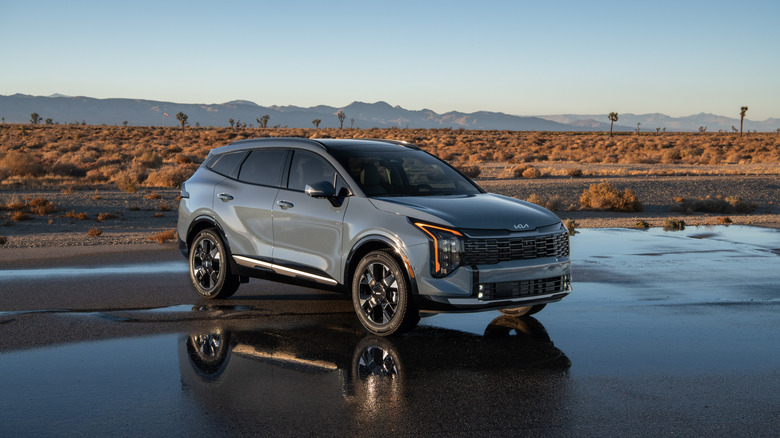
Taking the second spot is the Kia Sportage Hybrid. This compact SUV seems to be a popular contender for multiple publications (also appearing in Car and Driver's top three current hybrid compact SUVs), and for good reason. Edmunds' review fervently highlights that there are almost too many good things to name, as Kia truly covered all its bases with this vehicle. Let's go through the main takeaways, though.
Cargo room is one of the Kia's strong suits, holding 39.5 cubic feet or 73.7 with the rear seats folded down. That puts it near the very top of its segment. Moving on, the rest of the interior impressed with comfortable seating, high-quality materials and finish, and standout insulation from both engine vibration and road noise. The turbocharged 1.6-liter inline-four (coupled with two electric motors) provides ample thrust with 231 horsepower (there is also a 268-hp version of this powertrain available in plug-in hybrid form). Edmunds appreciated its smoothness and ability to transfer between electric and gas power with no hiccups or noticeable hesitation.
Negatives were measly, but Edmunds mentioned that the 12.3-inch infotainment screen, while modern in feel, can be frustrating because it houses both the climate and media controls. Flipping between both was confusing and irritating for the reviewers, with hard-to-use buttons only exacerbating the issue. Yes, some of its modern tech features made things worse, but the Kia has proven itself as a truly quality automobile going into the new year.
Hyundai Tucson Hybrid (1st place)
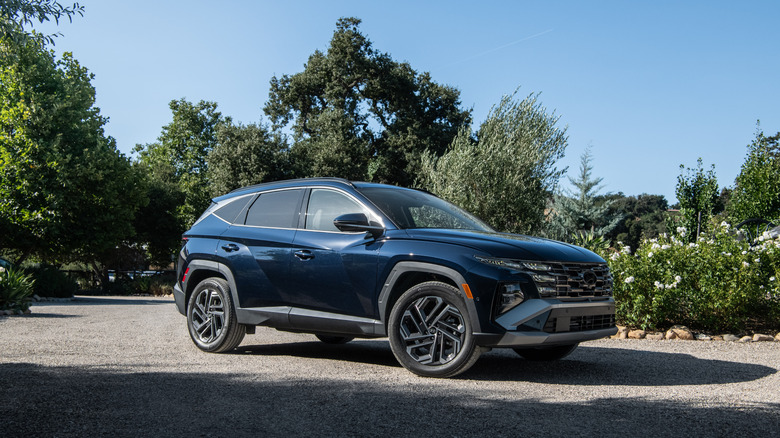
Obviously, the Kia was lauded by the folks at Edmunds, and the first-place Hyundai Tucson shares many things with its subsidiary sister (they are based on the same platform), but it was the minutiae baked into the Tucson that put it over the top for Edmunds. Here's what we mean: While both SUVs have solid powertrains (they use the same 231-hp powertrain), tight and direct steering, well-fashioned interiors, good standard tech, nimble suspension, and good modern technology, Edmunds felt that the Tucson did a few of those things slightly better than the Sportage.
For example, the center screen used in the Tucson was criticized for housing the climate controls but applauded for not using the screen for any other major functions like the Kia's does. Additionally, small-item storage was slightly better than the Kia, giving it the edge in that particular section of competition.
In essence, the Tucson did everything as well as its Kia cousin, but it got a couple of extra things right. Funny enough, they both have poor fuel economy (35 mpg) for hybrid vehicles, cancelling each other out in that respect. To conclude, we'd like to say that while we respect Edmunds' opinions, this ranking is just that — an opinion. You will find other reputable and compelling reviews that give very different scores. So, to sum it up, don't shoot us, we're just the messenger.