

Can-Am Origin Is An Interesting Electric Motorcycle With Limited Real-World Practicality
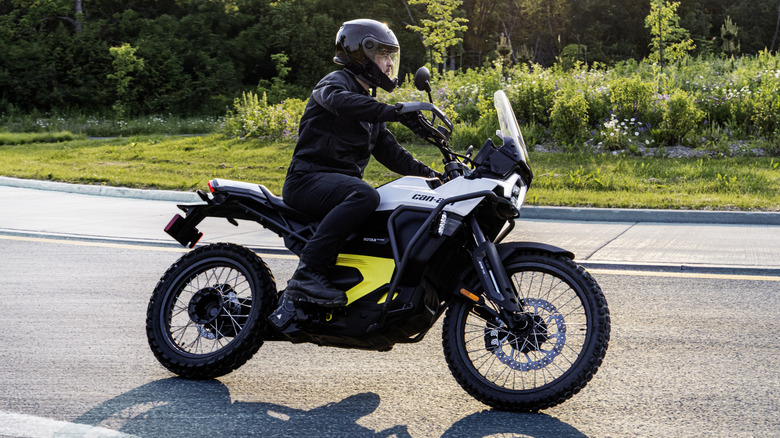
I'm a big fan of electric cars. For most applications, I think they're better than gas cars in nearly every way, especially when it comes to the boring task of just driving around town. That's why I was so excited to try out my first electric motorcycle — the Can-Am Origin — but my experience was a bit of a mixed bag.
The healthy torque numbers, relative tossability and feature-packed driver infotainment system meant there was a lot to like about riding about Origin. However, the damn thing used up its battery the same way a Dodge Challenger Hellcat goes through gas. The entire time I was riding, trying to enjoy myself, I couldn't help but wonder if I had enough juice to make it back home, drawing a 30-ish-mile circle around my home, making sure not to stray any further for risk of being stranded or having to stand awkwardly at an EV charger as the bike slowly juices back up. If you're someone who has a very regimented work commute and is looking for a fun way to dispatch it, the Origin is arguably the way to go. For every other application, this guy just isn't there yet.
Full Disclosure: Can-Am lent me an Origin with a full charge to do with as I pleased for a full month. It was mighty kind of them.
Power player
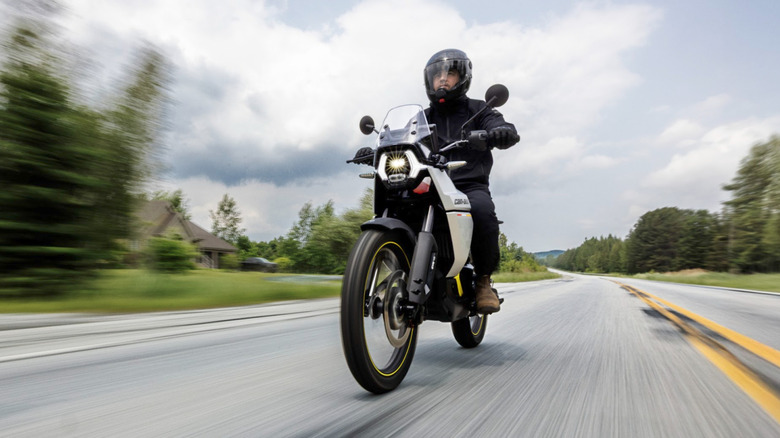
As with its Can-Am Pulse sister, the Origin is powered by a Rotax E-Power motor that pumps out a solid 47 horsepower and 53 pound-feet of torque. It's enough to get the 412-pound pulse (and 230-pound rider) from 0 to 60 mph in about 4.3 seconds, according to Can-Am. Keeping my head down with the throttle pinned, I easily — and silently — hit the electronically limited top speed of 80 mph, all while draining the life out of the Origin's 8.9-kWh battery pack that also serves as a structural part of the chassis.
 Andy Kalmowitz / Jalopnik
Like all EVs, this thing's torque is instantaneous with a quick twist of the throttle, and it's incredibly easy to get in trouble. That's why Can-Am throws in some drive modes (Normal, Eco, Rain, Sport+, Off-Road and Off-Road+) to calm everything down. Of course, there is a full-kill mode, but be prepared to hold on. It's also got selectable levels of regenerative braking, which can be activated by twisting the throttle forward. It takes a bit of getting used to, since that's a motion you rarely do on a bike, but it's important for getting back as much of that precious battery as possible.
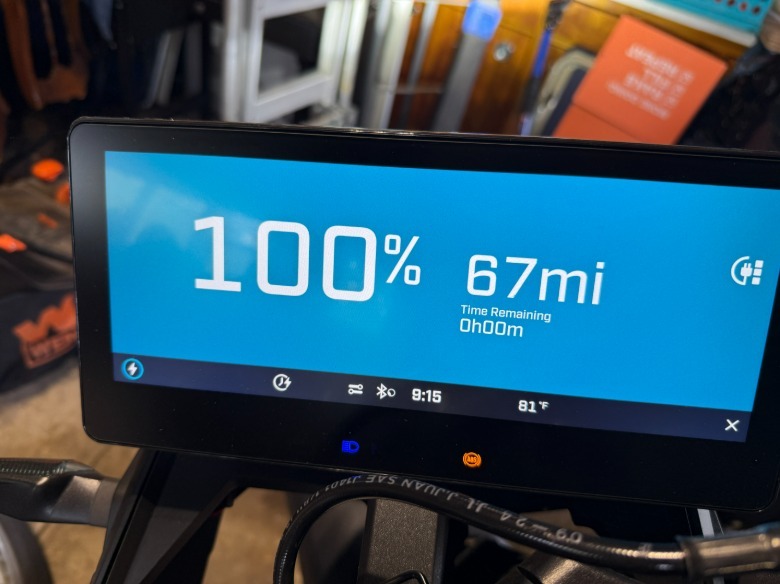
Can-Am says the Origin can travel up to 90 miles in the city and 71 miles in mixed riding, and those numbers are generous. When I fully charged the Origin, it said I had 67 miles of range to play with. That is a brutally low number. Over my testing, I averaged about 10 miles per kWh, so even in a best-case scenario where I ran it all the way to empty, I'd only be able to travel about 89 miles. That's just not good enough.
 Andy Kalmowitz / Jalopnik
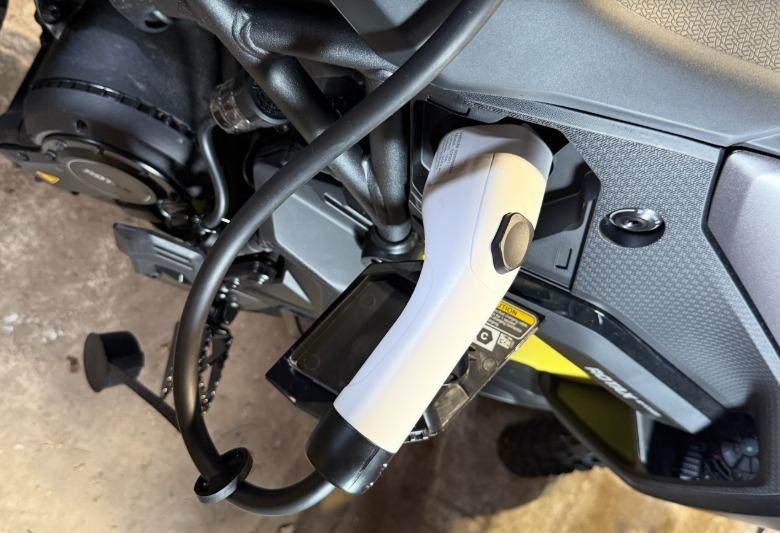
Perhaps things would be a bit more forgivable if the Origin charged quickly and I was able to take advantage of public chargers, but it doesn't, so I couldn't. The Origin only supports Level 1 and Level 2 charging — no DC fast-charging found here, which means the quickest you could possibly charge from 20% to 80% is about 50 minutes, and that only equates to around 40 miles. Charging from 0% to 100% with a Level 2 plug takes about an hour and a half, and with Level 1? Forget it. You're looking at about 3 hours and 10 minutes for 20%-80% and dead empty to fully charged in over 5 hours.
Making a case
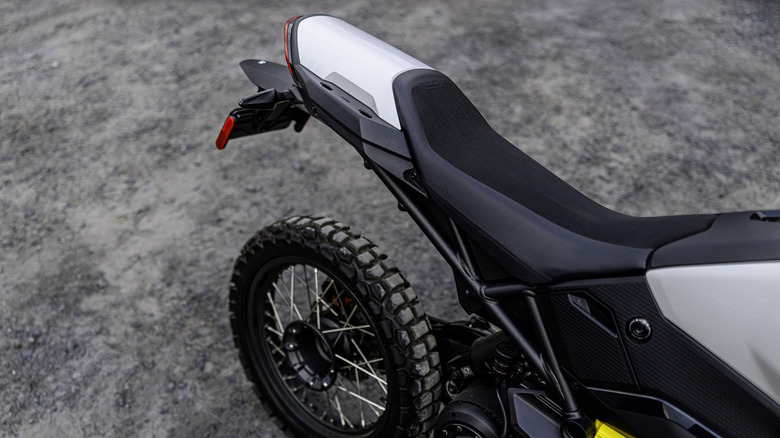
There's a very specific use case where the Origin makes all the sense in the world to me. Follow me down this path, won't you? Imagine you live in the suburbs and you've got a daily commute to the Big City that is about 40 miles round-trip. The Big City has terrible, craggly pavement that requires a bit more suspension travel than something like the Pulse would give you, and you're tired of driving your Terrible Evil Car into the Big City. Boom. The Can-Am Pulse is perfect for you.
Really, other than the range letdown, the Origin is a lovely daily commuter bike. I'm sure it also can handle business off-road, but I'm too much of a little baby scaredy cat to mess with that sort of stuff. Plus, most of these things will never see the dirt anyway.
 Can-Am
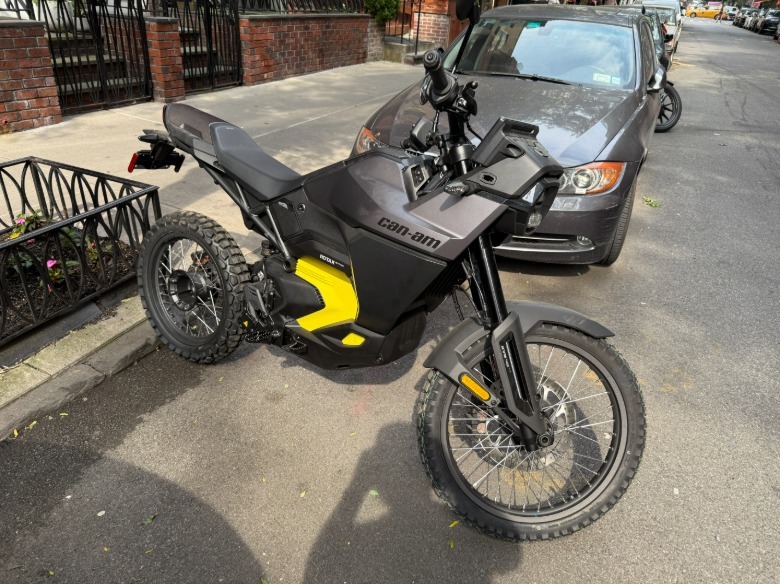
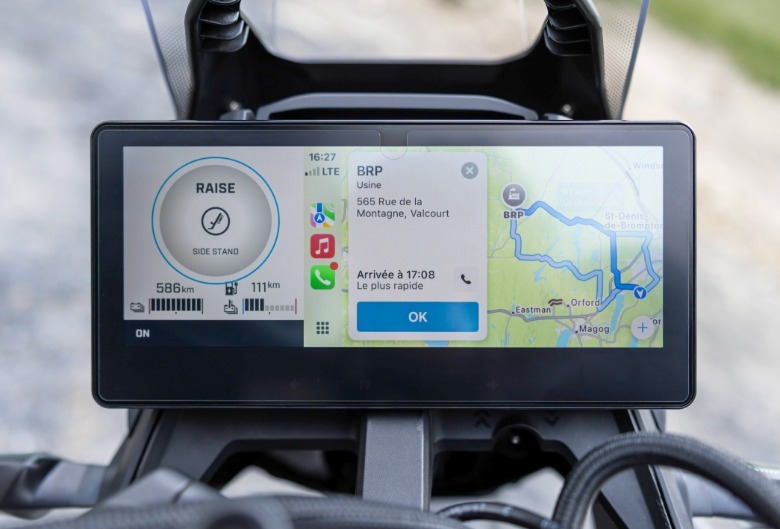
Can-Am went out of its way to give the Origin a ton of thoughtful creature comforts you won't see on many other bikes this size. Hell, it's even got a reverse gear, something that was super useful for me when I was parking it on the streets of New York City. The big thing this bike has going for it, though, is the brilliant 10.25-inch touchscreen interface that serves as your gauge cluster as well as an Apple CarPlay display. It lets you set up the bike exactly how you want to, and is very helpful for keeping an eye on that range. The added benefit of CarPlay means you'll always be able to know how far from home you are, and you can play all your favorite tunes without using some janky handlebar-mounted phone holder. The one drawback is CarPlay is wired-only, and you'll need a USB-A plug. At the very least, Can-Am provides a cubby for your phone where the gas tank would usually be, so it's not that big a deal.
The running gear
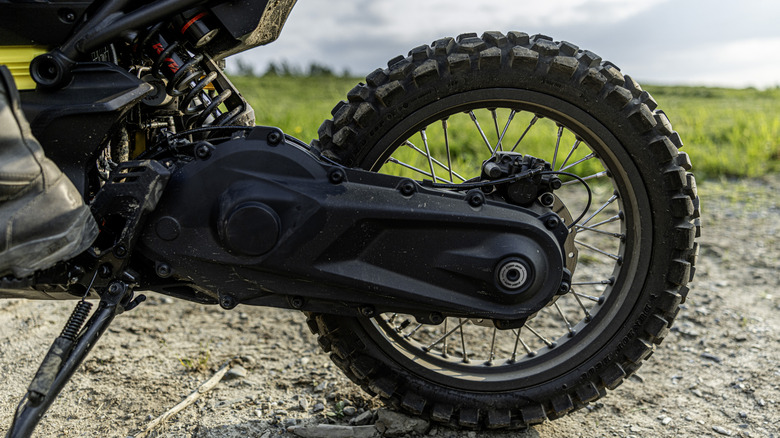
Helping the Origin's commuter creds is the fact that it's really damn comfortable. I'm 6-foot-1, and the rider triangle (seat, pegs and handlebars) all felt really well placed. As someone who prefers a more upright riding position, this certainly gives that, and even though I've got a rapidly shrinking ass, the seat felt comfortable enough for the longest journey you could ever conceive of doing in this thing, too.
Giving the Origin its dual sport creds are the suspension, wheels and tires. It comes with a 21-inch wheel up front and an 18-inch wheel out back. Both are fitted with knobby Dunlop D605 rubber. There's a 43mm KYB front fork and a single swing arm in the rear, which always looks cool. All in all, the Origin has 10.2 inches of ground clearance, which is more than enough to deal with even the gnarliest potholes in NYC. Despite the 34.5-inch seat height, I had no issue flat-footing the bike with my 32-inch inseam while wearing boots.
 Andy Kalmowitz / Jalopnik
It's also got plenty of stopping power thanks to the two-piston 12.6-inch front disc and one-piston 9.4-inch rear disc, both supplied by J.Juan. When you add in the regenerative braking, ABS and traction control, it's very easy to feel at ease on the Origin.
Fun while it lasts
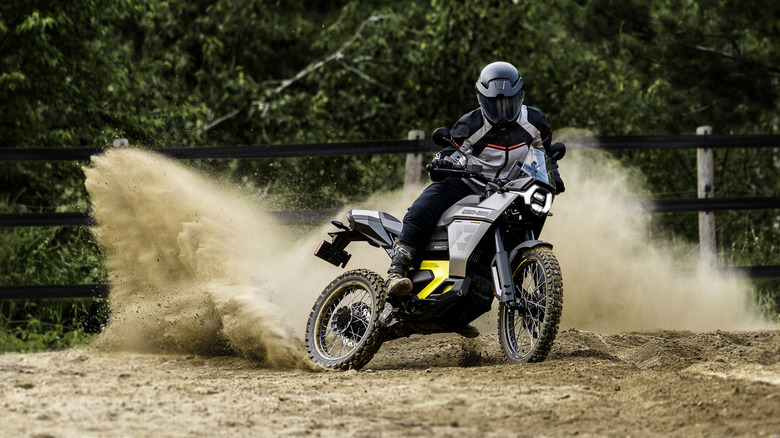
The Origin is a hoot to ride. Around town or on a curvy backroad, the off-road-focused dual-sport eggs you on to push a little bit harder. The only issue is that the harder you push, the quicker the fun ends.
I tried to think of other drawbacks of the Origin, and it's hard to come up with them. It's built well, it has plenty of features, the technology is neat to say the least, it's fun to ride, and it even looks pretty damn good. I suppose it does come at a bit of a price. The 2026 Can-Am Origin starts at $11,499, not including destination. That's definitely not cheap, but it is actually a $3,000 price cut compared to the 2025 model, so that's nothing to sneeze at.
The Can-Am Origin is a genuinely interesting bike. I do think it could work well in a lot of people's lives, just so long as they're okay with not using it very much, or they're open to finding a job in The Big City.