

10 Of The Rarest Chevy Muscle Cars Ever Made
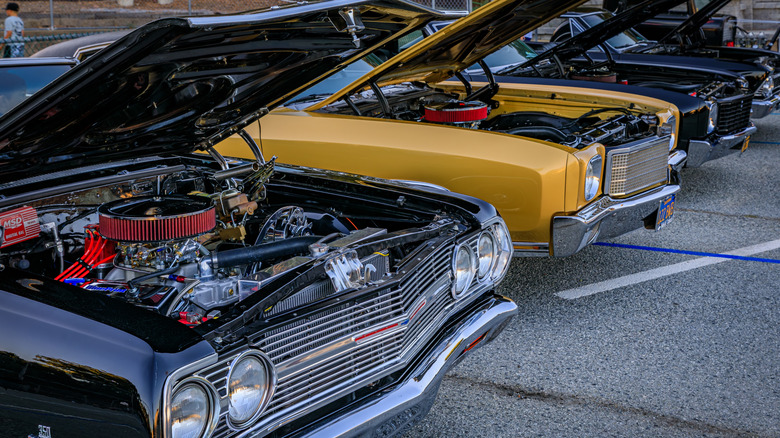
The title of "muscle car" gets thrown around for almost any old American performance machine, but the classic idea is simpler: it's a mainstream front‑engine street car built around big power and straight‑line attitude, not a delicate two‑seat sports car built primarily for handling. That definition matters here, because Chevrolet has plenty of rare performance icons. Even the first Corvette ever made is excluded from this definition. Chevrolet consistently frames the Corvette as a sports car, and standard definitions of "sports car" lean toward speed‑focused two‑passenger layouts.
As such, this list is about the other Chevy vehicles that were built in more usual body styles and turned into monsters through special packages, racing‑driven approvals, or dealer‑level innovation. We're ranking these cars from least to most rare, focusing on a time when some think American muscle peaked, using production totals for specific high‑performance variants with numbers that show up repeatedly in enthusiast records, factory paperwork, and major auction documentation. If a model's rarity is mostly rumor, it didn't make the cut.
This list gets Yenko‑heavy near the top, and that isn't because of favoritism. Don Yenko's Chevrolet dealership became famous for tiny runs of upgraded cars with consistent branding and well‑tracked build counts, making them easier to verify but harder to find. Some were even ordered through Central Office Production Order (COPO) channels to dodge internal restrictions.
1967 Chevrolet Camaro Z/28

The first‑year Z/28 is rare because it was built to satisfy racing rules, not to chase casual showroom shoppers. That's why Chevrolet only produced 602 of them for 1967. In a Camaro lineup with dress‑up trims and big‑block dreams, the Z/28 was the focused one with a small‑block package where displacement limits pushed engineers to get clever instead of just getting bigger. This led to the car that began the Camaro Z/28's history.
That clever part is the 302 cubic‑inch V8. On paper, it was rated at 290 horsepower, but the real appeal was how it delivered that power with a high‑rev attitude, quick responses, and a personality that felt closer to a track tool than a boulevard cruiser. Rarity alone wasn't make a car special, but the Z/28's scarcity is tied directly to its purpose. It's a project Camaro that proves Chevrolet was willing to build a niche, numbers‑limited performance model just to play in the right racing sandbox. That kind of backstory helps explain why verified examples matter. When only a few hundred existed to begin with, clone culture becomes part of the conversation.
1969 Chevrolet Chevelle COPO 427 (COPO 9562)

COPO cars exist because enthusiasts don't like being told what they can't order. In 1969, this Chevrolet system, meant for fleet and special purposes, became a backdoor for serious performance. The COPO 9562 Chevelle is a factory‑built vehicle that could come with a 427 cubic‑inch L72 big‑block, and it's documented at just 323 cars produced.
The contrast is what makes it so fascinating. A COPO Chevelle could look like a plain coupe while hiding the kind of engine you'd expect in something louder and flashier. The car's whole point was to run hard without announcing itself from half a block away. On the performance side, the numbers tell the story. Period specs cite the L72 at 425 horsepower, a rating that instantly puts this Chevelle in the top tier of factory muscle from the era. But the rarity isn't just from the engine, but the ordering method, too. COPO builds were special‑case cars, and that means authenticity lives in documentation with build sheets, codes, and origin.
Survivors are highly prized alongside the mainstream 1969 Chevrolet Chevelle. With a production total in the low hundreds, a small number of clones or tribute builds can muddy the waters. A real COPO 9562 isn't just a rare, fast Chevelle. It's proof that the right paperwork could bend the factory rules. If you manage to find one, it's probably already in a collector's hands.
1965 Chevrolet Chevelle Z16

Before "big‑block Chevelle" became a familiar phrase, Chevrolet tested the waters with the Z16. Hemmings has described it as "a high‑profile showcase for the new street version" of Chevrolet's Mark IV big‑block, with the driveline strengthened to survive the added punch. The production math is what earns it a spot here with 200 coupes, plus a single convertible, for a total of 201. That one‑convertible detail is the kind of trivia that turns into collector obsession. The factory-built ragtop reportedly disappeared long ago, which means the only way to see a Z16 convertible today is through a clone built to match the original concept.
The coupe package is plenty special on its own. An L37‑code 396 is rated at 375 horsepower and backed by the kind of supporting parts you'd want when you're trying to make a Chevelle feel like a prototype for the SS396 boom that followed. In general, the Z16 is also hard to talk about casually. With production counted in the hundreds, attrition is brutal and clones are inevitable, so authenticity becomes a documentation game as much as a mechanical one. It isn't the loudest Chevelle, but it's one of the most important. Chevrolet was able to prove the formula with this model right before the muscle car era caught fire.
1970 Yenko Deuce (Nova)

By the time muscle cars hit their stride, there was a problem for buyers who wanted the wild stuff. The factory couldn't always sell you the exact combination you wanted, and corporate limits were always changing. Dealer specials filled that gap, and few names hit harder than Yenko. The 1970 Yenko Deuce takes that formula and applies it to the Chevrolet Nova by being small, simple, and ready to embarrass bigger cars.
Production is cited at 175 Deuces, which is the kind of number that turns a cool story into a genuine rarity. Instead of building another big‑block poster car, Yenko leaned into a high‑output small‑block approach paired with the dealership's signature branding. It's the kind of machine that feels like a street fight in formal wear. It was compact outside, but serious under the hood.
The rarity here comes from the identity, too. A Yenko Deuce is a Nova you can't fully understand unless you know what you're looking at. It has the right stripes, badges, and conversion details that separate it from any other Nova. Yenko cars are well-documented because the conversions were a defined program. That documentation is why the collector community treats them differently than random dealer-installed folklore. In short, the Deuce is rare by intention, and that plays a major part of what made it so famous.
1969 Yenko Chevelle

The Chevelle didn't need help being a muscle car. It was already the mid‑size Chevy you bought when you wanted real power without going for full luxury. But a Yenko Chevelle is what happens when "already fast" isn't enough, and a famous dealer decides to build the version that the factory won't advertise. Only 99 Yenko Chevelles are documented for 1969, and that small number is a big reason as to why these cars feel mythical. The core idea was simple: take a Chevelle platform buyers already trusted and turn the dial to "supercar" with the right high‑performance engine combination and a package that made the conversion recognizable.
Yenko's branding matters here. Its badging and stripes make the cars easier to track than random one‑off dealer builds. That traceability is a huge part of the rarity story; a low production number is one thing, but a low number with a paper trail is something else entirely. Collectors chase Yenkosbecause the name continues to carry weight without any lingering uncertainty. There's also an emotional reason the Yenko Chevelle lands this high on the list: it's the most "classic muscle" shape here that still carries the secret‑handshake status of a specialty build. In other words, it's rare in the way enthusiasts love most: familiar, ferocious, and almost never for sale.
1968 Yenko Camaro

The Camaro was already Chevrolet's youth‑market weapon, but the Yenko version is where it became a dealer‑built supercar with a signature. For 1968, the conversion count is documented at 64 cars, which makes the idea of spotting one in the wild a bit of fantasy. Yenko's conversion program was built around delivering big power in a compact shape, then marking it with the graphics and details that made Yenko cars recognizable – even to people who didn't know the details. That matters, because the rarity conversation is more about how clearly these scarce few models can be authenticated decades later.
There's also a context point for this model's inclusion here. Yenko Camaros weren't a single one‑year lightning strike. The program spanned multiple model years, which means the story is broader than a single production figure. That's why this 1968 run sits here instead of later in this list. 64 is small, but the Yenko Camaro lineage simply continued here after 1967.
Still, the 1968 cars are special because they come from the dealer-supercar era, which was when showroom rules could be bent by the right dealer, the right paperwork, and the right buyer with enough nerve. Today, that translates into collector gravity and a constant need for documentation, because the badge means plenty while the cars are few in number.
1969 Chevrolet Camaro ZL-1

The ZL‑1 Camaro is the kind of car that sounds fictional until you see it. In 1969, Chevrolet famously built 69 cars, pairing the Camaro with an all‑aluminum 427 cubic‑inch big‑block. It's a muscle car that reads like a loophole, and that loophole is the point. Like other COPO-era oddities, the ZL‑1 exists because certain buyers wanted maximum potential, and normal ordering wasn't going to hand it to them. The result was a Camaro that looked familiar but carried hardware far beyond the typical big‑block formula.
Period figures cite the ZL1's factory numbers for horsepower in the low 400s, but the ZL‑1's legend is built on the idea that its real capability was far nastier than the brochure suggested. Either way, it's a serious engine in a compact shell, and that combination is why the ZL‑1 became the rare big‑block Camaro everyone talks about.
The rarity here certainly isn't abstract. 69 cars means the entire production could fit in a small parking lot. And because the ZL‑1 is so valuable, the authenticity conversation is relentless. The details matter because the market is full of people who would love to own the story — even if they can't own the car. That's why this Camaro ranks so high. It's a factory-backed outlier that sits at the intersection of rules, racing, and audacity.
1963 Chevrolet Impala Z11

If your mental picture of muscle starts with the late 1960s, the 1963 Impala Z11 is a reminder that Chevrolet was hunting drag strip wins earlier with full‑size sedans. The Z11 was a competition package with a tiny batch of 57 cars. It was built to improve quarter‑mile performance by giving a big Impala the kind of hardware normally reserved for racers. It was a factory-backed, drag-focused setup with a high-performance engine and weight-saving measures aimed at helping the car leave harder and run quicker. In other words, this is Chevrolet treating a family-sized car like a weapon.
That makes the Z11 rare in a different way than the COPO and Yenko cars on this list. In this case, Chevrolet simply built what was needed in the smallest number required. Because production was so limited, surviving examples tend to be treated as artifacts, not just collectibles. Documentation becomes everything, and restoration choices get scrutinized because the cars are valuable precisely due to their specificity. There's no "close enough" when only a few dozen existed.
At this point in the ranking, the totals are so small that scarcity becomes physical. You're not searching for one on sale, just hoping for one that actually surfaces. The Z11 sits here because it's early, purpose-built, and nearly extinct by the numbers.
1967 Yenko Camaro

The first-year Yenko Camaro is where the dealer-supercar era gets real. For 1967, the conversion count is at 54 cars, a number so small it pushes this first‑year Super Camaro near the top of our list — even though the program continued later. This car is like the ones you might see in some of the largest private car collections in the world.
Camaro buyers wanted more in Chevy's new pony car, but factory rules and corporate caution didn't always make that combination easy. Yenko's dealership responded with a defined conversion package containing a serious engine and unmistakable branding. Most are associated with 427 cubic-inch power and the visual telltales, such as Yenko striping, badges, and the "sYc" (Yenko Super Car) vibe that separates a real car from a tribute when you pop the hood today.
That program is why these cars are easier to verify but harder to buy. Auction descriptions and enthusiast histories lean heavily on documentation. The 1967 examples matter most, as they're the beginning of that lineage. Later Yenko Camaros exist, but this is their origin point. At 54 built, you're not choosing between options — you're waiting for an opportunity. Rarity is the headline, but the bigger point is the workaround of a dealer using a conversion program to build what Chevrolet wouldn't.
1969 Yenko Nova S/C 427

There's rare, and then there's the 1969 Yenko Nova S/C 427. This sits at #1 because its production covered just 38 cars – the smallest number in this lineup. Scarcity that clean is truly rare; this car is the right canvas for this kind of legend, being compact without looking like the scariest thing at the light. The Yenko twist was to turn that modest shell into a supercar by dropping a 427 cubic‑inch big‑block into the mix, then backing it up alongside other Yenko builds with conversion details that made them recognizable. They had branding, specific equipment, and a story collectors could trace.
Plenty of Novas have been built with big power, but a Yenko S/C is valuable because it's not just a recipe. It's a limited run tied to a famous dealership and a specific moment in the muscle‑car era. Yenko's hype was simple, combining a big engine with a small car and low production. It's the same setup that makes a short‑wheelbase car feel rowdy, amplified by the idea that Chevrolet's wildest combinations often came through special channels. Finding one is less like shopping and more like archaeology. When only 38 models exist, every surviving car feels like a moving headline. This hasn't been about finding the ultimate muscle car, but seeking the rarest Chevrolet. That's why this Nova tops the list, being the rarest of rare: a compact Chevy turned into a monster.