

Why Ford Mustang Fans Are Still Salty The Boss 351 Beat The 429 Cobra Jet In 1971
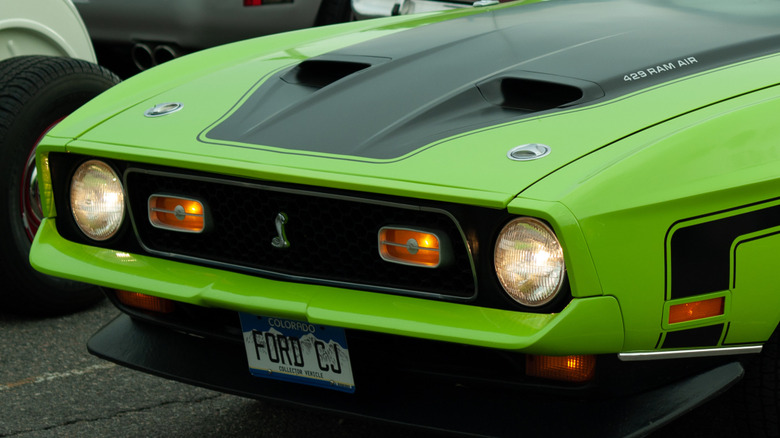
A single road test can solidify or tarnish a car's legacy. Sometimes the tarnishing is well-deserved, such as when a car can't deliver on expectations. One needs only to scan the Car and Driver test of Jerry Wiegert's constantly breaking Vector W8 to understand that level of disappointment (though Wiegert was probably more disappointed when then-Lamborghini-owner Megatech forced him out of his company). What's more frustrating is when the test forever diminishes a car's reputation, yet the details have been ignored even though they change the entire picture. Such is the case with a 1971 comparison by Motor Trend of three Mustangs: A Boss 351, a 429 Cobra Jet-powered Mach 1, and a standard hardtop with a 302.
Let's ignore the base Mustang and focus on the Boss 351 and 429 Cobra Jet. In the acceleration tests, the 429CJ lost. Despite having 370 horsepower and 450 pound-feet of torque compared to the Boss 351's 330 hp and 370 lb-ft, the 429 CJ was behind in every metric. The Boss 351 sprinted to 60 in 5.8 seconds, while the 429CJ needed 6.5. The quarter-mile was even more embarassing, as the Boss flashed through in 13.8 seconds at 104 mph, while the 429 posted a comparitively lazy 14.61 seconds at 96.8 mph.
Taken in a vacuum, this might seem like the 429 had overinflated power numbers or the 351 was stronger than advertised, but that doesn't account for literally everything else. The Boss 351 had a 3.91:1 final drive, while the 429CJ Mach 1 had a 3.25:1 ratio. Only the Boss had a four-speed manual, while the 429CJ was saddled with a three-speed Cruise-O-Matic slushbox. Motor Trend's 429CJ also had air conditioning, a power parasite not found in the Boss 351. In other words, it wasn't a fair fight.
We're not done here. The 429 Cobra Jet deserves more redemption
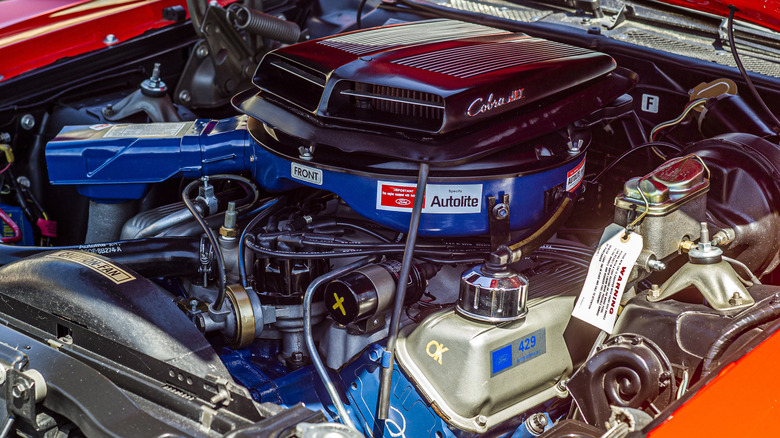
Here's another thing. That Boss 351 had aftermarket headers on it. Opening up an already respiration-prosperous 351 Cleveland with better-breathing exhaust doesn't make for an apples-to-apples comparison. Then there are the tires. Both the Boss 351 and 429 Cobra Jet were running F60-15s, which have a tread width of 8.25 inches. No doubt the torque-spewing, nose-heavy 429 would have had trouble hooking up compared to the lighter 351. This difference would have likely disappeared with slicks — or at least some wider, grabbier tires — on both cars.
Were there other period tests than Motor Trend's? Yes, and they were also unflattering on the surface, yet telling in the details. Sports Car Graphic tested a '71 429 Cobra Jet Mustang and also got a 14.6-second quarter, this time with a four-speed manual. However, the tires were F70-14s, which have a tread width of just 6.7 inches. Also, the differential was still pretty tall at 3.50:1. However, the trap speed was 99 mph vs. Motor Trend's 96, indicating that Sports Car Graphic's car was accelerating harder as it went, likely after the narrow tires grabbed and stopped producing more smoke than thrust.
A test that may more accurately reflect the 429CJ's grunt is the one found in Super Stock magazine. That test acheived a 13.97-second quarter at 100 mph, and Super Stock's car had an automatic and air conditioning. There's no gear ratio mentioned, but that 429CJ 'Stang was riding on 8.4-inch wide G60-15s, perhaps offering a smidge more traction than the F60s on Motor Trend's car.
Who's the Boss?
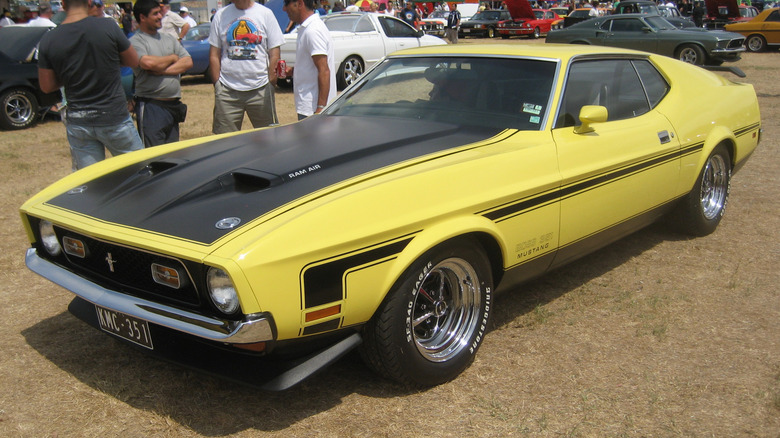
If you were car shopping and found Cobra Jets just weren't super enough, Ford also offered Super Cobra Jets! Super Cobra Jet 429s have four-bolt (vs. two-bolt) mains, forged (vs. cast) aluminum pistons, a 780-cubic-feet-per-minute (vs. 715-cfm) carb, an oil cooler, and a solid-lifter cam. That got you a 5-horsepower bump to 375 (wink, wink, nudge, nudge). Hemmings estimates standard CJs were close to 400 hp and SCJs were near 430. Plus, SCJs locked buyers into either a 3.91:1 or 4.11:1 final drive.
What's frustrating is that period tests for the 429 Super Cobra Jet seem nonexistent. Supercars '71 tested a Cobra Jet that at least had 4.11:1 gears, and despite the automatic transmission handicap and riding on 6.4-inch wide E70-14s, it ran a 13.4-second quarter at 105 mph. Imagine if it had some wider tires! Apparently, it was a 429CJ with a specially delivered Detroit Locker rear.
Meanwhile, most Boss 351 tests show quarter-mile times under 14 seconds. But gallingly, nearly all tests used prepped or modded cars. Motor Trend's car had aftermarket headers. Hot Rod and Car Craft's Boss had headers and a disconnected rev limiter. Popular Hot Rodding's Boss had headers and traction bars. Only Car and Driver's Boss 351 appeared stock, and even then, magazines were known to get ringers for the best numbers regardless of what actual showroom vehicles would achieve. Plus, testing procedures were less rigorous or standardized then.
The point is, Mustang fans deserve to be salty. Even now, 55 years later, the ripple effects can be felt in values for 1971 Ford Mustang Boss 351s vs. 429CJ Mach 1s. Boss 351s are consistently worth thousands of dollars more. And forums still have users saying magazine tests showed the 429 was slower. Man, Rodney Dangerfield got more respect.