

How Did The Buick Nailhead V8 Get Its Name?
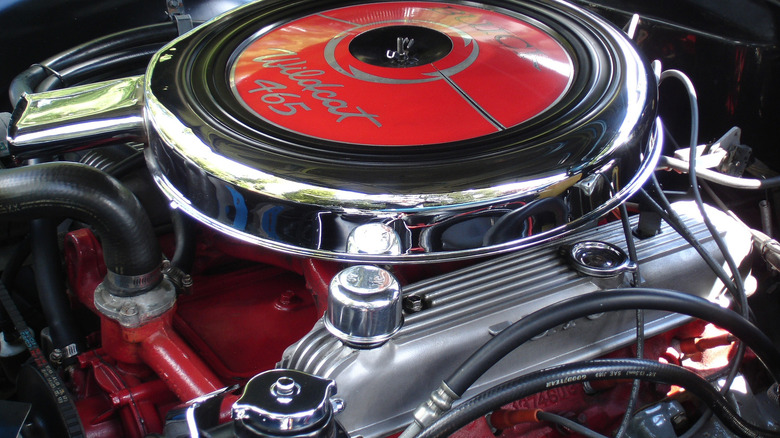
No, "Nailhead" is not the guy on the movie poster for Clive Barker's "Hellraiser" — that's Pinhead. The name "Nailhead" is a direct result of Buick trying to make a V8 as slim as possible.
Buick's 322-cubic-inch Nailhead was a relative latecomer to the overhead-valve V8 scene when first offered in 1953, at least as far as the more luxury-oriented brands went. In 1949, Cadillac debuted its 331-cubic-inch High Compression V8 and Oldsmobile released the 303-cubic-inch Rocket V8. Chrysler was rocking FirePower hemi-headed V8s in 1951, and over at Ford, Lincolns got Y-block V8s in 1952. Perhaps waking up like Rip Van Winkle, wondering where the years went, GM's third-tier prestige division got to work on a V8 to fill the tight-shouldered hole of its aging, bulky straight-eight that had hung around since 1931.
In fact, Buick was so concerned with engine girth that it tried V8s with Volkswagen VR-adjacent 22.5- and 35-degree vee angles. Since V8s much prefer being at 90 degrees so as not to create stupendously unpleasant vibrations, these weren't going to work. Buick sucked it up and went 90 degrees, but was dead set on keeping those heads from poking out too far. So Buick set all eight valves in each head perfectly vertically in a straight line, looking like nails in a board under their covers. The valves were quite tiny, too: 1.75-inch intake, 1.25-inch exhaust.
But Buick never called the engine "Nailhead" — that was a nickname bestowed by hot rodders. Flip open the January 1954 issue of Buick Magazine and the copy brags about the new "Fireball" V8. The brand later called it "Wildcat" and "Super Wildcat," too, because Buick understood cool names.
It's not the size of the valves, it's how you use them
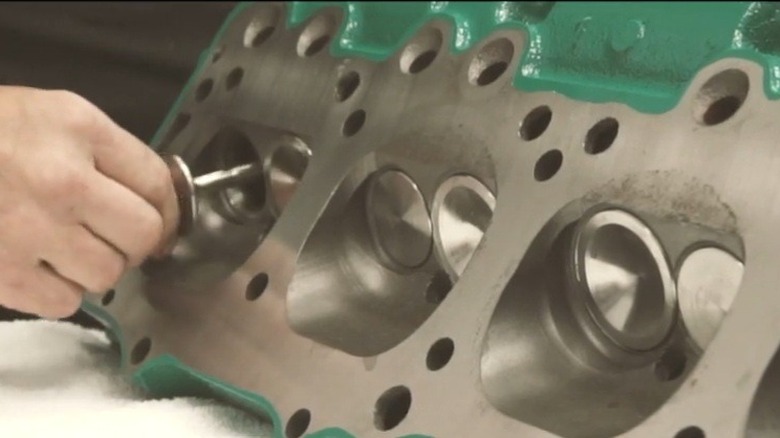
Don't think the eensy-weensy valves were simply an accident. They were part and parcel with the tight, compact, relatively high-compression (8.5:1) pent-roof chambers and domed pistons that helped Buick achieve the down-low torque it wanted. Everything was designed with purpose. SAE International paper 530248, written by Buick engineers Verner P. Mathews and Joe Turlay, claims "Improved combustion chambers and fuels permit higher compression ratios." And that 1954 Buick Magazine says, "The new combustion chamber, which has an increased volume to area ratio, means increased power and better fuel economy through better thermal efficiency."
The Nailhead couldn't breathe like a Hemi or rev like a Ford SOHC 427, but that wasn't the point. The top-dog 322-cube version in 1963 made a respectable 188 horsepower, but the real star was the engine's 300 pound-feet of torque at just 2,400 rpm. That being said, there's still a downside to Buick's design. While "crossflow" Hemi heads channel air across the chamber, making full use of its space for fantastic breathing, Nailhead valves are next to each other on one side of the pent roof. Intake ports can breathe fine, but air passing through the exhaust ports make a nearly 180-degree turn. It's like a four-valve pent-roof head with two of the valves permamently closed.
To make power with the Nailhead's shrimpy valves, Buick used stupendously aggressive cams. What would have been a lumpy, choppy cam on other engines was just the price of doing business to keep air flowing through a Nailhead. That first 322-cube Nailhead had a 282-degree intake/292-degree exhaust valve duration and an overlap of 67 degrees. By contrast, Chrysler's 331 FirePower hemi had a 252-degree intake/244-degree exhaust with 30 degrees of overlap.
The Nailhead was a drag racing monster
As displacements grew to 364 cubes, an AMC-like 401 cubes, then to 425 cubes (there was a small 264-cube version briefly, but let's focus on the displacement-rich), torque became a marketing focus. The Buick Wildcat 465's name didn't refer to cubic inches (425) or horsepower (340), but the torque rating of 465 pound-feet. Why all this focus on torque when plenty of people say horsepower is what really matters? Let's let BMW explain why torque rules: "High torque means the shortest possible delay between the driver pressing the gas pedal and the engine responding. The driver perceives the high torque as great traction when setting off or overtaking."
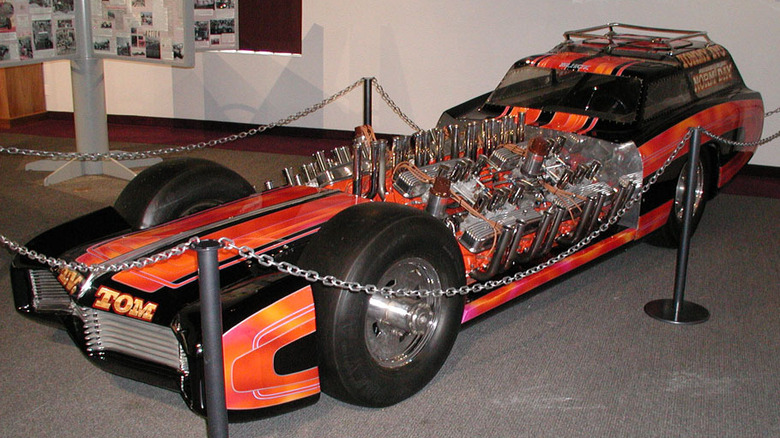
And here's where drag racers enter the Nailhead picture. On the drag strip, reaction times need to be millisecond-precise and launches have to get the car moving immediately. Torque is your friend in drag racing, and the Nailhead nailed it. Perhaps the most famous of these early drag racers who embraced the Nailhead's stump-yanking nature is TV Tommy Ivo. His single-engined and twin-engined dragsters are cool, but it's his four-engined dragsters that everyone remembers. Here's his Showboat dragster doing a four-wheeled burnout:
Unfortunately for the Nailhead, all the drag racer tricks with multi-carb setups and forcing the intake valves to become exhaust valves and vice versa could only mitigate the constricted breathing for so long. In 1967, Buick replaced the Nailhead with the dome-headed 400, 430, and eventually the glorious Buick 455 V8s.