

These 9 Trucks Have Super Cool Bed Features
Few technologies in the automotive industry have been truly perfected. Sure, Porsche may have come close to the perfect sports car with the 911, economy engines from Honda and Toyota might be just about as reliable a motor can get, and, of course, physical knobs and buttons should always be the industry standard. Truck bed innovations though? That's something that we don't pay enough attention to.
A truck bed is as simple and ingenious as technology comes. For decades, however, the basic engineering behind them remained largely unchanged and stagnant. Six or eight feet, a tie-down or step-side body style here or there — that was the extent of the story. To their credit, the manufacturers haven't given up. Truck bed tech is still very much an ongoing project, and over the last 20 years, especially, we've seen major strides in this area.
Some are complex, while others are no-brainers that should have been on factory trucks from the very beginning. Regardless, these are the ones you'll want to remember — here are the trucks with the coolest beds.
Utili-Track — 2004 Nissan Titan
The truck bed tie-down is nothing new, with manufacturers utilizing multiple anchor points and factory hardware to secure loads. However, the Nissan Utili-Track system may have been the best version of this concept. It began in the mid-2000s, first showing up on the full-size Nissan Titan and quickly bleeding over into the smaller Frontier just a year after the system's 2004 debut.
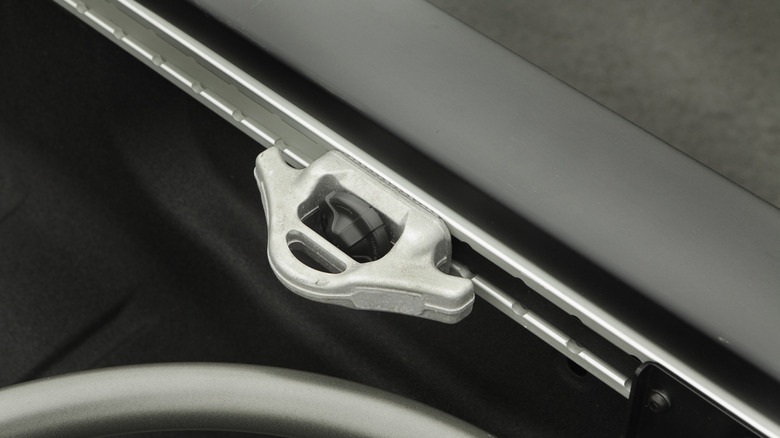
Using specially designed rails secured to the inner side of the bed walls, Nissan installed adjustable cleats that could slide along the length of the rails and be secured down at any point. Maybe the coolest feature, though, is the sliding floor channels. This consists of two metal rails that run along the length of the bed floor, acting in a very similar manner to the sliding rails on the bed's walls. Using the same adjustable sliding cleat system, it allowed for more awkward-sized loads to be secured to the bed floor.
You can also just get creative, using the floor rails to push heavier loads towards the back of the cab, or securing factory accessories like cargo boxes in neat arrangements. Of course, these floor rails also came with full-length covers, ensuring that any rocks or dirt you haul doesn't end up jamming the sliding components. Though remember, this equipment was, and still is, optional on Titans and Frontiers, so you'll want to find one that came from the factory with the utility-centered packages.
Ram's RamBox — 2009 RAM Trucks
There have been plenty of changes that drivers have had to adjust to as trucks have gotten bigger, such as thick A-pillars that keep creating worse and worse blind spots. However, there are a couple of advantages to larger stance of modern pickups — as the bed walls or siderails of modern trucks have grown you might have even started to think, "Hey, I could probably fit some stuff in there."
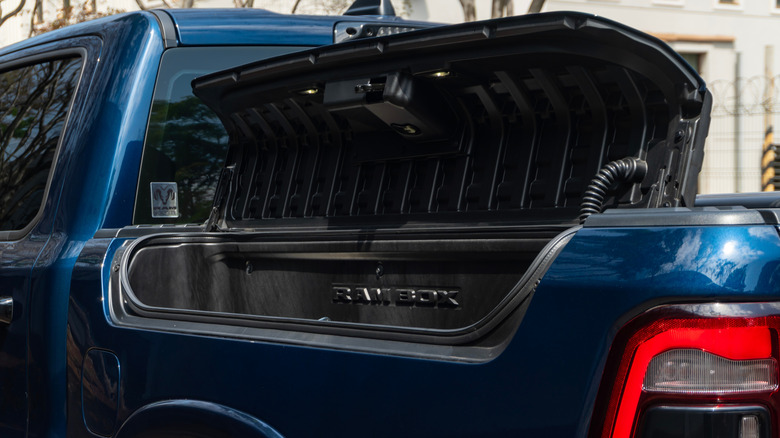
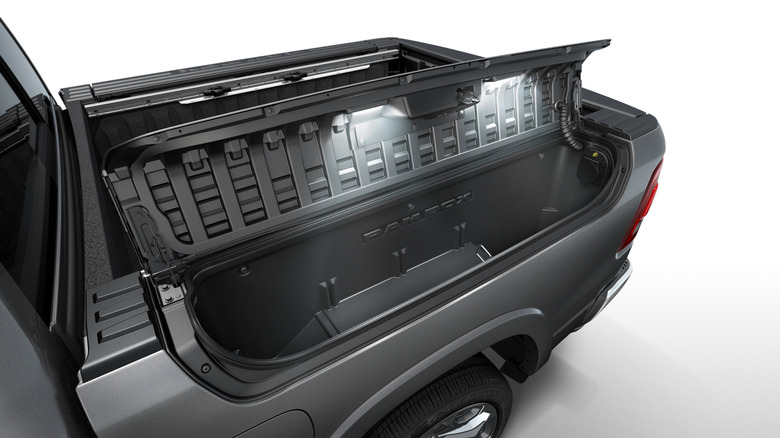
Ram certainly agreed, because since 2009 the American truck maker has been making the most out of that space sitting on the edges of your bed. Dubbed the RamBox, these storage compartments have been slightly changed over the last 15 or so years, but in general, the compartments are hinged at the top of the rail to open up on the exterior of the truck and allow anywhere from 7.3 to 8.6 cubic-feet of extra watertight storage on modern RAM trucks.
They now also come with built-in lighting and compatibility with other features like bed extenders and dividers. Our favorite nugget of information we found was one Ram dealership's claim that owners could fit 140 standard-sized cans with the RamBox. These savvy salesmen know exactly what those boxes will be used for, and the RamBox even comes with a drainage plug so you can keep those brews — we mean sodas — on a cold bed of ice.
Dual-Action Tailgate — 2006 Honda Ridgeline
For those who grew up in the 1970s, or have spent time around mid-to-late-century station wagons and utility vehicles, you'll probably throw up your hands in protest about Honda "inventing" the so-called Dual-Action tailgate. So, to clear things up, let's briefly discuss what this means.
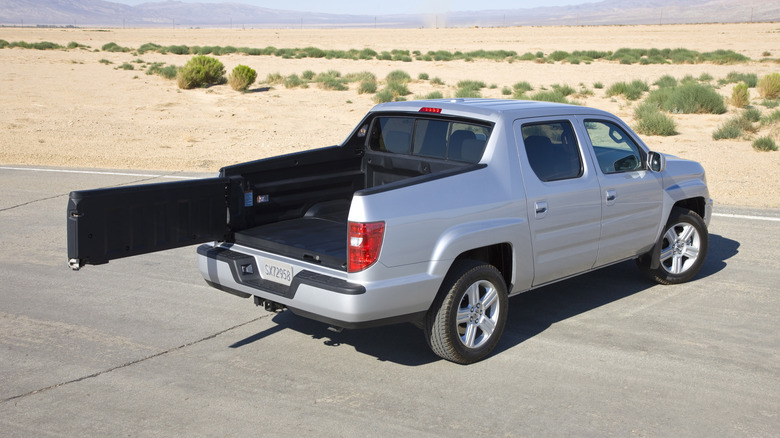
Decades ago, long forgotten wagons such as the Ford Country Sedan featured one of the coolest tailgate innovations ever. Sometimes called a drop-and-swing, or — as Ford endearingly called it — the Magic Doorgate, the system used a clever set of hinges that allowed the tailgate to drop down like a typical truck tailgate or swing open laterally like a door. In 2006, however, Honda debuted the first mass-market drop-and-swing tailgate in a pickup truck.
The Dual-Action tailgate first appeared in the unibody-constructed 2006 Honda Ridgeline, and did exactly the same thing as those old station wagons, just with even more user-friendly design features. When using the tailgate in swing mode, the door opens at 30-degree increments, ensuring you don't throw the heavy sheet metal open and smack another parked car, until it reaches its full 80-degree open angle.
Other tidbits include in-bed lighting when the tailgate was open, as well as hinges and mechanisms that could close even when packed in dirt, snow, mud, or dust. Unlike some other companies, Honda knows when it has a good idea on hand, which is why the Dual-Action tailgate has been a keystone feature of every Ridgeline model year since its debut.
MidGate — 2002 Chevrolet Avalanche
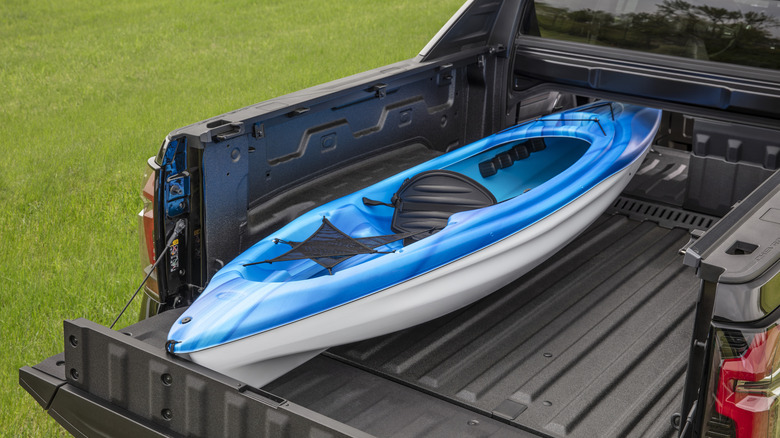
In 2002, both Ford and GM attempted to blend the comfort of an SUV and the utility of a pickup truck into one vehicle. Ford's attempt, the Lincoln Blackwood, was a F-150/Navigator crossover and was wildly cool in hindsight, but only lasted one year. GM's effort, while objectively unsightly, lasted quite a while. It was called the Avalanche, and was essentially the product of what happens when a Suburban and a Silverado love each other very much.
More specifically, this ugly duckling was based on the GMT800 body-on-frame platform that also housed the brand's other trucks and SUVs, but instead of being one or the other, it wanted to be both. As a result, GM's engineers needed to find clever ways to avoid its inherent utilitarian compromises, the best among them being the Avalanche's Midgate.
The feature consisted of a gate on the back of the cab that could open, adding several feet to the Avalanche's relatively short bed when the rear seats were folded down. The Midgate was no technological breakthrough, but it was a step forward in applying some out-of-the-box thinking to a tired area of design. It worked so well that GM also fitted the Midgate to its other big products like the Escalade EXT, as well as the GMC Hummer H2 SUT and GMC Envoy XUV.
To truck-averse enthusiasts, the 2013 death of the Avalanche may have been fine with you, but at the very least, this freak of nature was a fascinating experiment — heck, it even won MotorTrend's 2002 Truck of the Year award.
MultiPro Tailgate — 2019 GMC Sierra
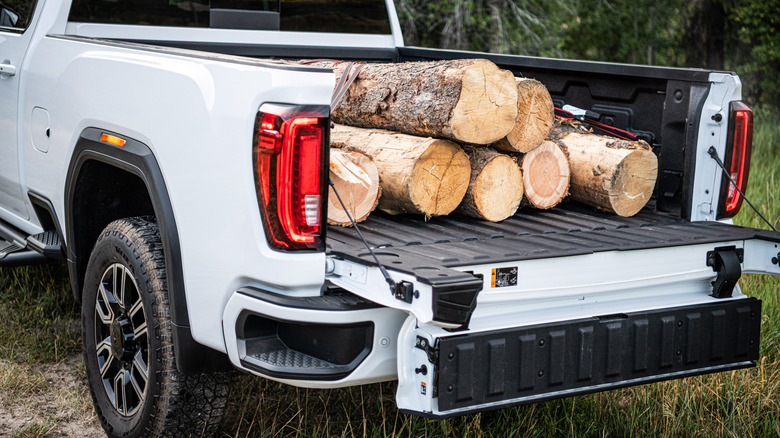
Like many great ideas, the MultiPro concept was born from a competition. However, while the average patented bed feature may have one or two individual nifty functions, this one had at least six at the time of its debut in the 2019 GMC Sierra pickup.
The project started when GM's engineering divisions were tasked with designing a new feature that would satisfy buyers' needs, with one group investigating the demand for easier entry and exit of vehicles. The project soon snowballed into a much more involved piece that would eventually become the MultiPro. So what it can do? First, there's the gate load stop. This is a flap on the inner side of the tailgate that flips up and acts as a stop for cargo inside the bed while the gate is in the open position. Next is the folding inner gate, which splits the tailgate in half, allowing the end to fold down and provide closer access to the bed.
Oh, but there's more. We then have the gate step, which is yet another flap on that folding end of the tailgate that runs nearly the full width of the truck, helping you enter and exit the bed more easily. This upper tailgate can be folded down while the lower portion is in the closed position, turning it into a small workbench (the load stop can also be used in this position). Last, but not least, there was even mounted Bluetooth speaker available. It's a lot of stuff – even if some of it felt a bit unnecessary back in 2019 – but you never know when you'll need it.
Grab Handle and Tailgate Step — 2009 Ford Trucks
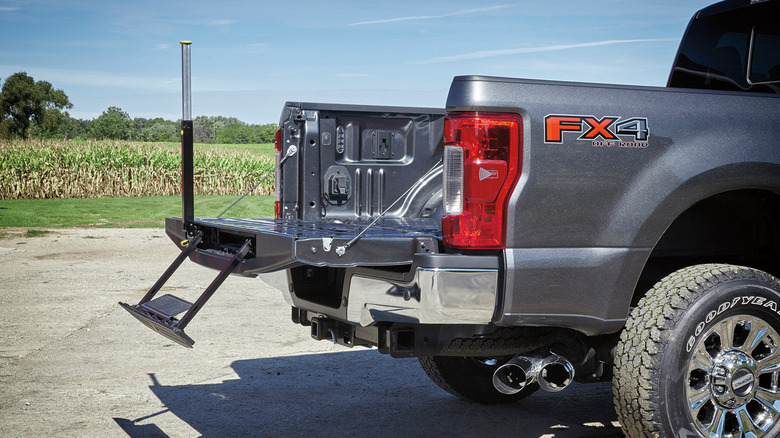
The MultiPro tailgate was revolutionary in its ability to pack so many helpful features into essentially one body panel, but it wasn't the first to introduce integrated ingress and egress features. Back in 1997, Ford revealed the Powerforce concept, an extremely modern (for the time) pickup prototype that set the stage for the future Super Duty lineup. It featured state-of-the-art components like sequential LED taillights, HID headlights, and the one feature we're particularly interested in — an electric tailgate that lowers to the ground, helping lift heavy loads into the bed and acting as a step for easier access.
Obviously, that special gate never made it to production, and it wouldn't be until more than a decade later that a tailgate step would finally make it to a road-going Ford pickup. In 2008, the optional tailgate step was debuted, which extended out from the tailgate and folded down. Also introduced to accompany the step was a new tailgate grab handle. When stowed away, it lay flush with the inside of the tailgate, but when lifted up, it provided extra balance for those entering the bed via the tailgate step.
With the extra addition of an attachable tailgate bed extender, one could argue this was the MultiPro before the MultiPro, just with fewer functions. Again, ultra-simple but super effective, and over the years, the design was so good that it's remained almost exactly the same over the last 17 years.
In-Bed Trunk — 2006 Honda Ridgeline
Producing an SUV-based truck using a unibody platform instead of a body-on-frame construction has always been taboo to dedicated truck folk. That's precisely why the Honda Ridgeline is such a polarizing vehicle. Never mind that Honda modified and strengthened the chassis with ladder-frame elements – it's still often considered the odd one out in the U.S. truck market.
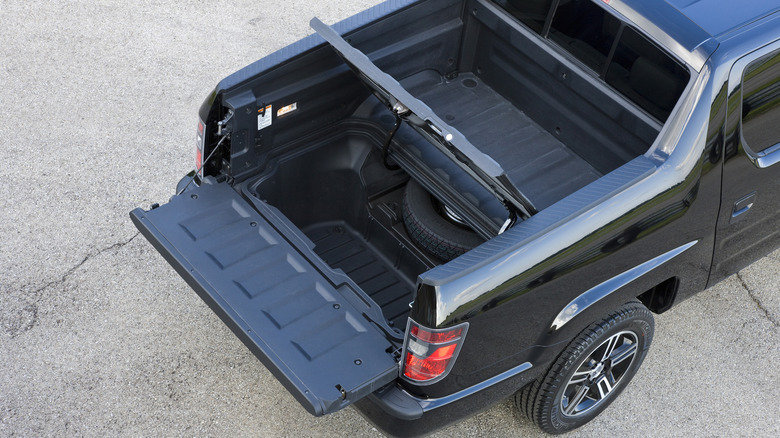
Regardless, it was pushing the pickup bed design needle forward. Other than its Dual-Action tailgate, the In-Bed Trunk was one of the signature features of the Ridgeline. This 8.5 cubic-foot storage trunk, according to Honda, was large enough to house three golf bags or a 72-quart cooler. Essentially, it was the Honda version of the RamBox, only the Ridgeline's solution came several years earlier. Speaking of the RamBox, the In-Bed Trunk has similar features, like a drainage hole and interior dividers to help you keep it organized and clean.
Say what you will about the "not a truck" Ridgeline pickup, but its unibody platform is a part of why Honda was able to fit a usable trunk inside the bed. Oh, and by the way, it also holds an entire spare tire in there. Honda did carry the In-Bed Trunk into the second-generation Ridgelines, but for reasons we can only imagine to be packaging and increased safety standards, you'll now have to settle for a slightly smaller 7.3 cubic-feet of cargo room.
CornerStep - 2014 Chevrolet Silverado
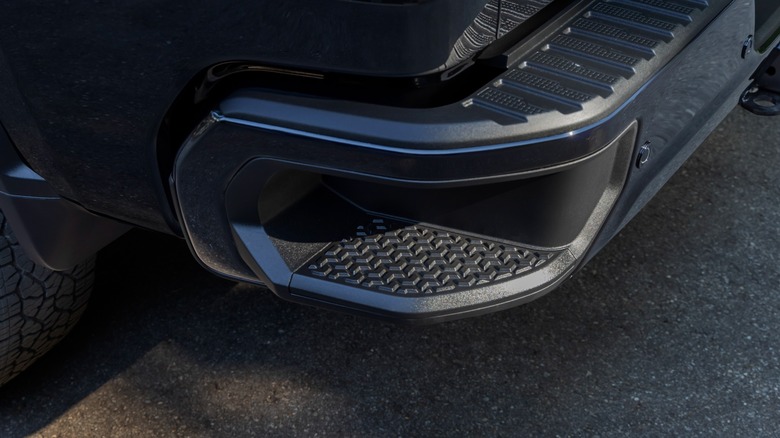
Those more rugged than most will scoff at the idea of something called a corner step being new. After all, stepside trucks have been around since your grandfather first entered the workforce. Additionally, the rear bumpers of pickups have, for many decades, been designed in a way that makes them easier to step onto, with manufacturers playing around with different shapes and materials to help you get in and out of the bed. So why is General Motors' corner step significant?
It all comes down to the modernization of design, and surprisingly, customer feedback. You see, over the years, the classic stepside design, while timeless and innovative, meant less overall space in the bed. Having that convenient stepside feature forced manufacturers to make sacrifices in other utilitarian areas, and now that cargo room is king — among several other factors — the stepside has gone by the wayside.
That's why companies have slowly shifted to integrated features like this clever bumper step. It was seen on the first-generation 2002 Chevrolet Avalanche and added a cutout on the corner of the bumper that one could secure their foot in while climbing into the bed. Since it was in the bumper and not just the top of the bumper, the step's height was slightly lower, requiring less effort to use. This concept reappeared on next-gen trucks such as the 2014 Silverado and the Sierra, where it became the CornerStep.
Integrated steps like these also laid the path for other brands like Ford to create similar features, such as a bed-side step that folds into the truck's body.
Gear Tunnel — 2022 Rivian R1T
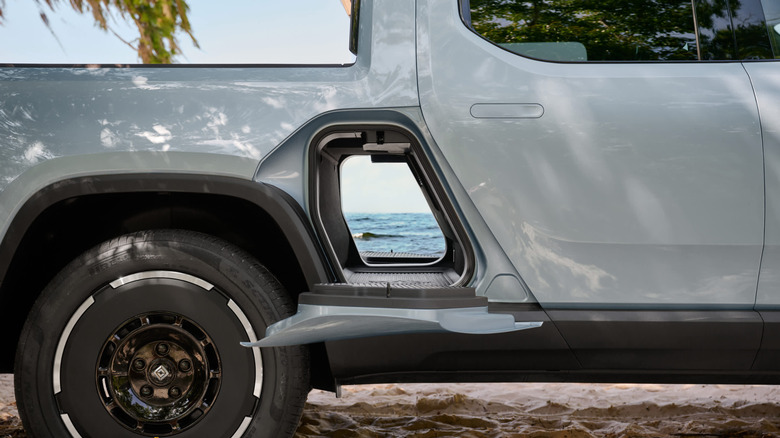
Let's be honest — while all of these previous bed features are useful, many seem like semi-obvious evolutions in the natural progression of bed design. Finding more space in common places or assistance in entering the bed are great, but with the Rivian Gear Tunnel, we're not convinced the average person would (or could) come up with this. If you've never been exposed to this feature, the name Gear Tunnel is just about all you need to know.
The openings (one for each side) are located where the step on a stepside truck would be, tucked in front of the rear wheels and directly behind the rear doors. Both can be opened to create a fully see-through tunnel that stretches the width of the truck and provides 11.6 cubic feet of storage space that can also be accessed through a door hidden behind the middle-rear seat. Similar to Honda's In-Bed Trunk, the Gear Tunnel is a good spot for items that are too cumbersome for the cab, but too important to be tossed freely in the bed.
On its own, the tunnel is incredibly creative and useful, but it's the small details that take it to the next level. For example, the tunnel also comes with a 110-volt and 12-volt outlet system at each side for any electricity needs while outdoors, and those door openings that fold down can be used as small benches if needed.
Ford Power Pro Onboard — 2021 Ford F-150
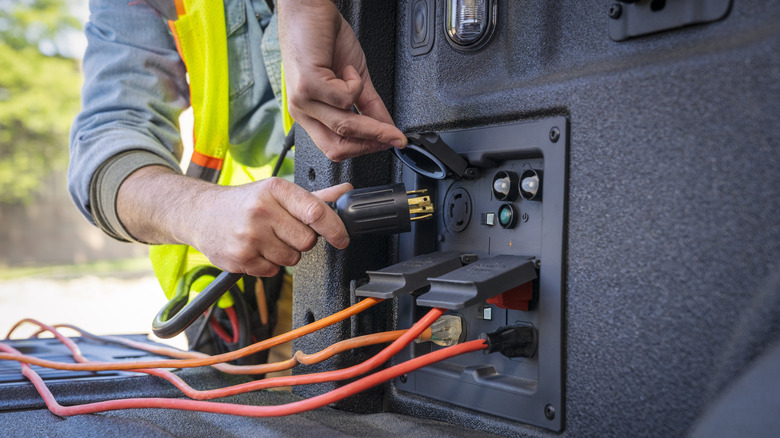
When Ford introduced the Power Pro Onboard system in 2021, mobile contractors probably dropped to their knees in elation. There had always been third-party products that helped folks utilize their truck's engine to power other tools or equipment, but Power Pro Onboard was among the first truly integrated, multi-use generator systems from the factory.
The apparatus uses the engine or electric battery pack to power a series of external outlets that can be applied to any kind of appliance or tool you could imagine. Ford offers 2.0 kW systems all the way up to 7.2 kW, as well as specially designed operational Power Pro applications for Super Duty and F-150 Lightning trucks. Of course, most modern trucks have outlets, but they are typically the standard 400-watt units that can't handle accessories with higher power demands. Power Pro, on the other hand, delivers 2,000 watts in its most basic form and can go up to 7,200 watts with the beefier 7.2 kW system.
It can even be used while driving, meaning you can charge whatever you need on your way to a destination and have everything ready to go when you arrive — just don't forget to plug your stuff into the outlets before leaving. Power Pro Onboard also includes a generator mode, which overrides the automatic idle shutoff and keeps the electricity flowing as long as the truck is on.