

Can You Really Get A Ticket For Going 1 MPH Over The Speed Limit?

A long-standing belief among drivers is that there's a small buffer built into speed limits. You might have heard the phrase "Nine you're fine, 10 you're mine." This is misleading and has planted misconceptions that going just a little over the speed limit is not a big deal. Not to rain on your parade, but legally, it most definitely is a big deal. Most states deem even the tiniest amount over the designated limit as a violation under what is called an absolute speed limit.
North Carolina is one such state, where even driving at 46 mph in a 45 mph zone can land you in trouble. State troopers have also fined people in Colorado for driving at speeds between 1 and 9 mph over. Under Colorado law, driving just 1 mph too fast is a Class A traffic infraction, punishable by a fine of $30 and a $6 surcharge. Other states take a similar stance. Texas law does not provide any formal grace for speeding, whether it's by 1 mph or 10. Texas and North Carolina also among the states where going 10 over will cost you the most.
Why most drivers aren't stopped for minor speeding
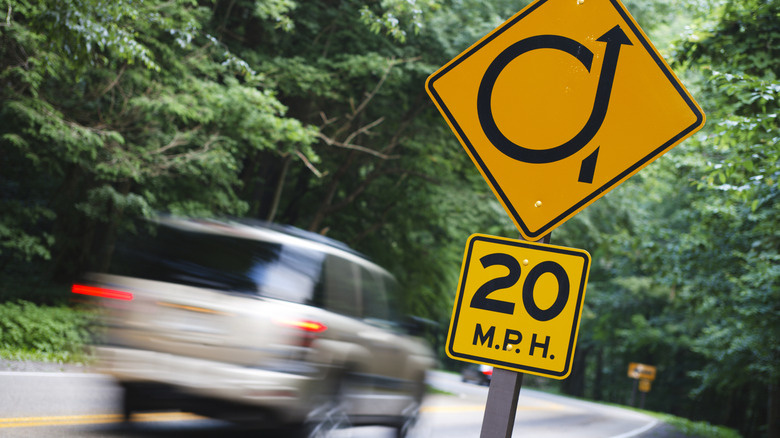
So the law is pretty strict and doesn't allow even one toe out of line. But you might be wondering why people are not caught left and right every time they go past the limit. That's because police lack the resources, nor are they required to stop everyone. It's completely at their discretion who they stop and who they don't.
That isn't to say that the stops are random, though. Conditions dictate when stops occur. You're more likely to get pulled over for going slightly over the limit in school or construction zones, for example. You should also be more careful about going over during extreme weather. Officers have made it clear that just because other drivers are speeding and everyone is simply following the flow of traffic, it doesn't mean an individual driver can't be singled out for a stop.
Real consequences, even at low amounts over the limit

No matter how likely you are to be pulled over, once you are, the consequences are the same whether you are speeding by a lot or just 1 mph over. The reason for this, officials say, is public safety. According to a 2023 analysis by the Colorado State Patrol, speeding was the leading cause of fatal and injury crashes, at 23%, which is why fines begin as low as 1 to 4 mph over the limit. And in Chicago, designated safety zones have automatic speed cameras that issue a ticket starting at 6 mph over the limit.
Texas, meanwhile, classifies speeding as a misdemeanor. The fines there increase with how much you were over the limit, ranging from $165 for 1 to 5 mph above the limit to $300 for 30 mph or more over it. Florida also has a similar law, with drivers going 50 or 100 mph over the limit deemed "super speeders" and facing mandatory court, fines of $1,000 to $2,500, and possible jail time. This man found that out the hard way, just two minutes after the law began being enforced.
There can also be insurance consequences for your speeding ticket. Even a first offense can affect premiums. And while some drivers may avoid increases after an initial ticket, repeated violations often lead to higher rates.