

After January Crash, Military Helicopters Can Once Again Fly In Washington, D.C. Without Tracking Technology (Except Maybe They Can't)
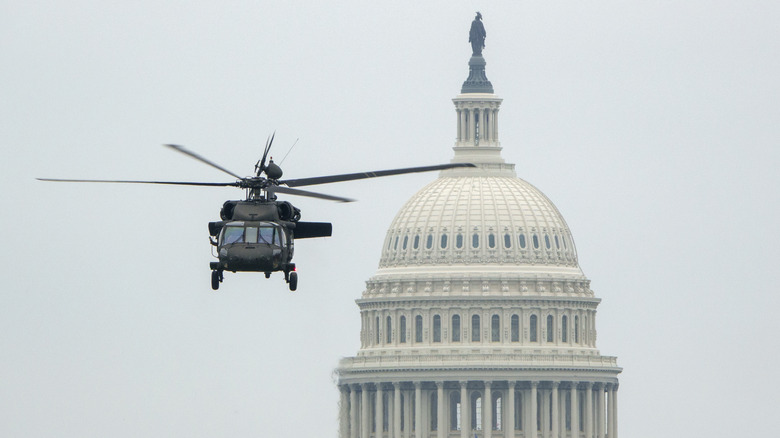
Congress is in the midst of a battle over how military helicopters fly through the airspace of the nation's capital, which all relates back to the fatal crash of an Army Black Hawk with American Airlines Flight 5342 back in January. Apparently, a senator (no one is quite sure who) snuck a provision into the middle of the National Defense Authorization Act (NDAA), the annual funding bill for the Pentagon. Section 373 of this 3,000-page legislation adds a specific exception to allow the military to keep flying over Washington, D.C. without using modern tracking technology. Now, the NDAA has passed, so the exception is in effect. Except the exception may be excepted by another bill, maybe, forcing the military to use the tracker anyway. Welcome to democracy!
The technology in question is called Automatic Dependent Surveillance-Broadcast (ADS-B), which we've written about before. Essentially, it broadcasts the aircraft's position every second or so on an open protocol. This gives air traffic controllers a much better idea of its moment-to-moment location, which is obviously a good thing. However, since anybody with the right equipment could do the same, it also would let nefarious actors track it easily, which is bad. So even though military helicopters had it installed, they didn't use it. Then the January crash happened, and it's been a battle ever since.
Switch it on, switch it off
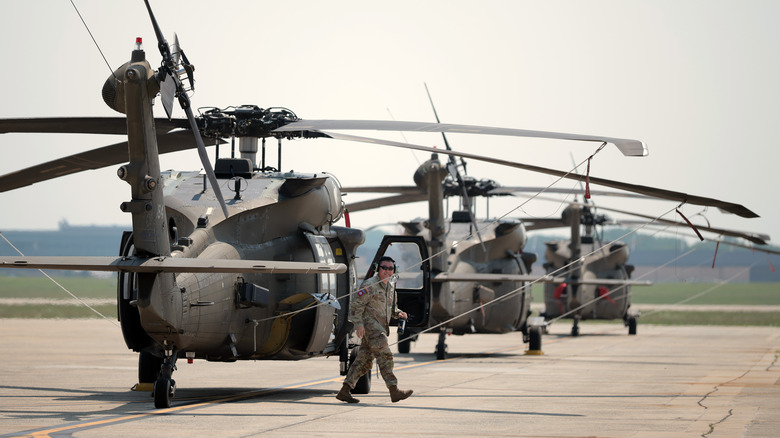
After the horrific crash in January, the FAA required the use of ADS-B in Washington, as Politico reports. Chairman of the Senate Commerce Committee Ted Cruz (R-TX) then demanded the Army's memo outlining how it uses the technology, which the Army refused to hand over. That led to a very public spat between the Senate and the Pentagon, which the Senate eventually won. Following that, Cruz and Senator Maria Cantwell (D-WA) introduced the ROTOR Act, which would legally mandate the use of the tracker.
That bill stayed in a holding pattern for months. Congress, of course, has been busy not passing a budget and generally being a mess. In the meantime, the gigantic NDAA was assembled, which you might think is unrelated to the ADS-B issue. Think again! In fact, because it's unrelated, that was probably why somebody tried to sneak Section 373 in: no one was looking for it. It's basically a must-pass bill, so Section 373 would pretty much guarantee a new legal exception for the military to keep ADS-B off, per Forbes.
Overriding the override

Well, Cruz and Cantwell did catch the provision before the NDAA passed, but too late to stop it. The two tried to introduce an amendment that would kill Section 373 and replace it with their stalled ROTOR Act, but this was shot down. Per Politico, what Cruz worked out instead was a deal to approve the NDAA as-is, but then immediately hold a vote to pass ROTOR by unanimous consent. Both of these have now happened, although due to timing issues around the holidays, the NDAA has already been signed into law while ROTOR still needs to pass the House. And it isn't inconceivable that the House might strike it down, or even simply not vote on it at all, leaving the NDAA exception in place.
Confused yet? Don't worry, it's only air safety. You'll be pleased to learn that the NTSB's preliminary report on the crash found that there have been 15,214 near misses at Reagan National Airport between October 2021 and December 2024. Sure does sound like something ought to change, doesn't it? That said, while ADS-B would be an improvement, the real fix to these issues is to get America's air traffic control system sorted out, both in terms of equipment and workers. There are some plans underway there, but jury's out as to how well those will address the problems.