

Mirai Owners Suing Toyota Because Hydrogen Is The Most Common Element In The Universe But It's Damn Difficult To Find On Earth
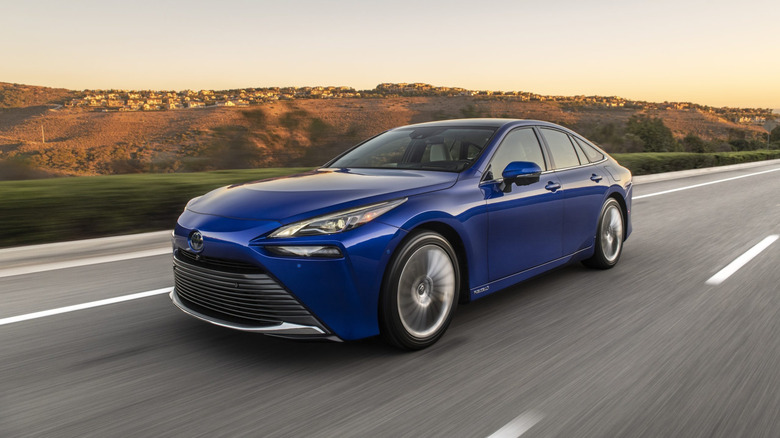
The Toyota Mirai is quite possibly the dumbest car on sale today. Some people who own them are having so much buyer's remorse that they are suing Toyota for essentially selling them cars they can't use, reports CBS News. Attorney Jason Ingber has filed a lawsuit on behalf of current Mirai owners, citing several reasons why they deserve compensation for their decision to purchase this car.
The Mirai's reliance on fuel cell technology requires hydrogen filling stations, which are pretty much non-existent in the U.S. — if you think you have range anxiety in an EV, imagine only being able to charge at 54 locations scattered around California as of 2024, and not being able to plug into any outlet for a slow but steady charge. That's exactly the situation Mirai owners find themselves in, despite promises to expand the hydrogen refueling infrastructure. While it has technically expanded from its original 20 or so stations in 2016 when the Mirai was first released, owners still can't leave California (or Vancouver, British Columbia, or the area of one station in Hawaii and a single east coast station in Quebec) without running out of hydrogen. Some of the few existing stations are not even working properly. From CBS News:
Malcolm Boehme waited at a broken pump in Mill Valley, the only hydrogen filling station in all of Marin County.
"I'm stuck. I can't drive my car home because then I won't make it back to the gas station," he said. "I'm literally stuck here."
The lawsuit also alleges that Toyota dealers oversold the Mirai's usability. The Autopian goes into the details of some of the lawsuit's specific allegations, such as claiming that the Mirai would become just as popular as the Prius that one customer was cross-shopping, and promising that hydrogen filling stations would be everywhere within a year.
Massive depreciation
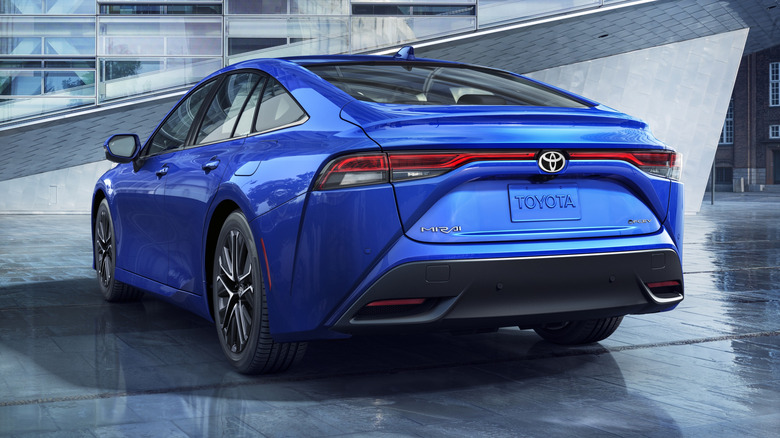
The lack of fueling infrastructure for the Mirai has led to Toyota practically giving them away. At one point in 2024, you could get as much as $43,000 off MSRP, zero percent financing, and $15,000 in free fuel (assuming you can actually use it). All these discounts meant you could take home a Mirai for as little as $15,000, making it technically the least expensive car in the U.S. Even this price may not have been worth it, considering that the used market exists and an older Prius that you can easily refuel and actually drive places other than California costs even less.
This price drop on new cars hit depreciation on used models hard. Owners can't sell them now, because they are significantly underwater on their loans. The Autopian tells of another situation alleged in the lawsuit, a Marine stationed in California who bought a 2023 Mirai for $42,358.93 and was promised he could return the car if he was stationed elsewhere. He was later transferred to Virginia and offered a mere $11,000, leaving him on the hook for a $24,000 balance on a car he could no longer use. Another unpleasant surprise was that there are no hydrogen filling stations in Virginia or anywhere on the East Coast, something he was apparently unaware of when he bought the Mirai. It would have been smart for this customer to do his own research about this, but the dealer allegedly failed to inform him of this significant issue as well, despite discussing the distinct possibility that he might suddenly leave California due to his service as a Marine.
What's the deal with fuel cells?
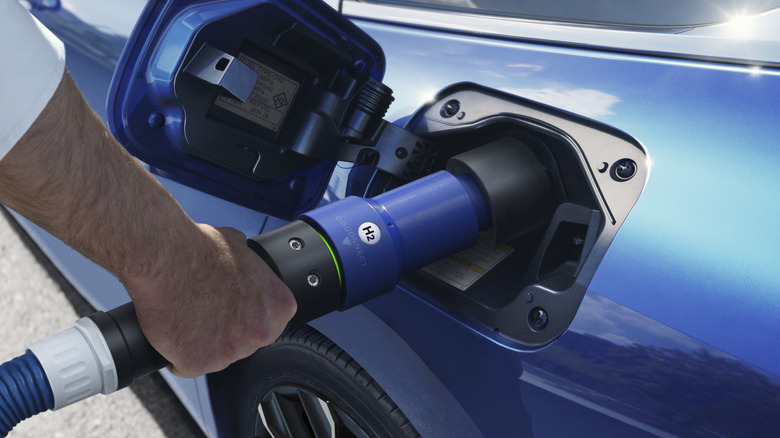
Fuel cell vehicles are an idea whose time has come and gone. When Toyota first introduced the Mirai for the 2016 model year, the U.S. EV charging infrastructure was quite underdeveloped. Tesla had only 3,608 Superchargers worldwide (that number is over 75,000 today), and they were unavailable to cars from other manufacturers. They had to rely on a hodgepodge of independent chargers, with the promise of more to come, financed by Volkswagen in the wake of Dieselgate. Under these circumstances, the idea of an onboard electrical power source was quite appealing, as it provided all the benefits of an EV without relying on a then-unreliable charging infrastructure. If fuel cells were good enough to fly us to the moon, they could certainly get us around here on Earth.
The Apollo fuel cell lifespan was limited by the amount of hydrogen and oxygen that could be carried on board. If you think finding a hydrogen filling station on Earth is hard, try looking for one between here and the moon. Refuelling is easier on Earth, and oxygen is abundant in the air we breathe. Hydrogen, however, is not. Although hydrogen is the most common element in the universe, it is also the most reactive, according to the U.S. Energy Information Administration. It isn't easy to find and keep in its pure form because it wants to combine with other elements. It also takes more energy to create pure hydrogen than it provides in fuel cells.
With the EV charging infrastructure growing rapidly, and the hydrogen infrastructure very much not, fuel cell vehicles have become impractical in the modern world. Most, like the Honda Clarity, have already been discontinued. We seem to have passed the tipping point of the "chicken and egg" situation with EVs and their charging stations, where there are now enough of both to be practical, but that time will likely never come for fuel cell vehicles like the Toyota Mirai.