

The Convoluted History Behind The Oldsmobile 442 Name
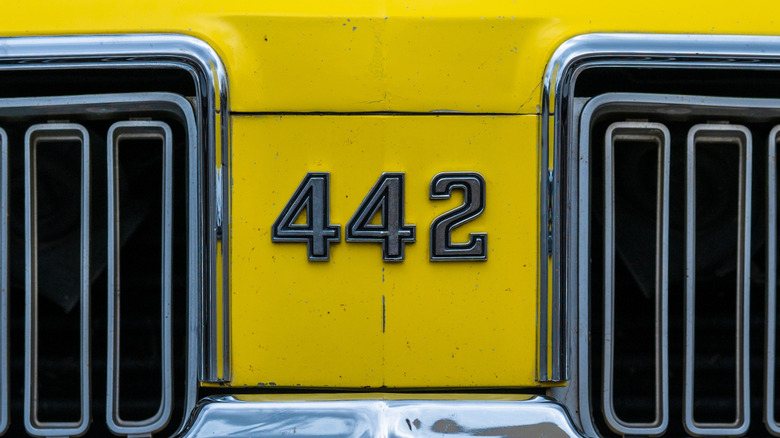
So, the Oldsmobile 442. Sorry, the 4-4-2, depending on the year, anyway. Despite three-number model names being mostly a Porsche thing, there are other three-number American cars where the numbers stand for something specific. There's the Buick Electra 225 referring to its 225-inch length, and (supposedly) the Ford Galaxie 500 leeching coolness from 500-mile NASCAR races. But then there's the 4-4-2, an arbitrary designation if ever there were one.
When the Olds 442 debuted in 1964, the dealer sales sheets really went out of their way to spell out what the name meant. Not only did the name have dashes at the time, but dealer sheets often put it in quotation marks, printing it as "4-4-2" — you can just feel implied air quotes whenever it's read out loud. This number referenced the car's four-barrel carburetor, four-on-the-floor manual transmission, and dual exhausts. Apparently, the name "4-4-dual" would have sounded odd, so "4-4-2" it was.
Aside from the 442 badges that had no dashes or quotes, there was nothing to distinguish it from a regular 1964 Oldsmobile F-85/Cutlass with the Police Apprehender Pursuit package, or RPO code B09, which 10 awesome people ordered as a four-door. It's interesting that Oldsmobile didn't turn its RPO code into the name of the car like Chevy did with the 302-powered Camaro Z28 (then Z/28, and sometimes printed as Z-28). To be fair, "Bee-Oh-Nine" doesn't have the same ring to it, but that's something the ad agency could have fixed. With its 330-cube V8 putting out 310 horsepower and upgraded, stiffer suspension, it could have played up the police pursuit origins and made B09 sound cool, like some sort of hip cop lingo.
4-4-2: Shifting definitions
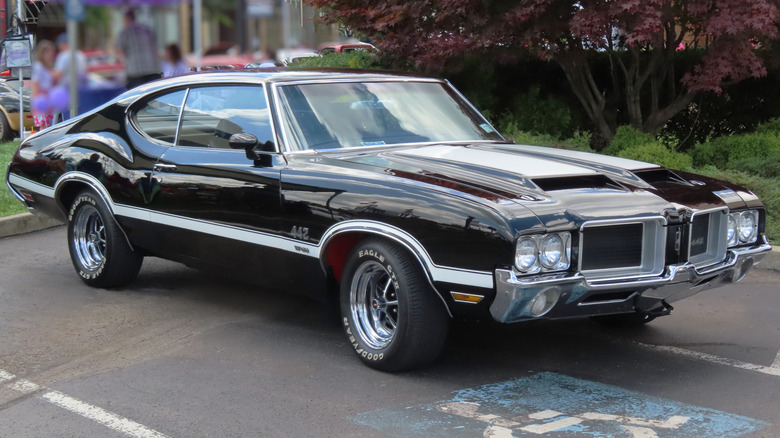
In 1965, Oldsmobile decided consistency was too much of a bother and claimed the first four in the 4-4-2 name represented its new 400-cubic-inch V8. That's fine, the other two numbers still referenced the four-barrel carb and dual exhaust, so no confusion there yet. Let's see what happened to the specs in 1966.
So, for the 1966 model year, Oldsmobile added a new induction option: a triple two-barrel setup. That's fine — Olds could have always gone back to saying that the second four in 4-4-2 means it has a "four-on-the-floor" shifter. No need to panic, that four doesn't necessarily have to reference the carburetor. Oh, but then in 1968, Oldsmobile not only made the 4-4-2 its own separate model, but the company added a three-speed manual and a three-speed TH-400 automatic to the option sheet. Then, for good measure, Oldsmobile let people order the engine with a single two-barrel carb. Man, this is like trying to pin down Bob Lutz about what the Cadillac V stands for.
Let's back up to 1966 for a second, because that's when Oldsmobile introduced the W-30 package. This performance option added cold air induction scoops to the front bumper, a more aggressive cam, a 4.11:1 differential, a heavy-duty radiator, factory engine blueprinting, and a trunk-dwelling battery to aid in weight distribution, resulting in a respectable 360 hp.
Dashing toward 442
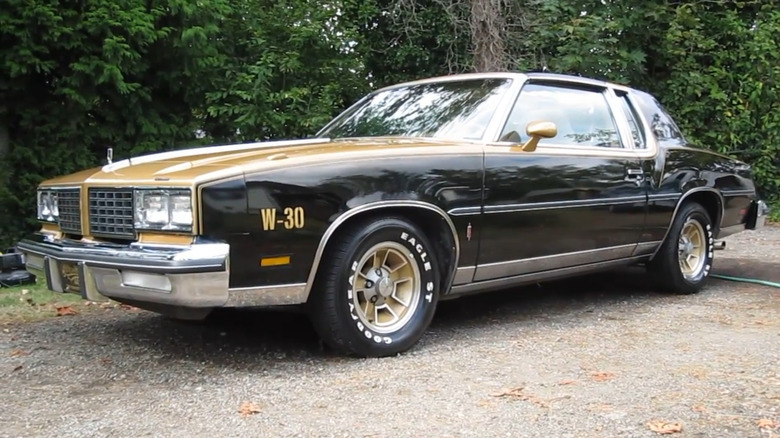
GM lifted its 400-cubic-inch engine size limit for mid-sized cars in 1970, meaning the 4-4-2 was free to borrow the 455 from full-sized Oldsmobiles. What it didn't get was a new definition for 4-4-2. The numbers were nostalgia, referencing a time when they meant something tangible. In 1972, the 4-4-2 was downgraded from a separate model to a Cutlass trim package. RPO W29 added all the 442 emblems, stripes, hood louvers, upgraded FE2 Rallye Suspension, and a three-speed manual with Hurst shifter. Buyers could also pick any engine, including a two-barrel 350 with 160 net hp. The name limped on until 1980 when, at the very least, Oldsmobile plumped the 350 back in after deleting it for 1978 and 1979. It only made 170 hp.
From 1985 to 1987, Oldsmobile tried again, this time getting rid of the dashes and calling the car what its badges had always read: 442. The engineers massaged the Oldsmobile 307 (which is different from a Chevy 307) to bring it from 140 hp to 180 hp. And, an explanation was back! This time, the ad copy said 442 stood for "four-barrel carb," "four-speed automatic," and "dual exhaust."
In 1990, Oldsmobile gave the 442 name one last hurrah on The Oldsmobile Cutlass Calais Quad442. You're reading that right, this was a "442" that used the Quad4 four-cylinder to drive the front wheels, and the name now stood for "four-cylinders, four valves per cylinder, and dual camshafts." Standard Quad4s made 180 hp, but with the W41 package, that went up to 190. That was good enough to run 14.7 seconds through the quarter, which would probably crush the smog-strangled two-barrel 350 4-4-2s from the early '70s.