

Why Is Gas More Expensive In Canada Than It Is In The US?
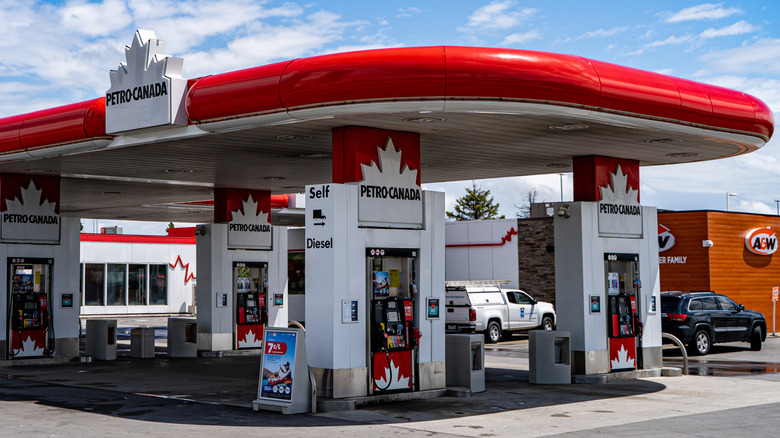
Gas might not seem cheap anywhere in the U.S., unless you live in one of the cheapest states, like Oklahoma, Mississippi, or Louisiana. With a national average just over $2.90 per gallon for regular, and a handful of states paying north of $4 a gallon, filling up the tank certainly won't feel cheap to most Americans.
Here's the thing, though. Cross the northern border and step into Canada, and all of a sudden you'll realize you've had the better deal all along. According to the daily price tracker from the Canadian Automobile Association, the average cost of gas in Canada on December 16, 2025 was $1.24 per liter in Canadian dollars. That translates to $3.41 per gallon in U.S. dollars, a half-dollar more a gallon on average than U.S. customers pay.
To put that into perspective, a 2026 Ford F-150 sports a 36-gallon gas tank. Filling up from empty in Canada costs $18 more in Canada than in the U.S., and imagine how that extra expense stacks up over the course of a year. Many factors contribute to the differing price of gas in the two countries, but the most influential factor as to why your fill-up costs more in Canada than in the U.S. (as opposed to why there are price differences between U.S. gas stations) comes down to taxes.
A closer look at taxes paid on Canadian fuels
Of course, Americans pay tax on fuel too, they just don't pay as much. When buying gas in Canada, you'll fork out around $1.20 in U.S. dollars in taxes alone for each gallon of fuel, whereas in the U.S., that cost is more like 50 cents a gallon.
The taxes tacked on in Canada include a federal excise tax, a provincial tax, a goods and services tax/harmonized sales tax, plus in some places a provincial sales tax, a carbon tax, and a transit tax. The carbon tax is a charge for emitting greenhouse-gas pollution (even if the EPA no longer thinks greenhouse gases are bad for humans), and is designed to encourage consumers to shift to greener solutions, such as driving electric cars. In short, Canadians pay an awful lot of tax on top of the actual cost of gas. Strip these taxes away, and you'll find the price is quite similar to what Americans pay.
Of course, there are other factors to consider as well, such as the fluctuating price of crude oil because of everything from weather to political problems. There's also the fact that Canada buys gas on the global market when use is high in summer, and supply disruptions such as natural disaster or unions striking, although some of these factors will affect the gas price everywhere, not just in Canada.