

Inflating To The PSI Number On Your Tire Is A Terrible Idea: Here's Why
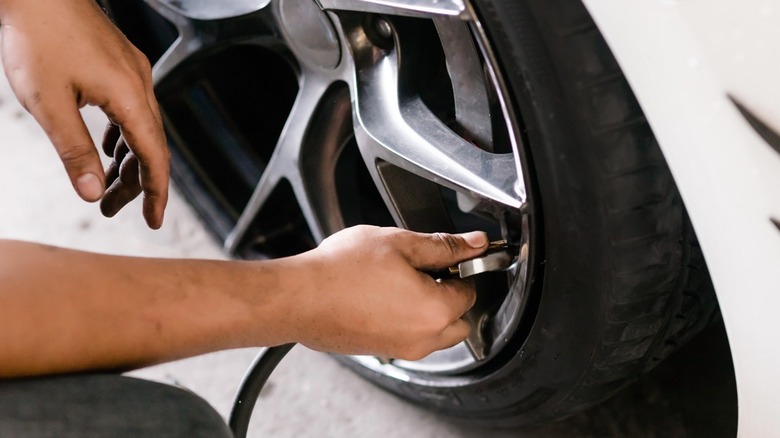
So you notice one of your tires is low and you pull into a gas station to use the air machine. Or maybe you've got one of those nifty portable tire inflators. But wait! The air machine is asking for the PSI number — that's pounds per square inch. How do you know how much air to put in the tire? Easy! Just look at the sidewall of the tire, right? After all, the number is right there, right next to "PSI," isn't it? Wrong! That is not the number you should be going by!
Inflating your tire to the PSI number indicated on the side of it could result in overinflating it, which could put you in danger. But why would the tire manufacturer do that to us? Before you start to feel betrayed by the Michelin Man, you might want to take a closer look at what's actually printed on the side of the tire. It usually says, "max PSI" or "maximum PSI." In other words, that's the upper limit of air pressure that the tire is built to withstand. It's definitely not the pressure your tires should be running at all the time.
The recommended tire pressure is set by the manufacturer of your car, and it is typically well below the max PSI number found on the side of your tire. You'll generally find it somewhere in the car, usually on a sticker on the driver's side door jamb. It's important to abide by this number because driving on overinflated tires can cause a lot of problems and, if you're like us, you've got enough of those.
Why you shouldn't inflate your tires to the max PSI

Maybe you like paying for new tires so much that you wish you could do it more often. In that case, go ahead and inflate your tires to the maximum PSI. We're guessing, though, you'd like to shell out for new tires as infrequently as possible. One of the ways to keep your tires from wearing out before their time is to make sure they are properly inflated, not overinflated.
Overinflation causes the tread on your tires to wear unevenly. This is because the increased air pressure pushes out the middle part of the tread area, instead of providing a flat tire surface for contacting the road. This can significantly shorten the life of your tires — by the way, here are some ways to extend the life of your tires. Expect a less comfortable ride, as well. Overinflated tires are stiff and inflexible, so they don't provide much cushion when contacting the road.
But overinflated tires can also make it harder to control your vehicle, especially on wet surfaces. That's because less of the tire is grabbing the road, resulting in less traction. And because there is less traction, it can take the car longer to come to a complete stop on any surface. Overinflation also increases your chances of a blowout, for a few reasons. One reason is that the stiffness and inflexibility make the tire more vulnerable to bumps, foreign objects, and potholes. Overinflated tires can also be punctured more easily (think how much easier it is to pop a very full balloon instead of a partially inflated one). And excessive pressure is put on the sidewalls, making it harder for them to bear the force of impacts.
How do you find the right PSI for your tires
Since we can't go by the number on the side of the tire, where do you find the right PSI for your tires? Some car manufacturers make it easy by displaying the correct PSI in your dash. A lot of cars for the last several model years have had a feature called the Tire Pressure Monitoring System (TPMS). You may have to dig through your dash menu to see it, but sometimes this system displays the air pressure of each tire. Some go a step further and display what the pressure should be. However, the TPMS doesn't do this on every car.
But what if you don't have a fancy new car built in the last decade with one of those newfangled TPMS thingies? How are you supposed to figure out the right PSI, then? The most common reference that people use to find the recommended air pressure is usually found right on the jamb of your driver's side door. There is a sticker there with a bunch of numbers, and among them is the recommended PSI. If that sticker is missing, damaged, or painted over, you can try looking for a similar sticker elsewhere on your car, or look in the owner's manual. When all else fails, you can always inquire of the Google.
There may be situations, such as when you are towing, where you might want to temporarily inflate the tire a little beyond the recommended PSI, but do not go past the max PSI. Sometimes — like when soft-roading, for example – you may want to underinflate your tires. But for most scenarios, make sure your tires are inflated to the recommended PSI, and never the maximum PSI.